NORWAY NEWS – latest news, breaking stories and comment – NORWAY NEWS
  • Home
  • About us
  • News
  • Other News
    • Africa and Norway
    • Asia and Norway
    • Asylum
    • Breaking News
    • China and Norway
    • Corruption in Norway
    • Crimes
    • Defence
    • Diplomatic relations
    • Economics
    • Environment
    • Farming
    • Featured
    • Health
    • Killing
    • Media Freedom
    • Middle East and Norway
    • NATO and Norway
    • Nobel Peace Prize
    • Norwegian Aid
    • Norwegian American
    • Oil & Gas
    • Peace Talks
    • Politics
    • Racism in Norway
    • Religion
    • Royal House
    • Russia and Norway
    • Science
    • Sex scandal
    • Sports
    • Spy War
    • Srilanka and Norway
    • Svalbard
    • Taiwan and Norway
    • Terrorist
    • Travel
    • Video clips
  • Disclaimer
  • Contact us
NORWAY NEWS – latest news, breaking stories and comment – NORWAY NEWS
  • Home
  • About us
  • News
  • Other News
    • Africa and Norway
    • Asia and Norway
    • Asylum
    • Breaking News
    • China and Norway
    • Corruption in Norway
    • Crimes
    • Defence
    • Diplomatic relations
    • Economics
    • Environment
    • Farming
    • Featured
    • Health
    • Killing
    • Media Freedom
    • Middle East and Norway
    • NATO and Norway
    • Nobel Peace Prize
    • Norwegian Aid
    • Norwegian American
    • Oil & Gas
    • Peace Talks
    • Politics
    • Racism in Norway
    • Religion
    • Royal House
    • Russia and Norway
    • Science
    • Sex scandal
    • Sports
    • Spy War
    • Srilanka and Norway
    • Svalbard
    • Taiwan and Norway
    • Terrorist
    • Travel
    • Video clips
  • Disclaimer
  • Contact us
Saturday, December 27, 2025
NORWAY NEWS – latest news, breaking stories and comment – NORWAY NEWS
  • Home
  • About us
  • News
  • Other News
    • Africa and Norway
    • Asia and Norway
    • Asylum
    • Breaking News
    • China and Norway
    • Corruption in Norway
    • Crimes
    • Defence
    • Diplomatic relations
    • Economics
    • Environment
    • Farming
    • Featured
    • Health
    • Killing
    • Media Freedom
    • Middle East and Norway
    • NATO and Norway
    • Nobel Peace Prize
    • Norwegian Aid
    • Norwegian American
    • Oil & Gas
    • Peace Talks
    • Politics
    • Racism in Norway
    • Religion
    • Royal House
    • Russia and Norway
    • Science
    • Sex scandal
    • Sports
    • Spy War
    • Srilanka and Norway
    • Svalbard
    • Taiwan and Norway
    • Terrorist
    • Travel
    • Video clips
  • Disclaimer
  • Contact us
Copyright 2025- All Right Reserved Norway News
Defence

NASAMS missile system handed over to Lithuanian Armed Forces

by Nadarajah Sethurupan November 1, 2020
written by Nadarajah Sethurupan

Lithuania has published a news on the official website of the Lithuanian Defense Ministry announcing the procurement of additional NASAMS (National/Norwegian Advanced Surface to Air Missile System) ground-based medium-range air defense system combat and inert missiles from the Norwegian Ministry of Defense.


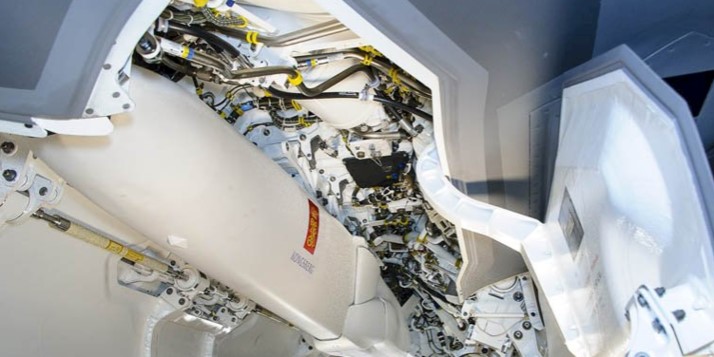
Official delivery of NASAMS medium-range air defense missile system to Lithuanian Armed Forces. (Picture source Lithuania MoD)

According to the contract signed by the Ministry of National Defense and Norway’s Kongsberg NASAMS manufacturer on 26 October 2017, the system procured by Lithuania is new, except for launchers that are pre-used by the Norwegian Armed Forces and currently upgraded. The systems procured from Norway use U.S.-made AMRAAM aircraft defense missiles capable of destroying aircraft and missiles of an adversary several tens of kilometers away.

The NASAMS S is the world’s first operational Network Centric Medium Range Air Defence System. A standard NASAMS unit has a modular design comprising a command post, an active 3D radar AN/MPQ-64F1 Sentinel, a passive electro-optic and infra-red sensor and a number of missile canister launchers with AMRAAM missiles. Normally, four NASAMS units are netted in a battalion network.

The NASAMS is in operational use in Norway, Spain, USA, the Netherlands, Finland, and one undisclosed customer, and in production for Oman. In addition Poland, Greece, Sweden and Turkey operate the KONGSBERG command and control solution for various weapon systems.

The NASAMS AIM-120 AMRAAM missile is able to destroy aerial threats such as cruise missiles, fighter aircraft, helicopters and unmanned aerial vehicles (UAVs). The system is able to engage simultaneously up to 72 targets with a maximum range of 40 km.

November 1, 2020 0 comments
0 FacebookTwitterPinterestEmail
Asia and Norway

India can be the next Norway

by Nadarajah Sethurupan October 31, 2020
written by Nadarajah Sethurupan

Volvo Car’s country head sees huge growth potential for electric luxury cars

Swedish luxury brand Volvo Car feels that the business case for electric luxury cars in India is better than that for internal combustion engine luxury cars. Given the high taxes and import tariffs which have constrained volume growth in the luxury ICE segment, it is betting big on EVs in India.

It expects the EV segment to be a volume driver for the country, a top company official said.

The current high tax structure will continue to hamper volume growth in the luxury ICE car segment which, coupled with the favourable government policies on EVs, is influencing Volvo Car India to invest heavily in EVs, Charles Frump, Managing Director, Volvo Car India, told BusinessLine. 

While a luxury ICE car attracts a GST of around 50 per cent, the GST for electric cars is just 5 per cent. 

Globally, Volvo Car plans to have half of its car volumes to be fully electric by 2025. “In India, our plan is the same goal or maybe even more,” said Frump. Volvo Car India will be launching its first fully electric car, Volvo XC40 Recharge, in the second half of 2021. 

Emulating Norway

“With the current tax structure, volumes are not going to be significant for any ICE luxury car (company). But, the opportunity is very much there for EVs. As the percentage of EVs grows, I see our opportunity growing a lot,” Frump said. 

On the importance of the Indian market for the company, he said: “I would say, at the moment, because the luxury business for Volvo and all luxury car companies is so small — 1 per cent in India of the total cars versus 10-40 per cent of all cars in other markets — to be honest, it hasn’t been a very big market for Volvo. But, we have seen what has happened in Norway. Electric cars have taken off in Norway and that has been huge for us as at Volvo. For Volvo, perhaps, India can be the next Norway.”

Norway’s EV story is famous. As per reports, almost 60 per cent of the new cars sold in the country in September were electric, and this goes up to 89 per cent when hybrids are included. There are far more EVs on Norwegian roads as a proportion of total vehicles than anywhere else in the world, according to a Forbes article dated June 2019. 

Norway’s goal is for all new cars sold in the country after 2025 to be electric.

Luxury advantage

“Luxury cars will lead when it comes to EVs,” said Frump. When asked about further EV launches, he said that there would be more, given that the current government policies on EVs — factors like the lower GST, road tax and import duties — remain in place. 

“I always ask the government officials to just keep the policy (the way it is) because the policy is good, (and) because I’ve built my entire forward EV strategy based on the very good policy that India has in line with their vision to be fully electrified,” said Frump.

Since EVs are currently more expensive than ICE cars, luxury car customers are more likely to purchase electric cars, said Frump, adding that the barriers in the adoption of EVs are fewer for luxury customers. 

“For example, all my customers own multiple cars. So, if there’s some worry about range anxiety, and they are going to go a really long way, they will take their other car. The majority of luxury customers can afford to have their own charging point at their house and at work. So, for luxury customers, some of the barriers are lower than for non-luxury customers.”

While this has been a “very tough” year for the luxury car business, Frump said that the company is extremely optimistic about 2021 and expects growth also to happen then. Safety is also going to be one of the primary focus areas for the company, he added.

October 31, 2020 0 comments
0 FacebookTwitterPinterestEmail
Asia and Norway

Grameenphone employees protest in Bangladesh

by Nadarajah Sethurupan October 29, 2020
written by Nadarajah Sethurupan

Employees of mobile operator Grameenphone today formed a human chain in front of its headquarters in Bashundhara area, protesting the termination of Mia Mohammad Shafiqur Rahman Masud, general secretary of GP Employees’ Union.

A press release issued by GP Employees Union reads that Mia Masud was terminated at 5pm on 27 October under Section 26 of the Labour Act-2006.

The statement alleged that the telecommunications company planned to conduct a massive layoff by sending workers in-home office. And Mia Masud was sacked because he tried to stop the layoff plan by sending letters to the government officials.

Acting President of the employees union Fazlul Haque, its Communications Secretary Ziaur Rahman, newly dismissed general secretary Mia Mohammad Masud and other GP employees were present at the human chain, which started at 9 am Wednesday.

“We will go to the concerned government offices including Bangladesh Telecommunication Regulatory Commission (BTRC) today and submit a letter with our logical demands,” said Ziaur Rahman.

Mia Masood was a senior specialist in Business Governance and Internal Compliance in GP’s Business Division.

October 29, 2020 0 comments
0 FacebookTwitterPinterestEmail
Asia and Norway

73rd Remembrance Day of Pakistan’s brutal invasion of Jammu & Kashmir

by Nadarajah Sethurupan October 29, 2020
written by Nadarajah Sethurupan

73rd Remembrance Day of Pakistan`s brutal invasion of Jammu & Kashmir on 22 October 1947 and to observe this day as “Black Day”.

A webinar was organized by Indian Community in Oslo, Norway on 25 October 2020 from 1400hrs. to mark the 73rd Remembrance Day of Pakistan`s brutal invasion of Jammu & Kashmir on 22 October 1947 and to observe this day as “Black Day”.

During the webinar people from Indian community expressed their view on the subject.  They accepted that this part of the history was removed in a planned way and not many people are aware of this tragic incident.  

One of the speakers explained in details about the background of the incident.  He said that – Once the US President Mr.Roovelt quotes “The more you know about the past, the better prepared you are for the future.” This is an opportunity to recap the history of the great princely state of Jammu & Kashmir. Before our independence, the British Crown made Standstill agreement to protect the interests of princely states. Our neighbouring Pakistan had entered into a Standstill Agreement with the Maharaja of Kashmir on August 12, 1947. 

At the beginning of September 1947, Major General Akbar Khan was asked by leaders of the Muslim League to prepare a plan to take over Kashmir. Then operation Gulmag has started with inflating tribal into Kashmir with the complete support of the neighbouring army. The entire operation was described by Major General Akbar Khan in his book “Raiders in Kashmir“. 

https://www.youtube.com/watch?v=Y71xfH_12sw

On October 22, 1947, Pakistan unilaterally broke the Agreement and launched an invasion to forcibly capture Jammu and Kashmir using tribal raiders. In the process, many people were killed and women were raped. For the past 70 years, the refugees of Pakistan Occupied Kashmir marked this as a black day in Kashmiri history and pay their respects to the people who have sacrificed their lives. For the past couple of years, the untold story is coming into mainstream media. 

Even the European Foundation for South Asian Studies (EFSAS), a think-tank, has said the intervening night of October 21-22, 1947, was the darkest day in the history of Jammu and Kashmir. On October 26 (1947), the Pakistani forces captured Baramula where only 3,000 survived out of 14,000. The troops were now only 35 miles from Srinagar. 

Then Maharaja (Hari Singh) was shaken and asked for help. Then Governor-General Mountbatten advised then Prime Minister Jawaharlal Nehru to get all the legal requirements done before sending the troops to Jammu and Kashmir. With that incident, India has rescued ¾ of Jammu & Kashmir from Tribal raids. On the other side, Pakistan marked October 27th as a black day for Jammu & Kashmir. We must not forget the sacrifices made by the people of Kashmir in the fight against the tribal groups.

During the webinar it was decided to continue the observance of 22nd October as BLACK DAY every year by the Indian community that too in large scale as this year it was not possible due to covid19 pandemic. During the webinar two videos were also played.  

October 29, 2020 0 comments
0 FacebookTwitterPinterestEmail
Media Freedom

Ukraine’s MFA calls for Russia’s responsibility for cyberattack on Norway

by Nadarajah Sethurupan October 29, 2020
written by Nadarajah Sethurupan

Ukrainian Foreign Minister Dmytro Kuleba has called for Russia to be held accountable for a cyberattack on the Norwegian parliament. This was stated by the official on his Twitter page.

“Russia must be held accountable … Euro-Atlantic solidarity and mutual support are key to countering the challenges of hybrid warfare,” Kuleba wrote.

Related:  Norwegian MFA accuses Russia of stealing data in hacker attack on parliament.

He also added that Ukraine was ready to strengthen cooperation with Norway and other partners in order to counter cyberthreats.

As we reported earlier, Foreign Ministry of Norway found Russia’s involvement in hacking the emails of members of the Norwegian parliament Storting in August, during which a data leak had occurred.

“On August 24, Storting announced a data leak in its e-mail systems. It is a serious incident affecting our most important democratic institution. Security and intelligence services are working closely on a national settlement of the incident. According to the government’s information base, we believe that Russia is behind this activity,” the statement said.

October 29, 2020 0 comments
0 FacebookTwitterPinterestEmail
Nobel Peace Prize

Cuban Doctors with Nobel Peace Prize accepted

by Nadarajah Sethurupan October 28, 2020
written by Nadarajah Sethurupan

As a recognition, the Chilean Solidarity Movement with Cuba on Wednesday appreciates the acceptance by the Norwegian Nobel Committee of new nominations to grant this award to the Cuban doctors. 
The confirmation by the Nobel Institute to nominate Cuba’s Henry Reeve Medical Contingent for that prestigious award in 2021 was revealed in Santiago on Tuesday. Julio Pinto Vallejos, National Prize of History 2016 in Chile, presented it this time.
The prominent academic received notification from that entity, regarding to accept the nomination proposal sent by him in a letter in accordance with the regulations of the Norwegian Institute.

On October 8, the Norwegian Nobel Institute also accepted the nomination from Chile of the Cuban doctors’ brigades presented by prominent Chilean academic Haroldo Quinteros, Professor Emeritus of Social Sciences.

Under the slogan ‘Doctors and not bombs, for life and peace’ the campaign for the Nobel Peace Prize was launched in Chile in August.

The Henry Reeve contingent was founded on September 19, 2005. Its brigades have worked in many countries, especially fighting the Ebola epidemic in Africa and this year the Covid-19 pandemic in nations of several continents.

ef/iff/mem/rc

October 28, 2020 0 comments
0 FacebookTwitterPinterestEmail
Asia and Norway

Norwegian FM delivers presentation on multilateralism

by Nadarajah Sethurupan October 27, 2020
written by Nadarajah Sethurupan

Norwegian Foreign Minister Ine Marie Eriksen Søreide on October 14 delivered a presentation on multilateralism amid rising global geo-political tension and pressure on multilateral system

Co-organised by the Diplomatic Academy of Vietnam (DAV) and the Norwegian Embassy in Vietnam, the event was held both online and offline in Hanoi and Oslo. 

In her opening speech, DAV Deputy Director Pham Lan Dung said it contributes to strengthening bilateral ties and reflects the two countries’ strong commitment to multilateralism to effectively cope with challenges amid changes in the region and the world. 

Assistant to Foreign Minister Pham Quang Hieu affirmed that multilateral diplomacy is an important strategic orientation in Vietnam’s foreign policy. 

With a long-standing relationship as well as shared interests and concern, the two countries’ commitment to supporting multilateralism will lay a solid foundation for them to boost collaboration not only via bilateral channel but also international forums, especially at the United Nations when Norway will become a non-permanent member of the UN Security Council (UNSC) for the 2021-2022 tenure. 

He wished that Norway would continue bolstering cooperation with ASEAN and supporting its central role in the Asia-Pacific and Indo-Pacific for the sake of peace, stability and prosperity in the region. 

Søreide, in her speech, said Vietnam’s commitments to ASEAN are of significance to strengthening internal solidarity and the bloc’s role in the world. 

She affirmed that both Norway and Vietnam strongly believe in multilateralism and rules-based international cooperation. 

As challenges become increasingly serious when the world is experiencing unprecedented medical and socio-economic crises due to the impact of the COVID-19 pandemic, she said only international solidarity and cooperation could bring about recovery and development. 

According to her, during its tenure as a non-permanent member of the UNSC, Norway will focus on peace-building diplomacy, strengthening women’s role in building sustainable peace, protecting people amid conflicts, and coping with security risks related to climate. 

In order to effectively address challenges in the near future, the UN needs to develop partnership with regional mechanisms such as ASEAN and the EU, she said. 

Her presentation concluded with a strong affirmation about the value of multilateralism spirit that countries need to develop amid current and upcoming challenges. 

Participants also discussed promising cooperation fields between the two nations and highlighted determination to reinforce multilateral system for the benefit of the two countries, regions and the world./.

October 27, 2020 0 comments
0 FacebookTwitterPinterestEmail
Crimes

Supreme Court sentences Norwegian MP

by Nadarajah Sethurupan October 26, 2020
written by Nadarajah Sethurupan

Parliamentary Representative Mazyar Keshvari, a former politician for the Progress Party (FRP), was sentenced to eleven months of prison after newspaper Aftenposten revealed that he had submitted false travel expense bills to the Storting over the course of several years.

Photo: Terje Bendiksby / NTB scanpix

The Court of Appeal sentenced the former FRP politician to seven months of prison, but the prosecution appealed the sentence to the Supreme Court.

The Supreme Court decided to increase Keshvari’s (FRP) sentence. He has now been sentenced to eleven months in prison for fraud before the Storting.

The Supreme Court concluded that the representative took advantage of the fact that no checks were made regarding whether the trips actually took place in the relevant period.

The Supreme Court emphasized that this was a serious breach of trust committed in the role of a parliamentary representative.

That provided a basis for increasing the penalty.

October 26, 2020 0 comments
0 FacebookTwitterPinterestEmail
Asia and Norway

Founding Anniversary of WPK Commemorated in Various Countries

by Nadarajah Sethurupan October 25, 2020
written by Nadarajah Sethurupan

Meetings took place in Pakistan, Russia, Norway, Denmark, Kazakhstan, and Belarus from Sept. 24 to Oct. 7 to commemorate the 75th anniversary of the founding of the Workers’ Party of Korea (WPK).

At a meeting held in Pakistan, a reporter and speakers said that the WPK is a great and dignified party which has advanced along the ever-victorious road since its foundation, holding aloft the banner of the Juche idea and weathering stern trials of its revolutionary struggle.

The first secretary of the Khabarovsk Territorial Committee of the Communist Party of the Russian Federation said that the WPK, founded by President Kim Il Sung and strengthened by Chairman Kim Jong Il, is a popular party, which solves every problem by relying on the people, adding that it is the faith of the WPK that there is nothing impossible to do if it believes in the people and relies on them.

The chairman of the Ostfold County Committee of the Communist Party of Norway said that the Juche idea, the guiding idea of the WPK, serves as the best cornerstone for developing socialism in the DPRK.

The chairman of the Denmark-DPRK Friendship Association said that the WPK is enjoying absolute support and trust by the revolutionary parties and progressives in the world as well as all the Korean people.

The chairman of the Kazakh Kim Jong Il Association for the Study and Dissemination of the Juche Idea said that although the DPRK was recently battered by natural disasters, the Korean people have pushed forward with the campaign to remove their aftereffects under the leadership of the great Party.

The chief of the Belarusian Group for Solidarity with the DPRK hoped that the Korean people would accomplish the cause of building a powerful socialist country without fail under the guidance of the WPK.

Messages of greeting and congratulatory letters to Supreme Leader Kim Jong Un were adopted at the meetings held in Norway and Denmark.

October 25, 2020 0 comments
0 FacebookTwitterPinterestEmail
Economics

UECC joins UN Global Compact

by Nadarajah Sethurupan October 24, 2020
written by Nadarajah Sethurupan

United European Car Carriers (UECC), a Norway-based provider of shortsea RoRo transportation, has joined the United Nations Global Compact, the world’s largest corporate sustainability initiative.

The UN Global Compact is a voluntary platform where close to ten thousand corporations and organizations in 160 countries develop, implement and share best practices in sustainable and responsible business.

“We are proud to invest time and resources in a global initiative for business conduct and corporate governance that is ethical and sustainable, where people and planet are at the centre for how businesses are run. Sustainable development is desired by our parent companies, our management group, and praised by all our employees,” Glenn Edvardsen, CEO of UECC, commented. 

“The principles of UN Global Compact initiative are in line with how we have conducted our business for years already, and we will ensure that we continue to comply with these guidelines, and raise the bar together with global businesses of all sizes and shapes,” he continued.

According to the International Maritime Organization (IMO), carbon dioxide emissions from shipping were equal to 2.2 percent of the global human-made emissions in 2012, and are expected to rise 50 to 250 percent by 2050 if no actions were taken. This has led to the creation of many industry-led programs to reduce the negative impact. Shipping companies all over the world are taking action to commission and operate ships that are more carbon-neutral.

Edvardsen believes that the maritime industry has a long way to go towards a more carbon-neutral future. UECC has for several years invested substantially in upgrading its fleet to run on more sustainable fuels, using LNG and biofuel instead of traditional marine oil fuel. 

The company has partnered with Goodships and BMW Group to reduce CO2 emissions on shipments by 80-90% and is the first to introduce RoRo ships that will operate as dual-fuel and battery-powered hybrids.

October 24, 2020 0 comments
0 FacebookTwitterPinterestEmail
Asia and Norway

US working on sanctioning Myanmar officials for oppressing Rohingya: State Department

by Nadarajah Sethurupan October 23, 2020
written by Nadarajah Sethurupan

The United States is “actively working” on sanctioning Myanmar military officials responsible for the oppression of the Rohingya minority, Deputy Assistant Secretary of State Richard Albright told reporters on Thursday.

“We are taking actions, including the imposition of visa sanctions and financial sanctions, on Myanmar military officials,” Albright said at the telephonic press briefing after the virtual conference on the support of Rohingya refugees.

The United States’ approach of supporting affected people is based on providing humanitarian assistance to refugees and internally displaced persons and holding accountable those who are responsible for atrocities, Albright added.

Earlier on Thursday, the United States announced a new aid package worth USD 200 million to support Rohingya refugees who fled Myanmar.

According to data provided by the UN Refugee Agency (UNHCR), more than 800,000 Rohingya have fled from Myanmar’s Rakhine State to Bangladesh between 2017 and 2019 amid clashes there.

Below is a full rush transcript of the press conference with Richard Albright Deputy Assistant Secretary for the Bureau of Population, Refugees, and Migration at U.S. Department of State And Lord Ahmad of Wimbledon Minister for South Asia and the Commonwealth UK Foreign, Commonwealth & Development Office And Janez Lenarčič Commissioner for Crisis Management European Commission And Indrika Ratwatte Director of UNHCR’s Regional Bureau for Asia and the Pacific.

DAS Albright:  I would like to start really by just stating how pleased we, the United States, has been to partner with the United Kingdom, the European Union, and the UN High Commissioner for Refugees to co-host today’s conference.  I want to recognize the governments and people of Bangladesh, Vietnam, Thailand, Indonesia, Malaysia, and others for their responsiveness to the needs of Rohingya refugees.   

This conference sought to sustain the international response to the Rohingya crisis and the international community has come together once again to help alleviate the suffering of those in need and to invest in the generous host communities that help them as well.  We’re very pleased with the turnout and to know that nearly 200 million in additional – $200 million in additional humanitarian assistance the United States announced today is part of nearly $600 million in total assistance announced by the international community today.   

Looking forward, the most immediate step is for the Government of Myanmar to permit humanitarian aid to flow to those in need and to create the conditions for sustainable returns of displaced persons in line with the recommendations of the Advisory Commission on Rakhine State.  And we support the work of the UN Special Envoy Christine Schraner Burgener to press for solutions to the crisis. 

In the coming weeks and months, we look forward to following up on efforts to provide Rohingya refugees and other displaced Rohingya with expanded opportunities to live lives with dignity and to resolve the root causes of the crisis.  The international community could play an important supporting role, but it is essential to understand that the Government of Myanmar is at the heart of a permanent solution, and we stand ready to support concrete improvements in Rakhine State in parallel with continuing to respond to the needs of Rohingya refugees in the region.  

Mr. Ahmad:  Today’s conference, as we’ve just heard, has brought together the international community in solidarity to show that the world has not forgotten the plight of the Rohingya people.  It’s hard to grasp the size of the humanitarian crisis faced by the Rohingya community.  But more than 740,000 were forced to flee their homes in the face of horrific brutality over three years ago.  Three years later, they are no closer to going home, despair is setting in, and they’re also dealing, of course, with the realities of the coronavirus. 

Today at the conference, the United Kingdom on our part announced a further £37.5 million to stop the suffering for hundreds of thousands of Rohingya refugees in Cox’s Bazar.  That brings our total UK commitment to the Rohingya response since August 2017 to close to 300 million pounds sterling.  This UK aid will – new UK aid will provide vulnerable people with food, healthcare, water, and sanitation.  And it also importantly improves access to education for 50,000 young people, as well as isolation and treatment centers for people suffering severely from coronavirus. 

Also recognizing the important role of the Government of Bangladesh and the Bangladeshi people, the UK has also announced £10 million of support to Bangladesh to help their country respond to the coronavirus and natural disasters, such as flooding, bringing our total new announcements today to 47.5 million.   

The UK stands at the forefront with international partners of providing life-saving aid, food and water and shelter, as well as education and counseling.  In addition to that, the UK has also sanctioned two generals in the Myanmar military as recommended by the UN independent investigation, which found them responsible for atrocities against the Rohingya community which is tantamount to ethnic cleansing. 

We have also made it clear along with the entire UN Security Council that Myanmar must take solid and constructive steps to create the conditions that will allow for the Rohingya to voluntarily return to Myanmar, of course, keeping in mind their safety and dignity.  And as well as being the second-largest donor to the Rohingya crisis, the UK continues to provide aid in Myanmar itself, including health, clean water, sanitation within the Rakhine State as well.  That amounts to about £44 million to all communities since 2017. 

And finally, we stand with other international partners in the need to support this event as a co-host with the United States, the European Commission, and UNHCR, to working together and committing ourselves once again to decisive action that will allow the Rohingya community to return safely back home.  Thank you. 

Mr. Lenarčič:  Ladies and gentlemen, today we have come together to demonstrate again our solidarity and support of the Rohingya people.  We are very much grateful to the government and the people of Bangladesh, as well as other host countries, for their continued support of Rohingya refugees. 

After this conference, many countries and institutions have reiterated their commitment towards the Rohingya community.  And for its part, the European Union has agreed to step up its efforts, pledging 96 million in support of the Rohingya crisis in the year 2020.  But of course, as we all know, humanitarian aid is not enough.  First, we must pursue a sustainable, durable solution to this crisis.  And this means we have to continue to seek and facilitate the safe and voluntary return of the refugees to their places of origin or choice.  And in this context, I would say that the recommendations of the Rakhine Advisory Commission are a good basis for this. 

Second, we must continue to support the Rohingya people’s aspirations for a better future, including, in particular, providing access to education to all Rohingya children. 

And finally, we must ensure that this crisis does not become a forgotten tragedy.  The European Union continues to stand ready to assist with its efforts.  The Rohingya people and their host communities can count on our support also in the future.  Thank you. 

Mr. Ratwatte:  I’d like to start by thanking our co-hosts, the governments of the United States, the UK, and the EU for the collaboration in pulling together this very important meeting.  And as the High Commissioner expressed in his closing remarks, we are grateful for all of those who have participated today and the strong financial support for the Rohingya refugee situation and the displaced Rohingya within Myanmar.   

Most of all, we’re grateful for the contributions of the refugees themselves, who are at the heart of the humanitarian response and show us all daily how capable they are as individuals and as a community, as we heard from the refugee voices and the powerful film clip in Omar’s Film School. 

We must also particularly express the thanks to Bangladesh, who continues to host 860,000 Rohingya, as well as Malaysia, India, Indonesia, and Thailand, as generous hosts despite the challenges imposed with COVID, as we see today.   

Ultimately, we must live up to the hope that the Rohingya refugees themselves still maintain, even after more than three years of exile.  We are concerned by the risks that many are taking on perilous journeys, as we have witnessed this year with the tragic loss of life.  And we are grateful to those countries who have allowed them to disembark safely, and urge all that the strategy must remain on the safe, predictable disembarkation to save lives and to prevent the tragic loss of life we have witnessed in the recent months. 

As you have heard, the Rohingya wish to go back to Myanmar when it is safe and sustainable to do so.  As such, we must renew our efforts together with the Government of Myanmar to realize the recommendations of the Rakhine Advisory Commission, which is the roadmap that we have collectively agreed to pursue, and to make the aspirations and the hopes expressed by the refugees themselves into reality.  To this end, UNHCR stands committed in solidarity and in partnership to work with the international community, Bangladesh, Myanmar, and the host countries in the region and beyond to make this a reality.  Thank you very much. 

Question:  Did I understand correctly that the total raised today was $600 million? Is that what you expected?  Is it less or more? 

Mr. Ahmad:  It’s Lord Ahmad here, minister of state from the UK, and perhaps others could follow.  I think if you look at the backdrop of today’s donor conference and the fact that the world itself is going through the incredible challenge of the COVID-19 pandemic, and of course the increased challenges posed on economies around the world and of course domestic challenges, I think the fact that over $600 million, over half a billion dollars, has been raised at today’s event I think is a testament to both the solidarity and the common humanity we share in standing up for the Rohingya community.   

So I’m very much not just encouraged but delighted and also quite humbled by the generosity of countries from across the globe who have once again come forward and made generous contributions.  

DAS Albright:  I would add to – I would concur with that.  Coming into the conference today, the humanitarian response plans were nearly 50 percent funded for the year.  So this is added, additional, new funding to a much more sustainable level, which is where we were hoping to achieve.  Thank you. 

Mr. Lenarčič:  If I may add from Brussels, Janez Lenarčič from the Commission, this amount almost doubles what was available or pledged so far toward the Rohingya crisis.  That’s one point.  Second point, you cannot compare different situations because there are different numbers of people who are in need of humanitarian aid.  So there is no reason for a comparison in absolute figures of pledged sums with some other situation.  

We are happy with the result of today’s pledging event, with today’s conference.  It demonstrated the solidarity of the international community, the continued solidarity of the international community with the plight of the Rohingya refugees and the needs of the host communities. 

Question:  Do you have any comment on the reaction of China and Russia?  Do they still support the Burmese Government ?  

DAS Albright:  Well, what I can say is that these other countries were invited to the conference.  They chose not to participate.  We are working very hard with our partners, UN agencies, NGOs, and other governments, to stop the cycle of violence in Rakhine, including by cooperating to end trafficking of weapons and narcotics that have contributed to instability so far in Rakhine and other parts of Myanmar.  And we believe that the permanent five members of the UN Security Council have a special obligation to contribute to ending conflict and aiding the victims of violence.  

We certainly recognize the contributions of other regional partners, and encourage responsiveness to the needs of the Rohingya refugees and the displaced Rohingya inside of Myanmar.  And we are trying to develop a multifaceted approach to resolve this crisis in adherence with international humanitarian principles, and avoid any kinds of unilateral measures, so that I would just stress that returns to Myanmar should be safe, should be voluntary, dignified, and well-informed.  Those are the principles that we adhere to in this response. 

Question:  First of all, the 597 million that were announced as the amount being raised today, are you satisfied that that is all new funding?  That wasn’t announced by donors before today?  Second of all, there’s been quite a bit of talk about the security situation in the camps in Cox’s Bazar.  Recently, I’ve spoken recently with Rohingya refugees who are very scared of violence occurring within the camps by criminal groups, and more recently by Bangladeshi security forces.  What that something that’s factoring into thinking of the humanitarian response?  And what’s being done to alleviate that?  

Mr. Ahmad:  I mean, every country, obviously, would need to speak for itself.  This is part of an additional monies to what we had announced previously for support for the Rohingya, and as I said in our contribution from the UK, we’ve sought to also recognize the challenge on Bangladesh in providing support to the Rohingya community both within Cox’s Bazar but also outside Cox’s Bazar as well. 

On your specific issue of the escalation of violence, I’m sure I speak for everyone on this call.  We’re all concerned, I think, about the escalation of violence.  And my last information was that since the 4th of October, I think seven people had also sadly died in this respect.  And the situation we understand from the Bangladeshi authorities – and Bangladesh were on the call today as well – and it has calmed down somewhat.  And we’re obviously supportive of ensuring both the welfare within those people within the camps, but also ensuring that the environment is both safe and secure.   

And in terms of humanitarian partners, of course we need to ensure that the partners we work with within Cox’s Bazar are also able to operate both unhindered, but also putting their safety and security first.  So while it is a – anyone who’s visited Cox’s Bazar, and certainly I have, it’s an incredibly – I termed it as one of the worst cases of humanity coming together, yet you put it into context that that is – that they are the lucky ones who have escaped with their lives.  So it’s incumbent on all of us to seek to improve both the health, safety, and security of people within Cox’s Bazar and work with Bangladesh to ensure the security of people within Cox’s Bazar as well. 

Question:  The first question I’d like to pose to UNHCR:  If they have a position on the security fencing that is being put up in Cox’s Bazar and the implications around freedom of movement?  And the second question is for PRM:  It’s interesting that the UK has pledged an additional $10 million to the country of Bangladesh as the host community.  Has the U.S. Government considered doing something similar to the UK? 

Mr. Ratwatte:  UNHCR has been working closely with the Government of Bangladesh, while acknowledging that the maintenance of security and law and order is the prerogative of the government.  We have underscored two points regarding their present response.  One, that systemically the best approach to security within the refugee camps and settlements is to really engage the refugees themselves through community participation and through the elders and systems instructed within the community together with law enforcement authorities as the best way forward. 

While we recognize that criminality, trafficking, and narcotic trafficking is an issue in the region, we have also worked together with elders in the community and refugees themselves to articulate their concerns to the government, and also put in a system with the community with protection and monitoring where issues related to security is fed into the government.  And enhanced also reporting, particularly for the vast majority of the population, who are women and children. 

And lastly, I think another way to look at the mid- to long-term issue related to security, stability, and well-being of the refugees is really to have opportunities, skills, and education within the camps that engage young people.  And as we all know, criminality is only for a few in these camps.  The vast majority are law-abiding individuals, and that we give opportunities for the young people in particular that we are able to build a future for them, and we dissuade any actors who may be pursuing other intents away from the population. 

Question:  Are you concentrating more on humanitarian assistance than on accountability and repatriation?  Are you giving more focus on Bangladesh than Myanmar?

DAS Albright:  Just let me first just respond to the previous question just about humanitarian and versus development resources.  I mean, in today’s conference we announced we were focused on humanitarian response and we announced over 200 million of new humanitarian assistance for the Rohingya crisis.  That brought our total for the year to $437 million, and that brings our total for the whole response since 2017 to $1.2 billion for this humanitarian response.   

We also have a longstanding and significant development program in Bangladesh, and we can provide you additional details on the scope of that program.  But a significant portion of that program is also geared toward supporting host communities in Cox’s Bazaar and Bandarban, and so we can provide you more – a bit more information on that.   

I would say that in response to the latest question, I mean, we are – we’re focused on – both on immediate life-saving humanitarian assistance for the affected refugees and internally displaced Rohingya and looking for solutions that would facilitate their return, looking to create conditions for return in Rakhine State.  But we are also working for accountability for atrocities that have occurred and supporting the processes in the International Court of Justice and other approaches for accountability.  And we have also taken action, including the imposition of financial sanctions and visa sanctions, on Myanmar military officials.  

DAS Albright:  I just wanted to thank all of our co-hosts – the United Kingdom, the European Union, the UN High Commissioner for Refugees.  I would like to thank all of the donor countries that participated in making this conference a success in, as Commissioner Lenarčič noted, nearly doubling the resources available for the humanitarian response.   

I would like to thank all of the countries of the region that have played and continue – will continue to play a critical role in working together to achieve solutions for this crisis, and thank you all for listening. 

Mr. Lenarčič:  I would also like to add my voice to the words of thanks just announced by Deputy Assistant Secretary Albright.  Our thanks go first to the host communities in Bangladesh and to Bangladesh Government.  Our thanks go to all the participants of today’s event that have pledged additional funding.  And I would like to underline that the European Union will remain committed to, first, immediate support for refugees and IDPs, Rohingya; and second, to the efforts to find a sustainable and durable solution, which, as many have said already today, is in their homeland, and that is Myanmar. 

Mr. Ratwatte:  I’d like to echo the comments by the Commissioner and Deputy Assistant Secretary Albright, and again, thank the co-hosts and all the participants, particularly also the host countries, namely Bangladesh and the others.  But also frame it, as others have done, as a regional problem that requires strong regional participation and the international community here, because I think what we heard from the refugees and everybody today is that status quo is something that cannot be sustainable in the long to mid term, and that the work we have to do together with the Myanmar Government to create conditions for solutions – namely sustainable, voluntary return in safety and dignity – should be an investment to be undertaken collectively.  Because that is, at the end of the day, the aspiration of the Rohingya which we have to work towards.   

October 23, 2020 0 comments
0 FacebookTwitterPinterestEmail
Africa and Norway

Norway targets Kenya in new Sh65 billion humanitarian plan

by Nadarajah Sethurupan October 23, 2020
written by Nadarajah Sethurupan

The Norwegian Government has announced a multibillion plan that is meant to alleviate the damaging effects of humanitarian crises to the economy and livelihoods now felt the world over.

In what would be a sigh of relief to Kenya that was almost brought to its knees on account of the COVID-19 pandemic and its aftershocks, the Royal Norwegian Ministry of Foreign Affairs has set aside Norwegian Krone (NOK) 5.5 billion, equivalent to Kenyan Sh65.4 billion, for urgent humanitarian assistance.

“In line with the Government’s humanitarian strategy, Norway will work to ensure an effective response in areas where the needs are greatest,” said the Ministry in a statement. 

Moreover, it noted, “In 2021, we will maintain our focus on protection, in particular protection against sexual and gender-based violence, protection of children and young people, and protection of civilians from land mines and other explosives.”

The Ministry also said that the funds would be available for any country adversely suffering the effects of climate change. COVID-19 is not out of the picture either.

October 23, 2020 0 comments
0 FacebookTwitterPinterestEmail
Asia and Norway

Market Intervention Scheme for procurement of apples in Jammu and Kashmir for the year

by Nadarajah Sethurupan October 22, 2020
written by Nadarajah Sethurupan

The Indian Union Cabinet, chaired by Indian Prime Minister Shri Narendra Modi, approved the extension of Market Intervention Scheme (MIS) for apple procurement in Jammu and Kashmir (J&K) for the current season also i.e. 2020-21 on the same terms and condition as was done in J&K during last season i.e. 2019-20.

The procurement of apple will be done by Central Procuring Agency i.e. National Agricultural Cooperative Marketing Federation ltd. (NAFED) through State Designated Agency i.e. Directorate of Planning and Marketing, Department of Horticulture & Jammu & Kashmir Horticulture Processing and Marketing Corporation (JKHPMC), directly from apple farmers of J&K and the payment will be made through Direct Benefit Transfer (DBT) into Bank account of apple farmers. 12 LMT of apples can be procured under this scheme.

          Government has also allowed NAFED to utilize Government Guarantee of Rs. 2,500 Crore for this operation. The losses, if any, to be incurred in this operation will be shared between Central Government and UT administration of J&K on 50:50 basis.         

The constituted Designated Price Committee of last Season will be continued for the fixation of price of various variety and grades of apples for this Season also. The UT administration of J&K shall ensure the provision of basic amenities in the designated mandis.

          Smooth and continuous implementation of the procurement process will be monitored by constituted Monitoring Committee under the Chairmanship of Cabinet Secretary at the central level and constituted implementation & Coordination Committee under the Chairmanship of Chief Secretary at the UT Level.

This announcement of the Government of India will provide an effective marketing platform to apples growers and will facilitate employment generation for the local people. It will ensure remunerative prices for apples resulting in overall income enhancement of farmers in J&K.  

(By Press Information Bureau, Government of India, New Delhi)

October 22, 2020 0 comments
0 FacebookTwitterPinterestEmail
Africa and Norway

EU Ambassadors “support the Libya Oil”

by Nadarajah Sethurupan October 22, 2020
written by Nadarajah Sethurupan

The Libyan National Oil Corporation (NOC)‘s Chairman of the Board Eng. Mustafa Sanalla received His Excellency the Ambassador and Head of the European Union Mission to Libya and Their Excellency Ambassadors of European Union States (Italy, Denmark, Sweden, Austria, Belgium, Spain, Norway, Finland, Poland Netherlands and Hungary) on Saturday 10 October 2020 at NOC headquarters (Sareer Hall) in Tripoli.

At the beginning of the meeting Chairman of the Board Eng. Mustafa Sanalla welcomed the Ambassadors expressing his gratefulness for the support that the European Union countries provide to the National Oil Corporation.

He started the meeting by illustrating the activities of the National Oil Corporation at this stage, as being the backbone of the Libyan economy, and the maintenance operations currently conducted in some fields in addition to the gradual resumption of production operations in the oil locations and fields concurrently with the improvement of security and logistics situations in those fields,  insuring the safety of oil sector workers in the first place as well as to preserve the petroleum installations which represent the Libyan people’s wealth.

For their part, the European Union Ambassadors expressed their appreciation for the great effort that the National Oil Corporation has been exerting throughout the past years by maintaining the production rates to support the national economy despite of the difficult circumstances that face the State of Libya.

They also commended the leadership role played by the National Oil Corporation as being the first Libyan sovereign entity that followed the principle of transparency and good governance through publishing the data of oil exports revenues in a transparent and professional way since 2018.

In this regard, the Chairman of the Board, Eng. Mustafa Sanalla, commented by saying that ‘the National Oil Corporation is the only entity responsible for the management of petroleum industry in the State of Libya in all aspects, including exploration, production, refining, manufacturing, exporting and marketing pursuant to the applicable Libyan laws and legislations. The Oil Sector employs about 65,000 employees including engineers, technicians and specialists in different fields related to petroleum industry.

They present the entire spectrum of the Libyan people from all over Libya. We have huge petroleum relationships with the main European oil companies. By restoring stability to the oil sector, all the region’s countries will maintain their stability including the European Union countries as Libya have had strong economic relationships with these countries for 500 years. We confirm that we must keep the NOC away from any political conflicts because it is the backbone of the Libyan economy and the only resource of income. The oil revenues must be managed in a fair and equitable manner for all in a way that ensures a decent life for the Libyan people and the next generations.’

He continued ‘by restoring stability to Libya, we will all be able to get through many big challenges and obstacles including the illegal immigration issue. We also need the European Union support in this respect, particularly the return of security and economic stability to our beloved Libyan south by securing the southern borders.’

At the end of the meeting, the European Union Ambassadors stressed their full and unlimited support to the National Oil Corporation in order to improve the sector and return the production process to its normal levels in a way that reflects on all aspects of life all over Libya without any exception.

(Source: NOC)

October 22, 2020 0 comments
0 FacebookTwitterPinterestEmail
NATO and Norway

Armenia, Azerbaijan Diplomats May Meet In Washington – US NATO Envoy

by Nadarajah Sethurupan October 21, 2020
written by Nadarajah Sethurupan

Foreign ministers of Armenia and Azerbaijan may meet this week in Washington to discuss ways to stop hostilities in the Nagorno-Karabakh disputed region, US Representative to NATO Kay Bailey Hutchison told reporters on Wednesday.

“I believe that both foreign ministers are going to be meeting in Washington, at least that was a plan for them to meet in Washington this week to discuss a way to stop the violence, to stop the killing,” Hutchison said during a briefing in Brussels.

Azerbaijan Foreign Minister Jeyhun Bayramov and Armenia’s Zohrab Mnatsakanyan have confirmed that they will be visiting the United States on Friday, but there has been no word yet on the possibility of their face-to-face meeting.

Below is a full rush transcript of the press conference by Ambassador Kay Bailey Hutchison U.S. Permanent Representative to the North Atlantic Treaty Organization (NATO).

Ambassador Hutchison:  I’m so glad to be with you and everyone as we look forward to the next two days of our Defense Ministerial.  And I would just say that we will be addressing the current issues, of course.  First of all, we are all dealing with COVID-19, and I am really pleased that the ventilators that the U.S. has put into our planning and our stockpile that we knew would have a second wave of COVID-19 to face, and we in fact think we are facing that right now, and our ventilators are being distributed as we speak to Albania, Montenegro, and North Macedonia.  

So I think this is just one small part of the enormous interest in our all collective help for our allies in this COVID-19 pandemic.  We’ve seen the first wave; we are now in the second wave, and NATO has had a plan put in place since June for the Defense Ministerial before in which we would share the trust funds and the in-kind contributions of NATO allies to help each other as we go through what appears to be a second wave.  So I think we are in the process of doing that, and it is a high priority for us.

Most certainly, we will be discussing burden-sharing where our Sec Gen will report on the increases in defense spending by all of our allies.  We are really pleased to see that 10 of our allies will now show that they are contributing 2 percent of their gross domestic product to their own defense spending that will allow NATO to have better and bigger capabilities, which is our collective defense.  We’re pleased that we are seeing this go in the right direction.  We still have a lot of work to do, but since the last six years, I guess, we have increased spending by our European and Canadian allies by $130 billion, and we know that that is going to continue to increase through the year 2024.  And we will be seeing more and more of our countries meet that 2 percent pledge that was made at Warsaw years ago.

So we’re very pleased that we are moving in the right direction on burden-sharing and that we are in this alliance in our operations and in – and the efforts that we are making in COVID together.  

I will say that in the ministerial, we will also be talking about our operations both in Afghanistan and in Iraq.  Certainly, in Iraq we are supporting the new government there and working with Mr. Kadhimi to try to help him set up a government and eventually have elections for Iraq.  And in Afghanistan we are supportive of the Afghan-led peace talks that are now going on and looking forward to continuing in that effort to support the Afghans so that they will have a durable peace that will allow Afghanistan to flourish as a country and, certainly, not allow a safe haven for terrorists, which is one of the reasons we went into Afghanistan for all of our security in our alliance and in our partners.

So thank you very much and we look forward to having these two days and I look forward to hearing from you.

Question :  I’d like to ask the Ambassador if she could tell us what she thinks the diplomatic legacy of the Trump administration has been so far.  What has it achieved?  How has it changed international relations and ties between the U.S. and its NATO partners ?

Ambassador Hutchison:  Well, I think that we have seen in NATO the firm commitment of the United States to the transatlantic bond.  I think there’s no secret that President Trump had initially been skeptical about NATO, but I think that he has now acknowledged that our European partners with Canada as well have stepped up and started going in the right direction on burden-sharing and spending, and I think that is a major accomplishment.  I was in the United States Senate for 20 years, and every president, Democrat and Republican, have said that Europe needs to do more for its own defense.  Now I think President Trump has focused on that and it is now doing more, going in the right direction, and my colleagues tell me that they know they need to do more and they are working to do that and try to make sure that our transatlantic bond is strong.

So I think that is a very important next step that we see in our relationships in the transatlantic bond, and I think there’s no question that all of us are now pulling in the same direction for the security umbrella that we know we need to face with a world that is not safe and needs the security of likeminded, freedom-loving countries.

Question:  Is there a possibility to extend the New START on Russia’s terms?  And would Washington be ready to withdraw its strategic weapons from Europe, as requested by Russia, particularly for the sake of reaching an agreement on the extension of the New START?  

Ambassador Hutchison:  We are encouraged that we are very close to coming to an agreement that the U.S. has offered to the Russian counterparts that would have a two-way street that we would agree to a freeze on nuclear warheads for one year, and Russia would agree also with us on a one-year extension of New START that is verifiable and that we can assure will freeze where we are and then start the negotiation on a long-term, new New START.

Question: Are there any more details on the U.S. troop withdrawal from Afghanistan and the U.S. troop reduction in Germany that will be shared with allies during the Defense Ministerial?  Will these two reductions go ahead regardless of the U.S. election result?

Ambassador Hutchison:  Well, let me take the second part first.  I don’t think there will be a reduction of troops in Europe.  I think there is an effort to begin to look at ways to make those troops more efficient by consolidating some of the headquarters in one place and having some of the troops in other places in Europe.  But I think the plans are going forward.  It will take certainly a lot of effort to decide how to move troops and making sure that there is an infrastructure that will allow a movement of troops.  So I think all of that is in the works.

On the issue of Afghanistan, we have been consulting with our allies, and as of just last week we had the commander of our forces in Afghanistan brief our NATO council, our 30 ambassadors, on where we are with the previously briefed troop drawdown where we together have decided to go down to a lower number 4,500 for America; approximately 6,000 for our allied troops that would be with us there which is still able to do all of the training and advising that we are doing with Afghan forces who are out in the field fighting for the freedom of the Afghan people.  And that is ongoing and there have been no different orders for where we are, and we’re almost to that point now that have been agreed to by our NATO council.

Going forward, we will be looking at conditions on the ground to determine if there is a capability to draw down more troops, which we all would hope that conditions would allow us to do that.  But certainly, the conditions have not been met at this time.

Let me just say that all of us want the Afghan-led peace talks to go forward.  We are very concerned with the violence that the Taliban has been producing in violation of the spirit of the agreement they made with the U.S., if not the letter of that agreement.  We are calling for a ceasefire or a significant reduction in violence, which we have not seen.  And we call on the Taliban to reduce that violence so that the conditions can be met, which is what all of us would like so that Afghans can decide for themselves how they can live together in peace and be at peace with their neighbors and assure that no terrorist groups would be able to grow in their country and be a cancer on their country and be exported to NATO allies.  That’s our goal and we are going to support the Afghan process to achieve that goal.

Question:  Turkish media reported that NATO member Turkey has tested its S-400 Russian-made air defense missile system.  Has Turkey informed its NATO partners, and how will that impact American-Turkish bilateral cooperation and relations, and how does it affect NATO?  On the other hand, there are also reports that another NATO ally, Greece, is preparing to conduct firing tests for the first time in 22 years with the S-300s in Crete.  How do you view these developments?

Ambassador Hutchison:  We are very concerned about, well, the – of course, the uptick in tensions between Turkey and Greece.  But America since 2017, when the Turkish Government said they were going to buy an S-400, we along with our whole NATO alliance has done everything we could to divert Turkey from buying a missile defense system by our acknowledged adversary, Russia, and putting that into our NATO alliance is a red line.  There is no doubt about it.  For that, Turkey has given up the ability to be a major maintenance facility and manufacturing line for the F-35, which is the next generation of fighter aircraft.  They’ve given up a lot to have a Russian missile defense system in Ankara, and we are very unhappy that we have not been able to dissuade them from sticking with our alliance and sticking with another ally to be able to work through their sovereign issues without reaching out to a Russian missile defense system.

There were many other missile defense systems offered to Turkey: a Norwegian system; the SAM, which is Italian and French; the Patriot, which is American.  They had many choices, and that they have tested* a S-400 Russian system within our NATO alliance is very troubling for all of us.

Question: The NATO Secretary General will meet the Armenian president at the NATO headquarters today to discuss the war in Nagorno-Karabakh.  Will you raise this issue with your Turkish counterpart, and do you think NATO should play a bigger role in Nagorno-Karabakh?

Ambassador Hutchison:  Well, NATO is trying to do what the U.S. is doing, what Russia is doing as well, and that is to try to stop the conflict in Nagorno-Karabakh.  This is an issue that has been festering for 30 years.  There is a Minsk Group of co-chairs, which is U.S., Russia, and France, that is willing to go into the initial conflict, which is where are the sovereign boundaries of Azerbaijan and what can accommodate the Armenian population within those boundaries?  That can be settled, and then this conflict would end.  

In the meantime, we are encouraging both sides – and I believe that both foreign ministers are going to be meeting in Washington; at least that was a plan for them to meet in Washington this week – to discuss a way to stop the violence, stop the killing.  This cannot be settled in a military conflict.  It needs to be settled on the issues of the boundary lines and the sovereignty issues.  And that’s what we are pushing for, Russia is pushing for the same, as well as France.  And we hope they will agree to that group or any group they could both agree would be trustworthy to them to solve this underlying issue so that the conflict and the killing and the destruction can stop in that area.

Question: Despite NATO’s mediatory efforts between Turkey and Greece, tensions are still high in the Eastern Mediterranean.  What is the U.S. position on the issue?  What could NATO do more to contribute to de-escalation between its two allies?  And how may this dispute between the two allies of the southern flank affect NATO?

Ambassador Hutchison:  Well, of course, we are very worried about that conflict, and NATO has had a role in the de-confliction.  We don’t have a role in the underlying issue that is the genesis of the problem, and that is what are the – the water issue – the border issues in the water, the navigation rights.  And it is very important for all of us that this not be settled in a military conflict as well, and NATO has been effective in putting forward steps that could de-conflict before there is any kind of a military altercation or mistake.  

So we have done that. But the underlying issue has to be solved, and that is: what are the water boundaries between Turkey and Greece or Cyprus?  And that can only be done with an agreed arbitrator, and that is Germany.  So we are urging both parties to not have a conflict that would fester into any kind of destruction, but to go back to Germany and settle the issue of what are the water rights and what are the navigation rights between those two countries that are fairly close together, which is what has caused the normal boundaries for international waters to not be as easy to settle as it would be if they were further apart.

Question: What will be the primary mission of the new NATO space center in Ramstein?  Is Russia the main reason for creating it?  What is the U.S. attitude to the Russian and Chinese proposal in the UN to prevent the militarization of space?

Ambassador Hutchison:  Well, I think that it is very important that we have established space as a domain for NATO and for our security interests, and that is because in the new technology that we now see other countries with activities in space – satellites – we are hoping that all of the countries that have space capabilities will agree to some steps that will assure that we don’t put satellites in places where they could crash or come together; that we would be transparent in where we would be doing activity in space.  And the space domain will give us a chance to hopefully do this right so that there will not be mistakes or accidents.  

Also, space debris is an issue that all of us are facing that have activities in space.  And by having transparencies and sharing information, hopefully we would be able to keep from having any kind of space debris that would interfere with the capabilities that are being used.  

So space is a new area that all of us are trying to address in the right mode, but it’s also an area that can be used for malign intent, and we want to make sure that we are a deterrent to assure that we have the capabilities to keep from having our satellites and the activities that we are using satellites for interrupted.  So we are in to space, we have space headquarters, we have space centers of excellence, and we are working to hopefully have agreement from all the countries that are active in space to be transparent and to share information so that there will not be accidents, as well as conflicts.

Question: Could you please update us on the status of U.S. troops in Eastern Europe?  Is there a plan for a deployment of U.S. troops there on an enduring basis?

Ambassador Hutchison:  Well, we have announced that we have rotating forces in Eastern Europe.  That really came about after Russia took Crimea out.  They haven’t taken them out of Ukraine; they are still part of Ukraine.  But Russia is now militarizing Crimea, and for that reason we must make sure that all of our allies on the Black Sea and elsewhere are protected.  So we have rotating troops, which we have been transparent about in our enhanced forward presence, our tailored forward presence, which includes the eastern allies – the Baltics, Poland, certainly Romania and Bulgaria – to make sure that the militarization of Crimea, which is very close in proximity to many of our allies, and the illegal attempt to take Crimea out of the Ukraine have caused us to require an enhanced presence that is not permanent-based, but it is a rotational level of forces to assure that we are deterring any further activities of Russia, and hope for the future that Crimea will come back to its rightful sovereign territory in Ukraine.

Ambassador Hutchison:  Well, just thank you so much for the Brussels Hub at our embassy in Brussels to give us this opportunity to hear from international members of the media and to be able to talk about what NATO is doing.  I’m really pleased that our NATO alliance has been able to operate for 21 – 71 years now, and in 2020 that was our 71st year.  And it has been an alliance that has succeeded because we have remained in a transatlantic bond and have operated by consensus.  And we look forward to our Defense Ministerial.  We will have a Foreign Ministerial in December.  And that’s where our leaders are able to talk about the most important issues of the day and coordinate our efforts for the security umbrella that protects Canada, the United States, and our European allies. 

October 21, 2020 0 comments
0 FacebookTwitterPinterestEmail
Economics

Wizz Air shakes the Norwegian market with three domestic routes

by Nadarajah Sethurupan October 21, 2020
written by Nadarajah Sethurupan

As already announced in our forum yesterday, low-cost carrier Wizz Air will launch its first base in Scandinavia and start offering domestic flights in Norway next month, in competition with SAS and Norwegian. The company will initially offer three routes with initially one Airbus A321 aircraft based at Oslo Gardermoen airport.

Wizz Air will start flying from 5 November on the routes from Oslo to Bergen, Trondheim and Tromsø. In total, there will be 35 weekly departures at prices starting at 18 euros one way. This number will double in December with the arrival of a second A321.

Wizz Air has been flying to Norway for 14 years, from several airports in Central and Eastern Europe, mainly in Poland. in 2020 Wizz Air has introduced six new routes to/from Norway: Krakow to Bergen, Haugesund, Stavanger, Tromsø, Trondheim, and Larnaca to Bergen.

October 21, 2020 0 comments
0 FacebookTwitterPinterestEmail
Media Freedom

Norwegians with Swedish property threaten legal action over travel restrictions

by Nadarajah Sethurupan October 20, 2020
written by Nadarajah Sethurupan

A group of Norwegians are threatening a lawsuit against their home country over its Covid-19 travel restrictions that they say prevent them from visiting property they own in Sweden.

Right now, much of Sweden is deemed a high transmission area for the virus by Norwegian health officials, meaning travellers coming from Sweden are required to quarantine for 10 days upon arrival in Norway.

A sign announcing the Swedish-Norwegian border. Credit: Dag W. Grundseth/NTB

Swedish Radio News reports that a group of Norwegian who own property in Sweden are seeking to pressure the Norwegian authorities to ease their restrictions. They have even planned to move forward with a lawsuit against them.

October 20, 2020 0 comments
0 FacebookTwitterPinterestEmail
Africa and Norway

Troika Statement on Peace Agreement in Sudan

by Nadarajah Sethurupan October 19, 2020
written by Nadarajah Sethurupan

The United States, the United Kingdom, and Norway (the Troika) welcome the signing of the peace agreement between the Civilian-led Transitional Government, the Sudan Revolutionary Front (SRF), Sudan Liberation Movement-Minni Minawi and Sudanese Alliance on October 3, 2020.  The peace agreement marks an important step toward meeting the calls of the Sudanese people for freedom, peace, and justice, especially for those affected by conflict in Darfur, South Kordofan and Blue Nile states, and other parts of Sudan.

From the ceremony 3 October. Credit: Pål Klouman Bekken, MFA

The agreement includes a ceasefire and an increase in participation from the opposition movements and conflict affected communities in the transitional government, as well as mechanisms and commitments for reconciliation, justice and resource sharing.  We commend the parties for engaging in the good faith negotiations needed for this comprehensive agreement and thank the Government of South Sudan for its mediation efforts leading to today’s signing.  We also recognize the role played by the UN and other regional and bilateral partners.

The Troika also welcomes the recent dialogue between the Government of Sudan and the Sudan People’s Liberation Movement-North/Abdelaziz al-Hilu and encourages both sides to begin wider negotiations on ending their conflict so all Sudanese can play a part in the transitional process.  We call on the Sudan Liberation Movement/Abdulwahid Al Nur and the Government of Sudan to begin talks to achieve a comprehensive peace involving all the major armed movements. 

A lasting peace will require dedicated and Sudanese-led efforts to implement this agreement in the spirit of cooperation and compromise.  The Troika looks forward to continuing our support for the parties and all Sudanese in the realization of a lasting peace.

October 19, 2020 0 comments
0 FacebookTwitterPinterestEmail
Diplomatic relations

This Is The Cave Facility In Norway That U.S. Navy Submarines Could Soon Operate From

by Nadarajah Sethurupan October 18, 2020
written by Nadarajah Sethurupan

U.S. Navy submarines could operate in the near future from a cavernous Norwegian naval base built under a mountain. A reported deal to re-open the once-secret facility comes amid concerns about increased Russian submarine activity in the nearby Barents Sea and the Arctic region. There has also been a notable uptick in American military activity in these same areas, including an unusually public port visit by the secretive first-in-class submarine USS Seawolf to Norway in August.

Norway’s state broadcaster NRK was first to report on the potential rehabilitation of the Royal Norwegian Navy’s former base at Olavsvern, near the city of Tromso, for use by American submarines on Oct. 10, 2020. Active Norwegian naval operations at this facility, which is now privately owned and operated, came to an end in 2002 and it was officially decommissioned in 2009. NRK said that American military officials have made a number of visits to the site recently and a lease deal allowing for U.S. naval operations to begin there could be signed within the next week.

At present, Norway allows U.S. submarines to sail into the Malangen fjord near Tromso to conduct personnel transfers and get fresh supplies. However, under this arrangement, small boats have to take passengers and cargo to and from the submarines, limiting the kind of support that can be provided to the American vessels. 

Olavsvern would not only offer an actual physical facility for American submarines to operate from in this strategic part of the world, but a robust onewith 32,000 square feet of deep-water docking space, including a full dry dock for maintenance, underneath the mountain. A 3,000-foot-long entrance tunnel, with a large blast door at the front, leads in and out of these berths. The entire base, some areas of which are nearly 900 feet underground, covers some 270,000 square feet, in total, and includes barracks, storage, and maintenance facilities above and below the surface.

Work on the base began on Olavsvern in 1964, at which time it was seen as a vital future facility to support naval operations in the Barents Sea and surrounding areas in the event of a major conflict with the Soviet Union. Building the base, which is situated less than 300 miles from Russia, deep underground offered added defense against an initial onslaught if war were to break out.

Building the base, plans for which were initially a closely-guarded secret, was an immense undertaking for Norway and was completed with significant financial assistance from the NATO Alliance. It ultimately took 30 years for the facility to be completely finished, by which time the Soviet Union had collapsed. 

Of course, it’s worth noting that Norway is hardly the only country to have built large subterranean military facilities, including underground naval bases capable of accommodating submarines, as well as other warships. China’s Yulin Naval Base on Hainan Island in the South China Sea is one of the best known examples, which you can read about in more detail in this War Zonepiece.

However, the Norwegian government subsequently determined that the base was extraneous to its post-Cold War needs. Two years after formally shuttering it in 2009, authorities in that country put it up for sale on the open market, with an asking price of around $17.5 million. The eventually winning bid from Olavsvern Group Limited was just under $6.5 million. This was a fraction of the cost to build the base in the first place, which was reportedly some $500 million, in the end, a figure that may not fully account for inflation after construction began in the 1960s. 

To add insult to injury, one of the first entities that Olavsvern Group rented the base to after that was an operator of underwater seismic survey ships that was linked to Russia’s partially-state-owned energy company Gazprom. It’s not immediately clear how long that arrangement lasted, but it would have been increasingly politically untenable as Norway, among others, hit Russia with sanctions after the Kremlin illegally seized Ukraine’s Crimea region in 2014.

Whatever the case, in 2019, Norwegian firm WilNor Governmental Services Limited acquired a controlling stake in the Olavsvern Group and subsequently announced its intention to make the base available to the Norwegian military, as well as those of Norway’s allies. Four years earlier, WilNor had received a wide-ranging contract from the Norwegian Defense Logistics Organization to provide logistics support to the Norwegian Armed Forces.

This deal with WilNor could make it relatively easy for Norwegian authorities to reopen Olavsvern and make it available to American submarines, as well as other ships. How long it might actually take for the U.S. Navy to begin operations there and what improvements or additions the facilities might need to support nuclear-powered submarines is unclear. Whether or not American submarines will actually be able to fit inside the base, or will simply dock outside, with internal areas simply providing operations and storage space, remains to be seen, as well.

NRK‘s report also indicated that Norwegian officials may be looking to offer Olavsvern as an alternative to above-ground berthing in ports in and around Tromso. In September, shortly after USS Seawolf‘s unusually public appearance the Malangen fjord, authorities in Norway announced plans to expand facilities in that city to accommodate American submarines. Local authorities have reportedly voiced concerns about the potential safety risks of having nuclear-powered submarines in their ports.

“The decision to use Grøtsund harbor [near Tromso] was made after consultation with the American authorities,” Norwegian Minister of Defense Frank Bakke-Jensen told NRK. He declined to confirm or deny any plans for the U.S. Navy to use Olavsvern and had also previously told the state broadcaster that the Defense Ministry reserved the right to overrule any local objections to basing arrangements.

“When it comes to Olavsvern, there is currently talk of storing equipment for the Norwegian army and HV [Heimevernet; the Norwegian Home Guard],” he added. NRK further reported that the U.S. Navy did not appear to be interested in giving up its ability to use above-ground facilities in the area, though it was open to using the underground naval base, as well.

“The U.S. and Norway have a great relationship, and our ability to use facilities in and around Tromso would provide a strategic location for our visits,” a U.S. defense official had told Breaking Defense in September. “It would give us flexibility for not only the U.S. but allied countries to exercise in the High North.”

The Navy is particularly interested in ways to expand its presence in the Barents Sea and the Arctic amid growing Russian activity in the region, which includes a significant uptick in Russian Navy submarine operations and the notable physical expansion of a constellation of air and other bases across Russia’s territory in the far north. The Barents Sea is a major transit point for Russian submarines and other warships heading from their bases in the northwestern part of the country toward the Atlantic via the so-called Greenland, Iceland, United Kingdom (GIUK) gap.

The U.S. military’s interest in the ability to operate from naval and other facilities in this general region is only likely to increase in the near future, in general, as well. The U.S. Marine Corps actually already uses another underground bunker complex in Norway, near the city of Trondheim, to store vehicles and other equipment to support rapid deployments.

Marine Corps Humvees inside an underground garage in the bunker complex near Trondheim, Norway, in 2015.

This broad area has seen a large amount of military activity, in general, both on the Russian and NATO sides, in recent years. Norwegian authorities have also accused Russian forces of conducting mock attacks on its territory, including simulated strikes on a secretive radar facility in Vardo, on multiple occasionsas part of exercises.

Depending on how discussions between U.S. and Norwegian officials proceed now, American submarines operating out of the caves at Olavsvern could become a new addition to the strategic equation in this region.

Contact the author: joe@thedrive.com

October 18, 2020 0 comments
0 FacebookTwitterPinterestEmail
Asia and Norway

US Calls On Kazakhstan To Fight Human Trafficking – State Dept.

by Nadarajah Sethurupan October 17, 2020
written by Nadarajah Sethurupan

The United States is calling on Kazakhstan to increase efforts to fight human trafficking and resolve the rights of refugees from China’s Xinjiang province, US State Department officials said during a virtual press briefing on Friday. The United States is calling on Kazakhstan to increase efforts to fight human trafficking and resolve the rights of refugees from China’s Xinjiang province, US State Department officials said during a virtual press briefing on Friday.

“We call on the Kazakh government to do more to fight human trafficking,” US Ambassador-at-Large John Cotton Richmond told reporters.

The Kazakh government should pay particular attention to ethnic Kazakhs who have became victims of human trafficking, Richmond said.

The government should amend its laws and reverse the four-year decline in convictions for human trafficking, he added.

Assistant Secretary of State Robert Destro called on Kazakhstan to resolve the legal status of refugees from China’s Xinjiang province and allow non-governmental organizations to advocate for the refugees’ their rights.

“Central Asian countries should really stand up for these victims,” Destro said.

Below is a full rush transcript of the press conference by Assistant Secretary Robert Destro Bureau of Democracy, Human Rights and Labor And Ambassador-at-Large John Cotton Richmond Office to Monitor and Combat Trafficking in Persons

Ambassador Richmond:  The United States has made the global fight against human trafficking a policy priority across government agencies.  Human trafficking is, of course, an umbrella term that includes both sex trafficking and forced labor.  And when we think about human trafficking, we normally think of individual criminals, gangs, or networks of conspirators.  In these cases, we rely upon governments to enforce laws to stop traffickers and protect victims.  But what do we do when the government itself is acting as the trafficker?  Far too often, governments have a policy or pattern of trafficking people.  And in the 2020 Trafficking in Persons Report published by the U.S. State Department, the Secretary of State found that there was a government policy or pattern in 10 countries.  Those 10 countries include China, along with Afghanistan, Belarus, Burma, Cuba, Eritrea, North Korea, Russia, South Sudan, and Turkmenistan.  

The United States condemns the Chinese Communist Party’s egregious and widespread practice of trafficking its own people as part of its campaign of repression against Muslim Uyghurs and members of ethnic and religious minority groups in Xinjiang and throughout China.  The Chinese Communist Party has intensified its repression, arbitrarily detaining more than 1 million Uyghurs and members of other ethnic religious minority groups, subjecting them to compulsory political and ideological indoctrination and forcing many in work camps, factories, and sweat shops to labor.

Since 2017, the Chinese Communist Party has reportedly transferred many thousands of detainees forcibly from internment camps in Xinjiang to factories producing textiles, electronics, and other items in provinces throughout China where their abuse continues under the guise of poverty alleviation or vocational training programs.  Although the Chinese Communist Party at various times has claimed that it began to close the internment camps and scaling this horrific program back, recent reports indicate it actually criminally charging many detainees and moving them into new or expanded, higher security prisons, and in some cases transferring them to and forcing them to work in manufacturing sites.

We’re further dismayed to learn of reports that these abuses may exist at an alarming scale in the Tibetan Autonomous Region: the forceful relocation and reeducation, quote, “vocational training and poverty alleviation,” of many thousands of Tibetans coupled with allegations of compulsory participation in vocational training programs and forced labor.  We will continue to monitor this situation as we assess China’s complicity in 2020 and 2021.

As the government’s practice of forced labor continues to spread beyond Xinjiang, it is increasingly difficult for well-intentioned international companies to track exactly which products in their supply chain are made with forced labor, and if the suppliers or other entities they work with are involved in these abuses.  

Meanwhile, the People’s Republic of China injects these products made with forced labor into global supply chains through its exports.  And we will not allow those products to enter United States markets.  U.S. companies do not want to unwittingly support forced labor, and neither do U.S. consumers.  We will continue to help them connect with labor rights advocates, NGOs, governments, and others to create solutions, to call attention to forced labor abuses in China, and ensure that Beijing is not profiting from forced labor.

In 2017, the State Department’s Trafficking in Persons Report ranked China as Tier 3, the lowest possible tier, because of state-sanctioned forced labor.  In 2020 in the TIP Report, we called upon China to abolish the arbitrary detention and forced labor of persons in internment camps and affiliated manufacturing sites in Xinjiang and other provinces immediately, and to release and pay restitution to individuals whom they detained, end forced labor in government facilities and nongovernmental facilities converted to government detention centers, and by government officials outside the penal process.

We commit to working with our government and private sector partners to ensure the Chinese Communist Party can no longer profit from its own human rights abuses, including human trafficking in the form of forced labor.  We call on all nations, business, and consumers to demand global supply chains that are free from forced labor.  This is an important issue because at the heart of human trafficking is the inherent right of every individual to be free.  

Assistant Secretary Destro:  Ambassador Richmond has done a great job this morning talking about the human trafficking elements of the situation in China.  My job is to talk a little bit about the shocking human rights abuses generally being perpetrated by the Chinese Communist Party in Xinjiang against Uyghurs, ethnic Kazakhs, ethnic Kyrgyz, and members of other minority groups.  There’s also abuses are – that are going on constantly and now include forced abortions, sterilization, mass arbitrary detention, forced labor, high-technology surveillance, involuntary collection of biometric data and other genetic information.

Today, we want to focus on aspects of the campaign of repression that intersect with business and labor.  There are growing reports that Beijing’s state-sponsored labor practices in Xinjiang – the CCP says that these are vocational training or, quote, “poverty alleviation programs.”  But the reality is quite different.  It’s clear that people are being compelled to work against their will.  It’s also the case that these so-called programs frequently include transferring workers involuntarily from Xinjiang to other regions of China.  These forced labor programs separate families, leaving children as young as 18 months old in state-run orphanages, boarding schools, and other indoctrination facilities while the parents are forced to work full-time under constant surveillance with little or no pay and with limited freedom of movement.  

The CCP and Chinese businesses are blatantly profiting from their victims’ labor.  The strategy is predicated upon low-skilled, labor-intensive industries that only require a limited amount of job training, such as textiles and garments, electrical products, shoes, and furniture.  The companies take advantage of the free or low-cost forced labor of Xinjiang residents.  These businesses then export their goods around the world.  This puts businesses in other countries and consumers like you and me at risk of unknowingly supporting forced labor and the CCP’s human rights abuses.

So, to address this problem, the U.S. Government is launching a coordinated response against these abuses, including closing off opportunities to do business in the United States for companies that do not respect human rights, and kicking off a clean supply chain effort.  Over the last several months, the U.S. Department of Commerce added dozens of commercial and government organizations to the PRC – in the PRC to their Bureau of Industry and Security Entity List.  These companies provide technology that perpetrates Beijing’s campaign of repression in Xinjiang, including the development of artificial intelligence applications that allow for the high-tech surveillance of Uyghurs and other ethnic Muslim minorities.  The effect being – of being on the entity list is the imposition of a license requirement on the export of U.S.-origin items to these companies.  

Last month, U.S. Customs and Border Protection issued five withhold release orders on goods produced in China, four of which were directly linked to products produced in Xinjiang.  These new actions are in addition to five other withhold release orders previously issued related to goods produced in China since last September.  These orders prevent goods from being imported into the United States when made with forced labor.  If there’s a withhold release order, that means that Customs and Border Protection will detain any shipments of goods from the company or a location named in the order, and not let those goods enter the United States, in line with U.S. customs laws.  

The United States is also trying to help businesses make sure that they are not unknowingly complicit in human rights abuses in Xinjiang and other places, including the use of forced labor.  In July, the U.S. Department of State, along with three other U.S. federal government agencies, issued a business advisory for U.S. businesses about the risks of having their supply chains linked to entities complicit in forced labor and other human rights abuses throughout China.  We’re also helping businesses concerned that their companies’ products are being sold overseas that can be misused as a tool for human rights abuse.  For example, over the last several years, we’ve seen a large rise in foreign governments such as the PRC misusing products or services with surveillance capabilities; concerning trends, including government use of spyware to target journalists and human rights advocates; and the use of DNA sequencers and facial recognition technologies to suppress human rights and human rights advocates in China and elsewhere.

Businesses in the United States and all around the world don’t want to be complicit in this type of human rights abuse, nor, I might add, do most ordinary consumers.  To help minimize this risk, last month the U.S. Department of State issued guidance to help U.S. businesses evaluate the human rights impacts of their products or services with surveillance capabilities and to understand the risks associated with engaging in transactions with various government end users.  The guidance also recommends a human rights safeguard if the U.S. business considered proceeding with the transaction, developing a grievance mechanism, or publicly reporting on sales practices.

We all have a role to play in stopping business rights – business-related human rights abuses, including forced labor.  Businesses should conduct human rights due diligence on their supply chains and business partners before entering into contracts.  Consumers should speak up with concerns about the money they spend buying apparel, electronics, or food going into the pockets of human rights abusers.  And governments should engage with companies and restrict imports of goods made with forced labor.

Question:  Wonderful.  On September 26th, Chinese President Xi called the Xinjiang policy, and I quote, ‘correct,’ end quote.  Does this mean that China will continue to ignore the international community?  What other sanctions on China can we expect? 

Assistant Secretary Destro:  We don’t really comment on sanctions.  What we call on is for the PRC to respect – to respect all of its workers, to respect – to stop the brutal repression and repressive campaign against the Uyghurs and other ethnic and religious minorities in Xinjiang.  The PRC still claims that these minorities, including Uyghur intellectuals and professionals, are enrolled in vocational training and has provided no evidence for its claim that 90 percent or more of the camp victims have graduated from this so-called training.  So what I want to emphasize here is that the Chinese Government’s actions speak far louder than its words.

Ambassador Richmond:  I think your point on sanctions is absolutely right.  We can’t comment on those.  But the first question really calls on a forecast, on a prediction of what the future conduct of the Chinese Communist Party will be.  And we can only hope and encourage them to align with international human rights standards and make sure that there is no state-sanctioned forced labor or other human rights abuses in Xinjiang occurring. 

Question:  What advice can the United States give to the Kazakhstan authorities who persecute ethnic Kazakhs who illegally cross the border with Kazakhstan for the sake of confidentiality? 

Assistant Secretary Destro:  Secretary Pompeo met with the foreign minister, Mukhtar Tleuberdi, on February 2nd and raised concerns about the more than 1 million Uyghur Muslims and ethnic Kazakhs that the Chinese Communist Party has detained in Xinjiang just across the border.  We encourage Kazakhstan to reserve – to resolve the legal status of asylum seekers from Xinjiang and encourage Kazakhstan to allow NGOs advocating for such individuals to operate freely. 

Ambassador Richmond:  Assistant Secretary Destro shared, that we have asked in the United States TIP Report, in the 10 recommendations that we provided for Kazakhstan, to include a remedy other than deportation for individuals that are found to be victims – victims of forced labor.  Obviously, Assistant Secretary Destro is thinking about a larger range of human rights abuses.  But we would note that we’ve called upon the Kazakh Government to do more to fight human trafficking, particularly that of individuals who include ethnic Kazakhs who are the victims of trafficking.  

And they can do it through a couple of ways.  One is by amending their law, amending the Kazakh law, to include force, fraud, and coercion as an element of the crime and not just an aggravating circumstance.  That’ll bring it into consistency with international law.  Another thing that they could do is reverse the four-year decline in convictions for human trafficking.  We’ve seen it fall all the way, over the last four years, to only eight convictions, which is a meager number given the scope of the problem in the country. 

Assistant Secretary Destro:  If I could just add one thing at the end, it’s also true that Central Asian countries should really stand up for these victims.  I mean, they should join us so that this is not simply an attack on China.  We’re simply pointing out what China’s doing.  And I’ve been trying to work closely with as many Muslim countries in the Organization of the Islamic Conference to get everybody together and to recognize this moral travesty for what it is. 

Question:  We’ve seen two DHS seizures of products that have come into the U.S. thanks to specific WROs.  Should there be a more regional WRO that applies to all products coming out of Xinjiang?  And is there any progress on the technology that could determine whether cotton comes from Xinjiang? 

Ambassador Richmond:  We’re incredibly encouraged by the increased number of withhold release orders that have been issued by Customs and Border Protection as part of Department of Homeland Security.  The whole point of these withhold release orders is basically to say, if there’s a good made with forced labor or prison labor, it’s not going to be able to be shipped in to disturb markets.  That is, product that is made with forced laborers shouldn’t be competing against products that are made with free laborers, who have to be paid market wages.  

So we’ve seen an increase, including several recent withhold release orders, focused on companies that are bringing things out of Xinjiang.  There has been a vigorous discussion about the application of a regional withhold release order and the pros and cons of that.  We obviously want to consider the merits of that.  But what we want to do as the United States is send a clear message that products that are made with forced labor are not going to be allowed to come into the United States.

To that end, we’ve issued a business advisory to encourage companies to consider due diligence and to try to determine what, if anything, they can determine regarding forced labor in the – in the companies that they are sourcing product, produce, or parts from. 

Assistant Secretary Destro:  And if I can address the parts of the question about the technology, there is really interesting technology out there that would allow you to find out where certain minerals and materials are sourced.  But I think the easiest and perhaps the most fruitful way to go about doing this is to reach out to the companies that are doing the importing and to encourage them to really get down into the depth of their supply chain and to find out what’s actually going on.  My experience in speaking with companies – and we’re scheduling meetings with companies as we speak – my experience is that most companies want to do the right thing.  They just don’t know how to get down far enough into that supply chain. 

And  when you actually look at the – what the supply chains look like, it’s bewilderingly complex, especially when you deal with something like cotton, which goes back and forth across borders several times as they’re spinning it, taking it from cotton, and ginning it, and spinning it into yarn, and you know.  So it’s a pretty complicated issue.  But boy, it’s a fascinating one, and we haven’t yet really even begun to encourage consumers to make these kinds of demands on the companies who are selling them goods. 

Question:  Muslim cheap labor is profitable for business.  Which U.S. companies have refused to cooperate with China?  And is there any official data as to how many Muslims are in labor camps in China today?

Assistant Secretary Destro:  Well, the numbers that we’ve seen, there’s more than a million ethnic Uyghurs and Kazakhs and other ethnic and religious minorities have been detained since April 2017.  We’re getting more and more reports about this happening to Tibetan Buddhists as well. 

And the question, “Which companies have refused,” if I get – if I have that question right, that’s not an easy question to answer.  What I would like an answer to – and if you can get it, we’d all appreciate what the answer is – is why have the members of the Organization of the Islamic Conference not come to the – to the defense of their fellow religionists?  We’re more than happy to work with them, and I stand ready to travel anywhere that needs to happen to get people organized. 

Question:  Secretary of State Pompeo and Ambassador-at-Large for International Religious Freedom Brownback publicly expressed concern for the persecution of Falun Gong practitioners by CCP, which has lasted for 21 years.  One of the cruelties done by the CCP is forced organ harvesting.  Would the Department of State step in and take specific actions to stop the forced organ harvesting by the Chinese Communist Party?

Assistant Secretary Destro:  I can’t think of a more horrific human rights abuse than stealing somebody’s liver.  I mean, this is – this is – we have had consistent reports of this.  We have actually looked into allegations of it.  And I encourage anybody who has information that we could use to nail this down to please be in touch with us.

Ambassador Richmond:  I’ll also say that the removal of organs is one of the forms of exploitation under the Palermo Protocol, the UN protocol against trafficking in persons.  And we continue to gather information about this, and like Assistant Secretary Destro, would call upon folks to provide information to the international community so that this issue can be raised with specifics and examples and any data that is available on the multilateral stage.

Question:  Last month, Malaysia said it would not entertain a request to extradite ethnic Uyghur refugees to China, and will allow them safe passage to a third country should they feel their safety is at risk.  How do you view this?  Would it encourage other Muslim-majority countries to do the same at a time when China is pouring huge investments into countries like Indonesia and Pakistan, to name a few?

Assistant Secretary Destro:  We always encourage countries to respect their international obligations with respect to refugees and people seeking asylum.  We applaud what the Malaysians have done; this is simply basic respect for human rights.  I mean, people are not fleeing to become economic refugees; they’re fleeing for their lives and for their families.  So we applaud what they do.  We encourage other countries, not simply Muslim countries but all countries, to recognize that this is a big problem and that these refugees have very serious problems and they should not be sent back. 

Ambassador Richmond:  And I think this is a larger pattern of doing the right thing.  We want to make sure that not only are the Uyghurs not sent back to their trafficker, the Chinese Communist Party in China, we want to make sure that no victims of human trafficking are sent back to their traffickers, regardless of what country that might be.  And so we want to make sure that there are alternatives to deportation, ways for refugees or human trafficking victims to find some sort of immigration status that allows them to remain and recover from the trauma that they’ve endured. 

Assistant Secretary Destro:  I’m only going to say a couple of words here.  I want to thank you today for participating in the press conference.  We take freedom of the press very seriously here, and we really welcome your inquiries.  

I think what we need to remember here, and this is the closing thought I’m going to leave you with, is that modern slavery still exists.  And every single one of us, every person of good faith no matter what religion, no matter what country, no matter what region, no matter what ethnicity, has an obligation to put a stop to it.

Ambassador Richmond:  I’ll just join Assistant Secretary Destro in expressing my gratitude for everyone who’s joined this call today.  Grateful for the role of the press in holding governments and culture to account.  And I’d also say that not only is there a great degree of urgency around the issue of human trafficking, when we think about just the sheer numbers that have been estimated of almost 25 million individuals who are currently victims; there is a sense of urgency around it that we need to do something right away. 

But there’s also a sense of doability.  These are – these are issues we could tackle.  These are issues that governments around the world are capable of addressing by just following the “three P paradigm”: that is, the P of prosecution – holding traffickers to account, governments or individuals; or the P of protection – how do we protect victims who have experienced this trauma; and then third, the P of prevention – how do we tackle the systems that make it easier for traffickers to operate.  And as we do that, I think we’ll see great success in this issue. 

October 17, 2020 0 comments
0 FacebookTwitterPinterestEmail
Asia and Norway

Al-Farabi and the crisis of idealism

by Nadarajah Sethurupan October 17, 2020
written by Nadarajah Sethurupan

By Adil Akhmetov, Kazakhstan’s former Ambassador to Norway – This year marks the 1150th anniversary of Abu Nasr al-Farabi – the great philosopher and scientist of the Middle Ages. Al-Farabi, born in present-day Kazakhstan, spent much of his life with Muslim and Christian scholars in Baghdad. Known in the West as Alfarabius, he thoroughly studied and developed the works of Plato and Aristotle. Islamic philosophical circles called him the “second teacher” (as Aristotle was considered the first).

Almaty, Kazakhstan – August 29, 2016: Al-Farabi University. Monument Abu Nasr Muhammad ibn Muhammad ibn Tarhan ibn al-Farabi Uzlag

Why is al-Farabi so crucial in today’s world? The philosopher seriously dealt with the issue of an ideal city-state and the model of the relationship between such cities. In particular, he developed the concept of the so-called “virtuous city”, that is, a state in which people live and work together in the name of achieving universal happiness. In a way, that was an advanced version of Plato’s “Republic.”

Al-Farabi saw an organic concept of the state, whose primary purpose is justice. He described important characteristics for residents and leaders of a virtuous city.

“A city, where the union of people is aimed at mutual assistance in matters, where people achieve true happiness, is a virtuous city, and a society where people help each other achieve happiness, is a virtuous society,” al-Farabi wrote in his famous treatise.

Interestingly, the philosopher further develops his thought from an ideal state to an ideal world where international cooperation is exceptional.

“People, since they belong to the human race, must maintain peace among themselves… The whole earth will become virtuous if all nations help each other to achieve happiness”.

Fast-forward to 2020, we are witnessing a crisis of idealism, which is necessary to stimulate further the progress towards universal prosperity. We hear fewer ideas and initiatives for a better world and rapprochement between nations. Enthusiasm, the hands-on, pro-active approach in solving global problems is waning amid increasing isolationism.

Obviously, al-Farabi realized his idea’s utopian nature, but at the same time, declared the importance of striving for this. Centuries would pass after him for humanity to develop a functioning democracy, a system of separation of powers, to ensure universal equality and education. What for? To achieve universal happiness, al-Farabi believed.

And the “virtuous global world” means a high quality of international cooperation, where “nations help each other to achieve happiness”.

If it seems distant in the current situation, we must nevertheless never let go of the ideal. What appears to be a utopia today may become a reality tomorrow.

Adil Akhmetov is a member of the International Academy of Science of Higher School, Doctor, Professor of Philology. Former Senator. He served as Kazakhstan’s Ambassador to the UK and Norway in 2000-2002.

October 17, 2020 0 comments
0 FacebookTwitterPinterestEmail
Russia and Norway

Norway Says Moscow Behind Cyberattack On Parliament

by Nadarajah Sethurupan October 17, 2020
written by Nadarajah Sethurupan

Norwegian Foreign Minister Ine Eriksen Soereide has said that Russia was behind a cyberattack launched against the Norwegian parliament in August, an accusation rejected by Moscow as “a deliberate provocation.”

The Norwegian legislature said on September 1 that it had been the target of a cyberattack the week before and that the e-mail accounts of several lawmakers and employees had been hacked.

Norwegian Foreign Minister Ine Eriksen Soereide (file photo)

“Based on the information available to the government, it is our assessment that Russia stood behind this activity,” Ine Eriksen Soereide said in a statement on October 13.

Norway wants to have a pragmatic relationship with Russia, but can’t accept such attacks against its democratic institutions, she added when asked if the attack would impact the relationship between Norway and Russia.

“We cannot accept that parliament is the subject of such attacks.”

The Russian Embassy in Oslo rejected the accusation, saying the it was “a deliberate provocation,” and said it
was expecting an explanation from Oslo.

“On October 13, 2020, the Norwegian authorities accused Russia of delivering a ‘cyberattack’ on the Storting [parliament]. No proof was presented. We view such accusations of our country as unacceptable. We deem this as a serious, deliberate provocation, which is harmful for bilateral relations,” the embassy wrote in a commentary on Facebook.

“We are expecting an explanation from the Norwegian side,” it said.

Norway, which is a member of NATO, has a border with Russia in the Arctic.

October 17, 2020 0 comments
0 FacebookTwitterPinterestEmail
Asia and Norway

Indian PM releases commemorative the 75th Anniversary of FAO

by Nadarajah Sethurupan October 16, 2020
written by Nadarajah Sethurupan

Prime Minister Shri Narendra Modi released commemorative coins of Rs 75 denomination to mark the 75th Anniversary of FAO today through video conferencing. He dedicated to the nation, 17 recently developed biofortified varieties of crops.

Speaking on the occasion, the Prime Minister greeted the people across the world who are constantly working to remove malnutrition. He said, our Kisan Saathi – our Annadata, our Agricultural Scientist, our Anganwadi ASHA workers, are the basis of the movement against malnutrition. While they have filled the granary of India with their hard work, they are also helping the government in reaching the poorest of the poor. He added, due to all these efforts, India is fighting a strong fight against malnutrition even in this crisis of Corona.

The Prime Minister said over the years, FAO helped to increase agricultural production and eradicate hunger all over the world, including India and has played a huge role in increasing nutrition and its service is respected by more than 130 crore Indians. He said this year’s Nobel Peace Prize to the World Food Program is also a major achievement for the FAO. He remarked that India is happy with the partnership and engagement which has been historic.

The Prime Minister said the world food program was started by FAO under the leadership of Dr Binay Ranjan Sen when he was the Director General in FAO. He had felt the pain of famine and starvation very closely and the scale of his work is still useful for the whole world. He said the FAO has also closely watched India’s fight against malnutrition in the past decades but its scope had many constraints. He said for reasons such as getting pregnant at a young age, lack of education, lack of information, inadequate access to drinking water, lack of cleanliness, etc. we could not get the expected results.

The Prime Minister remarked that with years of experience fresh efforts were made in the country after 2014. He said with an integrated approach Government took a holistic approach and ended all the silos to work on a multi-dimensional strategy. He listed the initiatives by the Government to fight malnutrition such as National Nutrition Mission (POSHAN Abhiyaan), construction of toilets under Swachh Bharat Mission, Mission Rainbow, Jal Jeevan mission, distribution of low cost Sanitation pads, etc. He highlighted the outcome of such efforts like Gross Enrollment Ratio of girls exceeding the Ratio for boys, etc. He said important work is done to tackle malnutrition like promoting coarse grains and crops rich in nutrition like protein, iron, zinc, etc.

The Prime Minister expressed thanks to FAO for fully supporting India’s proposal to declare 2023 as the International Year of Millets. He said this will encourage intake of nutritious food, increase their availability further and benefit small farmers a lot. He said the small and medium farmers mostly grow coarse grains on their land where there is a problem of water and the land is not so fertile. He added this will benefit not only to India but the whole world.

The Prime Minister remarked the common variety of some crops lacks some micronutrients and thus bio-fortified varieties were developed to overcome these shortcomings. He added today 17 bio-fortified seed varieties of several local and traditional crops including wheat and paddy are being made available to the farmers which is an important step to strengthen the nutrition campaign.

The Prime Minister said experts around the world were concerned about starvation & malnutrition in India owing to the Corona pandemic. He said amid these concerns, during the past 7-8 months, India has distributed food grains worth about Rs 1.5 crore to the 80 crore poor free of cost, to fight starvation & malnutrition. He added special care was taken to include rice or wheat along with lentils in the ration, as India’s commitment towards food security.

The Prime Minister said until 2014 the Food Security Act was in force only in 11 states and only after that it was implemented effectively in the entire country. He said while the whole world is struggling due to Corona, Indian farmers made a record production of food grains and the government also made new records in procurement of food grains like wheat, paddy and pulses. He said reforms are being done continuously in India which shows its commitment towards Global Food security. He listed various agricultural reforms being done to increase the income of farmers. He said the goal of the amendments made to the APMC Act is to make it more competitive. He added several steps have been taken to ensure that farmers get one and a half times the cost as MSP. MSP and government procurement are an important part of ensuring the country’s food security. So it is natural for them to continue

The Prime Minister said to give strength to small farmers, a large network of Farmer Producer Organizations i.e. FPOs are being developed in the country. Grain wastage has always been a major problem in India and amendments in the Essential Commodities Act will change this condition. Now the government as well as private players would get more opportunity to build better infrastructure in villages.

The Prime Minister while elaborating about the amendment to APMC Act, said when the farmer makes an agreement with any private company or industry, the price of the produce will be decided even before sowing. It will also provide relief from the price fluctuations and will encourage new technology in farming. He added apart from giving more options to the farmer, legal protection has been given to the farmer. If the farmer wants to break the agreement for any reason, then he will not have to pay any penalty. But if the institution that compromises the farmer breaks the agreement, he will have to pay a fine. He said the agreement will be only on the yield and there will not be any kind of crisis on the land of the farmer. That is, every type of protection to the farmer has been ensured through these reforms.

The Prime Minister concluded when the Indian farmers become strong their income will increase, so the campaign against malnutrition will get equal strength. He wished that increasing synergy between India and FAO will give further momentum to the campaign.

October 16, 2020 0 comments
0 FacebookTwitterPinterestEmail
Farming

U.S. agriculture secretary says unsure if China will meet Phase 1 farm commitment

by Nadarajah Sethurupan October 16, 2020
written by Nadarajah Sethurupan

China may fall short of annual agricultural product purchasing commitments made in its Phase 1 trade deal with the United States due to “non-agricultural trade issues,” U.S. Department of Agriculture Secretary Sonny Perdue said.

“I’m not sure they’re going to make it, but they’re trying,” Perdue said during a town hall meeting with farmers at Edge Dairy Farmer Cooperative. “Non-agricultural trade issues get in the way.”

China committed to importing $36.5 billion in U.S. farm products this year in the trade deal signed in January, but lagging purchases during the first half of the year cast doubt on the goal of increasing imports by more than 50% over 2017 levels.

U.S. Department of Agriculture (USDA) Secretary Sonny Perdue holds a press conference following the The Wall Street Journal Global Food Forum at the USDA headquarters in Washington, D.C., on April 20, 2019. USDA Photo by Lance Cheung.

It was unclear which trade issues Perdue believed were obstacles to the agreement. A series of hurdles have emerged since the Phase 1 deal was implemented, including a threatened U.S. ban on popular Chinese-owned social media app TikTok and an executive order signed by U.S. President Donald Trump ending preferential economic treatment for Hong Kong.

Below is a full rush transcript of the press conference by Secretary Sonny Perdue U.S. Department of Agriculture. 

Secretary Perdue: I think we’re in a very pivotal point here about how we produce our food. I think farmers and food producers around the world in both the U.S. and Europe are facing really the same two overarching challenges. And first of all, that’s to produce enough food and agricultural products to meet the needs of growing populations and rising standards of living in a economically – affordability and socially, a supportable standpoint as well as environmental. And secondly, to protect the natural resource base on which the agriculture depends for both current and future production.

So we are anxious to work with our friends in the EU and others to sustainably feed a population of what we expect to be, most demographers expect to be 10 billion people by 2050, even though we may disagree on how to achieve those results. But I do not believe and I want to issue a warning that I do not believe we will be on a track to meet our food needs and develop sustainable farming techniques if we continue to impose policies that stifle innovation.

I’ve asked our economists with USDA to project if the world – all production of societies in the world abided by the Farm to Fork, what would that mean? Their preliminary discussions – and we will be publishing this later – indicate a potential doubling of food prices around the world and increased – creating millions of more people in food insecurity. So from that I feel very strongly, and that’s one of the things that we are trying to have really good discussions about.

I think, again, the warning is we are in a period of surplus now. We’re not always that way. Since 2012 we’ve had good global growing weather all over the globe, and we have surplus commodities now. I think it’s very dangerous to create long-term restrictive policies in times of surplus because we know there will be times of drought and other types of situations that do not lend itself to food production.

Question: What consequences do you see for transatlantic trade if the EU implements its Farm to Fork strategy as proposed ?

Secretary Perdue: I think the impact on transatlantic trade can be extremely problematic. I think, again, every sovereign nation has the right to determine their rules and regulations regarding their food and agricultural production. We do. Europe does. EU does. And that is. But when you try to impose that – those standards on international trade based on subjective matters rather than the definitive health and safety matters, then I think it becomes extremely problematic.

We certainly believe in Codex standards. We believe in health and safety, of limitations of any issues contained in food that may be harmful. We’re big believers in that. But when you move into the methods of production that may be – that are, frankly – much more subjective, then I think that can be quite intimidating to international trade and would not be helpful at all. And I do believe it has the possibility of being contagious into other areas outside the food and ag sector.

Question: Can you tell me if you have expressed this view to the European Commission and to EU politicians and what the reaction has been and what you think is going to be the next step in hopefully liberalizing agricultural trade between the EU and the U.S.?

Secretary Perdue: I have done my best to express this to the EU Commission. I was there earlier this year. I’ve talked about these very things there. I’ve expressed them individually and corporately to those members, and both in writing and in direct communications. I was speaking to one secretary minister yesterday and discussing similar things. So I’ve tried to issue these warnings directly and these concerns directly regarding my belief that this is a very unfortunate policy that will affect international trade, it’ll affect international food production. And the response has been more a populist perspective, is this is what the people are demanding, and this is – we are determined to move this way, which I think is a very unfortunate method upon which to determine food policy.

Question: Will the U.S. accept a post-Brexit trade deal that excludes food and agricultural products that are produced to standards that would not be accepted in the EU?

Secretary Perdue: Well, we are certainly hopeful and are working towards a free trade agreement with the Brexit UK community. We would love to reset the relationship there, them having been, I would say, shackled by some of the EU policies over a period of years. We’re hopeful that they would have a resetting of that relationship that we think would be careful, that would be productive. We are not – absolutely will not agree to policies that restrict our methods of production to any other standards outside of this country. While we will absolutely accede to international standards of health and safety which we believe to be very measurable and objective, we do not intend to abide by any types of methods of production based on perception or anything else that’s not scientific.

Question: Which particular elements of the Farm to Fork strategy are you suggesting are the most detrimental to global food security?

Secretary Perdue: I think the policies that essentially restrict the tools of production. As I’ve indicated in previous comments and in previous discussions with European farmers, if they are held back from using modern technologies of food production which have been fabulously successful in the United States, and we pointed that out using – we’re producing multiple tons of food with less acres. If European farmers are restricted from using the modern tools, as has been stated in the Farm to Fork, we believe it’s misguided and that they will then only have the choice to be protectionist, which never leads to good trade relationships. If they are uncompetitive, if I were a European farmer, I would cry out for protectionism if my government was forcing me to use uncompetitive methods of production. Then my only choice is to be protectionist, which then limits supply and raises prices for our own citizens as well as really citizens across the world, if that.

And if the EU wanted to export those demands to other societies of producers, then, as I indicated earlier, our early indications are that it raises global food prices and creates much more food insecurity internationally. The Europeans may say, well, we’re affluent nations, we can afford that, but frankly, I don’t think that’s the moral, humanitarian way to look at it.

Question: I wanted to ask you about U.S.-Russian commercial and trade ties. President Trump, when he met Foreign Minister Lavrov last December, spoke about his desire to substantially expand the bilateral trade and commercial ties despite sanctions and all of that. So I was hoping to hear your views on that. How – do you see a potential to increase especially trade in agricultural goods and such? What are your thoughts on that? 

Secretary Perdue: I’m really unfamiliar with that. The President has never spoken to me about those types of things. And as we – as most everyone knows, our agricultural and food trade with Russia is extremely limited. We do not view them as a major trading partner as we do the EU and UK and Southeast Asia in that regard. We – at one time we were large trading partners. Russia has had a fair amount of success in their own production using modern technologies; where they used to be wheat importers, now they’re wheat exporters. So we view them more as competitors rather than trading partners in food and agriculture.

Question:  You were very busy with Brussels media with the New Europe interview a few weeks ago, and the op-ed this week in the EUobserver, and you mentioned the historical transatlantic partnership to address global challenges. So what would be your vision of an EU-U.S. partnership to address agricultural sustainability in developing countries around the world?

Secretary Perdue: Well, first of all, let me state that I think we both mutually have sustainability goals. There may be some different methods to achieve that. My definition of sustainability I have tried to articulate really has three pillars. Initially, environmental sustainability is imperative. No – there’s no way that we can poison the land in order to be able to have that land be productive in the future. So environmental sustainability is a given in that regard.

Secondly, I think we, as human beings and part of a global human brotherhood and sisterhood, have a social responsibility to produce food that can be absolutely affordable and obtained by the – by the global masses. We’ve made great progress in that in lifting people out of food security over the last 40 years, and the U.S. is very proud of its role in helping to do that. International trade does that. That’s what happens. But we see many millions less in food insecurity than we have seen in the past, and frankly, most of that deals with tribal conflicts and war and terrorism in various areas that contribute to that. So there’s a social responsibility of sustainability.

And then lastly, there has to be an economic sustainability for our producers – those people that we call upon for the very noble enterprise of producing our food and that we need to live. They have to make a living as well. We cannot expect them to do this at a loss in that way. So the balance and the equilibrium between environmental sustainability, social sustainability, being affordability for the masses, and economic sustainability for the producers – both small producers and large producers – is absolutely necessary in order to continue the balance of food production as we have known it and the zero tolerance that we have of giving out of food globally.

Question:  Do you believe that the proposed greening of the Common Agricultural Policy is fundamentally protectionist in nature, and if so, do you see possibilities for the U.S. to take it or elements of it to the WTO? 

Secretary Perdue: Well, if you’re referring to the Farm to Fork strategy or the greening of the Green New Deal that’s being proposed in Europe, I don’t necessarily think that in and of itself it is that, but I think it leads to protectionism. That’s my fear, is that the European producers who are throttled by the inability to use modern agricultural and food production techniques, their only choice in a very competitive world is to become protectionist, and that is to cry out and say, “Don’t let these products come in because they are not produced in the same restrictions that we have to do that.” That’s only reasonable from a production perspective.

So I don’t think the greening in and of itself or the Farm to Fork strategy is protectionist, but it will lead to a cry of protectionism because the effect that it will have will become uncompetitive to the producers, and they will not be able to maintain their economic sustainability in a global world of free trade.

Question: I basically wanted to ask the same question. So do you believe that it’s – that in the end, the United States will have to go to the WTO ?

Secretary Perdue: That remains to be seen. I don’t think we like to threaten about those kinds of things. If the protectionism does come to play in that – in that role, then WTO courts are one avenue. I much more prefer the diplomacy and the persuasion of both agricultural producers as well as European consumers that the choice is really the factor. If we export food to the EU and consumers do not want to choose that because of our methods of production, that’s the market, and we’re comfortable with that. There have been many disparaging comments about the way we produce our food, and I think many of them are inaccurate, unfortunately, because our citizens are really thriving from a healthy nutrition standpoint. In fact, most of the problem is we’ve got more problems with obesity than scarcity. And frankly, the other people – we have millions of people, certainly prior to COVID, that would travel to the United States and enjoy our food and eat heartily, and none the less healthy when they return from that.

So what we’re asking is let the consumers choose. Let the consumers – we believe in transparency of production. We believe in transparency of marketing. We believe in transparency of the labeling of food. But then allow the consumers to be the choice. The consumers are the ultimate guide of these things when we get past the regulatory healthy and safe – health and safety issues there. If they don’t like the way something is done for whatever reasons, be they ethical or any other reason, then they have the power of the purse to withhold their purchasing from that. And that looks like to me, rather than protectionism by – rather than a government saying, “we’re not going to allow these things in because some of our people don’t think they’re produced to our, quote, standards,” then why don’t you let – why don’t you trust the consumers to make that decision?

Question:  If there is any regulation which restricts import of products from the U.S. to countries like Georgia due to the pandemic? Georgia is depending on import of wheat currently from Russia, and what’s the perspective on importing this product from the U.S.?

Secretary Perdue: I’m not aware of any restrictions there. Certainly, when we have disease outbreaks such as the African swine fever that we see occurring in Brandenburg in Germany now, people have the right to withhold that for the fear of transmission of disease, when we’ve experienced it. As people may know, we’ve just received our first shipment of beef back from the UK after years over the BSE outbreak. But these things go away.

We’ve had in the United States occasional outbreaks of avian and swine influenza, and we’ve regionalized those and have been restricted over certain exports during those periods of time. But aside from that, as long as it complies with international health and safety standards, I think international trade depends on that objective standard rather than any other kind of issue, be there ideological or populist in belief or any other subjective reason.

Secretary Perdue: I appreciate the opportunity to speak to the European press and I hope that my words convey a willingness to work with our European counterparts in creating a sustainable food production system that can hopefully face those two challenges I mentioned earlier: to produce enough food and products to meet the needs of growing populations and to protect the natural resources based on which we – all producers depend. And I think those are not mutually exclusive, and I look forward to continue working with our European counterparts to achieve that.

October 16, 2020 0 comments
0 FacebookTwitterPinterestEmail
NATO and Norway

NASA Publishes Economic Impact Report; Jim Bridenstine Quoted

by Nadarajah Sethurupan October 16, 2020
written by Nadarajah Sethurupan

NASA has published the results of its agency wide economic impact report, showing that the agency has generated more than $64.3 billion in total economic output during fiscal year 2019, supported more than 312,000 jobs nationwide and generated an estimated $7 billion in federal, state, and local taxes throughout the nation. 

“This study confirms, and puts numbers, to what we have long understood – that taxpayer investment in America’s space program yields tremendous retfurns that strengthen our nation on several fronts – a stronger economy, advances in science and technology, and improvements to humanity,” said NASA Administrator and 2019 Wash100 Award recipient, Jim Bridenstine. 

NASA Administrator Jim Bridenstine meets with the media at the US embassy in Moscow on October 12, 2018. (Photo by Yuri KADOBNOV / AFP) (Photo credit should read YURI KADOBNOV/AFP/Getty Images)

NASA commissioned an economic impact study to further understand how the U.S. economy benefited in FY2019 from America’s lunar and Mars exploration efforts. The study found the agency’s Moon to Mars exploration approach generated more than $14 billion in total economic output in fiscal year 2019.

Additionally, NASA found that each state in the nation has economically benefited through NASA activities, with 43 states having an economic impact of more than $10 million. The agency’s Moon to Mars initiative, which includes the Artemis program, has supported more than 69,000 jobs, $14 billion in economic output, and $1.5 billion in tax revenue. 

NASA has more than 700 active international agreements for various scientific research and technology development activities in FY2019. The International Space Station (ISS) has been a significant representative of international partnerships, representing 15 nations and five space agencies and has been operating for 20 years.

Scientific research and development has the largest single-sector impact, accounting for 16 percent of the overall economic impact of NASA’s Moon to Mars program.

“In this new era of human spaceflight, NASA is contributing to economies locally and nationally, fueling growth in industries that will define the future, and supporting tens of thousands of new jobs in America,” Bridenstine added.

Below is a full rush transcript of the press conference by James Frederick Bridenstine,  American politician and the Administrator of the National Aeronautics and Space Administration (NASA).

MR BRIDENSTINE:  Well, It is great to be here, and certainly it’s been a  year in the making, but we are now ready to announce not just the Artemis Accords, but that we are starting the Artemis program with some amazing countries that are signatories to the Artemis Accords.   

But for a lot of the international media, I want to start by just saying what the Artemis program is.  We have been given a direction to go to the Moon, to go sustainably to the Moon – in other words, we’re going to stay at the Moon and we’re going to go with international partners.  And in fact, what we’re announcing today is that we want to build the broadest, most diverse, most inclusive coalition of international partners in any human space exploration in ever, and I believe that’s what we are starting today and I think that’s where we are ultimately going to go.   

But we’re going with international partners; we’re going with commercial partners.  We’re going to learn how to live and work on another world, this being the Moon, for long periods of time.  And we’re going to take all of that knowledge on to Mars.  So when we go to the Moon sustainably to stay, we call that program Artemis.   

And we had a meeting at the last International Astronautical Congress, where we invited all the nations that  were participating to come and share with us whether or not they would be interested in participating in the?– in the Artemis program, and the response was overwhelming.  We were grateful to see how much interest there is and in joining us in this effort to go to the Moon sustainably and peacefully.  

But we thought it was important when we do this that we create a system that is open architecture.  And when we talk about open architecture, the way we do docking in space for example, the way we do communication and data and navigation and avionics and environmental control and life-support systems – if we can create standards for the architectures that we build on the way to the Moon and eventually on the way to Mars, we can have nations join us in a very robust way where they can come onboard with whatever they can contribute now and they can grow their programs in the future, because the architecture is open and there’s room for more countries than ever before.  And that’s really what the Artemis program is all about. 

But we also thought it was important that if all the nations are going to go together to the Moon – and in many ways we’re going to be collaborating and working together – but in some cases we’re going to do things independently, in other cases we’re going to have commercial companies that are part of the Artemis program doing commercial activities – how do we go to the Moon sustainably and at the same time encourage as much transparency as possible for a purpose?  

What we are seeking is the peaceful uses of outer space, the peaceful process of getting to the Moon, utilization of lunar resources so that we can live and work on another world for a long period of time, and then enshrine these principles into a document that we all agree to, a document that ultimately is perfectly in keeping with the Outer Space Treaty.  And in fact, we call this?– the document, we call it the Artemis Accords.  These are the principles that we all agree to.  

So it starts with a very basic principle that is enshrined in the Outer Space Treaty that we are going to explore space peacefully, and we think that is so important.  And of course, the first step in the exploration of space peacefully is to make sure that nations are being transparent, so that we think NASA has done a really good job being very transparent with what our plans are, what our policies are, sharing those with the world.  Transparency ultimately enables trust and enables all of us to work together and collaborate as we go to the Moon.  

But it’s not just transparency.  It’s also interoperability.  Interoperability is how we do all of those things where we interact with each other as independent nations, but at the same time, how do we work together to do things that we couldn’t do alone but all of us together can do more than we would ever be able to do alone.  And so that interoperability is key.  And part of that interoperability is enabling different nations around the world to be able to provide support to our astronauts when they’re in distress, which of course is also enshrined in the Outer Space Treaty.  

And you’re going to hear that theme, I think, today quite frequently.  We are operationalizing the Outer Space Treaty and we’re using the Artemis Accords, which are part of the Artemis program, to make sure that when we all go to the Moon together, that we can operate peacefully, sustainably, transparently, interoperably, and then also be able to say, “Look, if one of our astronauts gets in distress, our other countries can come and support us.” 

Some of the other, I think, important provisions of the Artemis Accords are the registration of space objects.  Of course, we think about that in terms of orbital slots or objects going to specific orbits in space.  But we also think it’s important that we register what we’re sending to the Moon, and what you’re sending to maybe Mars, what you’re sending to other planetary bodies.  And this could even include asteroids or comets.   

And of course, we think that’s important because we have to make sure that we are operating in a way to not interfere with each other so that ultimately, when we go to the surface of another planet, we can be there safely, and dependably, and we’re transparent about what we’re doing and why.  And ultimately, it enables other countries, and even private companies, to come to the same planetary body and do so in a way that doesn’t interfere with the activities of others.  So registration is critically important for the deconfliction and making sure that we’re going with the norms of behavior.  We’re establishing norms of behavior that enable all of us to go and work together.  

We also think it’s important that as we go to the Moon and on to Mars and do all of the other space exploration that is important to humanity, that we are sharing the scientific data and information that we get in a very public way.  We think NASA has done really well with that over the years.  We want to continue that.  And we want to encourage all of our partners that when you get new science and new information, new data, share it with the world, just like NASA makes a point to share it with the world.  

We also want to make sure that we are protecting heritage sites.  We think about the Apollo program, and we want to preserve that hardware for posterity in some cases.  In other cases, we might want to bring that hardware back to Earth to study it and see how the radiation of deep space has affected that hardware.  So protecting those heritage sites is important.  

We also think it’s important to make sure that when countries go to the Moon and other celestial bodies, they’re able to extract resources, which I think is perfectly in keeping with the Outer Space Treaty.  We want to be clear:  Under the Artemis Accords, there?– we?– there is nobody interested in appropriating the Moon or other celestial bodies for national sovereignty.  But we also believe that when we extract resources from the ocean, we can own those resources; whether you are extracting tuna or whether you’re extracting energy, you can extract resources from the ocean, but it doesn’t mean that you own the ocean.  And we think that’s true of other celestial bodies, and we’ve put that into the Artemis Accords.  And the nations that so far have been wanting to join us in the Artemis program, they’ve all been very accommodating to that.  

And then, of course, another big issue that we’re all dealing with as a globe right now is the Space Debris Mitigation Guidelines.  We have to make sure that we are preserving space for the next generation and the generations that come after that.  We have way too much stuff that we need to do for science and discovery and exploration and when space becomes too congested – or contested, in many cases – it prevents us from being able to continue the exploration of space.  So we got to make sure that we have these guidelines to mitigate space debris as we move forward together into the cosmos. 

I also think it’s important that we recognize that today we’re focused on the Artemis Accords, but it’s also true that there’s – today we’re focused on the eight countries that have signed onto the Artemis Accords, but there’s a lot of room for more countries.  And there’s more countries that we anticipate signing on even by the end of the year in a second tranche of nations that come and say, “Hey, we want to be part of the Artemis program.  We want to join onto the Artemis Accords,” and we’re very excited about that next tranche.  There is room for more. 

What we’ve learned on the International Space Station is that all of us can do more when we work together, and really that’s what we’re doing right now with the Artemis program, which we want to make the broadest, most inclusive, most diverse, most transparent, safest program in the history of humanity to do more than we’ve ever been able to achieve before and do it with our international and commercial partners.  And that’s really what the Artemis Accords are all about. 

MR GOLD:   Yeah.Thank you, sir.  Just a few things.  Yeah, as you’ve pointed out, the Artemis program is meant to be the broadest, most inclusive, diverse human space flight exploration coalition in history.  We also wrote the principles of the accords to be as inclusive as possible, that because the accords are the U.S. and the partner nations that are executing the Artemis program, we said, “This is how we’re going to do it.  We’re going to abide by the Outer Space Treaty.  We’re going to reinforce the importance of the Registration Convention, Rescue on Astronauts,” basically taking all of our multilateral agreements and reinforcing them and implementing our obligations, operationalizing the Outer Space Treaty and the multilateral agreements.   

But because we knew not everyone would join, particularly in the near future, we wrote the accords to be inclusive, so that there are no countries that if they’re responsible, spacefaring nations couldn’t abide and shouldn’t already be abiding by every single one of these principles, particularly because most of the Artemis Accords are grounded in the Outer Space Treaty.  So we hope that even for nations that don’t sign that we’re establishing a precedent and that we’re influencing the debates and the discussions and future agreements to come in forums like the United Nations Committee on the Peaceful Uses of Outer Space and other international dialogue.  We want to drive the global discussion via our experiences that we gain on the Artemis program, because good experience, real experience, and facts drive good policy and good regulations. 

I’d also like to note that part of the reason international cooperation is so important is not only because it unites us as people, but space exploration is expensive, as I’m sure everyone knows and as I know the administrator is very aware.  And it’s terrific to be able to share that burden, to share the expense, share the risk.  And what’s been so heartening to see is the increased budgets that many of our partners have been coming forward with to support the Artemis program.  Our  colleagues in Japan have an unprecedented budget request.  Our friends in Europe have record-setting ministerial meetings with budgets that have been driven by Artemis and are going to be incredible contributions that are vital to this global mission moving forward. 

Additionally, if your country has more modest means, the Artemis Accords can accommodate that.  And that’s why the bilateral structure is so important, that while it’s terrific what we’ve done with the International Space Station and the IGA, the Intergovernmental Agreement is very important, the bilateral structure of the accords allow us to engage with far more nations.  And no matter how large or how modest your contribution, the Artemis Accords allow for countries to participate in the program, in building that broad coalition.  As the administrator said, it’s the purpose of the program, not only to create peace in space, but to create peace on Earth.  

QUESTION:  Can you talk a little bit about the role of the Italian Space Agency in this program? 

MR BRIDENSTINE:  Yeah, so there’s a number of ways that Italy has been very instrumental in human space flight in general.  Obviously, Italy is a partner with the European Space Agency.  And the European Space Agency is critically important to the operations of the International Space Station.  When we think about the development of modules for the International Space Station, Italy has amazing capabilities.  And when we think about even the launch to low-earth orbit with rockets, there is amazing capabilities in Italy as well. 

So the partnership between the United States and Italy is very strong and robust.  It has been for many years.  We have had I don’t know how many astronauts from Italy but a number of them, and they’re all the best.  They’re all fantastic.  I say that; I don’t want to insult any of our other international partners, but we get great astronauts from all of our international partners.  But between the astronauts and the ability to create to the habitation modules and of course launch for all kinds of scientific discoveries, the study of the Earth, things like that, Italy has been a great partner of the United States.  And Italy has been a big part of the European Space Agency, and so there is a lot of collaborations.   

And we look forward to taking all of this robust history all the way to the Moon with Italy.  This will be an exciting time for our nations to collaborate once again on a brand new endeavor, which is to go the Moon and on to Mars.   

MR GOLD:  Well, I think I can add that, Jim, without causing any controversy, the Italian astronauts have the best coffee of any of the astronauts.  I think we as a globe can agree on that. 

No, I think you hit upon it.  I just want to thank Italy that they were one of the first countries to actually agree to sign the Artemis Accords.  They are very interested per a Joint Statement of Intent that we executed on a surface habitat on the Moon.  And we’re very interested in engaging and look forward to what we can do together.   

QUESTION:  I wish to know about the Emirati astronauts training at NASA.  What will be their role in the Artemis program?  And can you talk about the different levels of U.S. and UAE cooperation in the space sector?

MR BRIDENSTINE:  Absolutely.  So the United Arab Emirates, I think, is an example to the world of how fast a country can create a space agency and then have huge impacts for the discovery and exploration of space.   

So I think about just a few months ago the United Arab Emirates launched the Hope Mission to Mars.  And of course, NASA is extremely excited to partner with the United Arab Emirates in that mission.  And of course, it goes beyond that.  As the questioner asked, we have astronauts from United Arab Emirates right now at the Johnson Space Center training to go to the International Space Station.  And on top of all of it, United Arab Emirates is launching satellites into Earth orbit and doing great Earth science and exploration in other ways as well.   

But here you have a country that five years ago started a space agency for the first time, and now they’ve got astronauts in training.  And in fact, they’ve already had one astronaut on the International Space Station, and now they’ve got a mission on its way to Mars as we speak.   

And of course, we see the great support that they have from their community, from the nation, and it’s just wonderful to see.  And of course, when we announced that we were going to go to the Moon under the Artemis program, the United Arab Emirates was one of the first nations to step up to the plate and say we want to be with you when we go to the Moon. 

I will tell you, I would like to see a UAE astronaut on the surface of the Moon one day.  There’s a lot that we have to be – we have to work through to figure out who’s doing what and as far as the contributions specifically from each nation in this effort to go to the Moon sustainably.  But certainly, I do see a future where the United Arab Emirates would have an astronaut on the surface of the Moon. 

MR GOLD:  Well, yeah, not much to add to that.  Again, appreciate everything the administrator has said.  The only thing I would add is at this very moment we have Emirati astronauts training at Johnson Space Center.  And as the administrator said – and we both struggle with this – when we talk about new, emerging space agencies we mention the UAE.  But their accomplishments are so amazing, it’s almost difficult to consider the country in that category anymore.  

So the only thing I would add beyond that is just we appreciate the leadership of the new chairwoman of the UAE Space Agency, Sarah al-Amiri.  This is the first time we’ve really been working with her, and what a terrific project to move out of the gate with. 

And it’s not only important we work together substantively but work together in policy.  And alphabetically the UAE and the U.S. sit together at the United Nations, so we’re just side-by-side both in terms of substantive policy and physically.  So appreciate all of the terrific partnership with UAE.   

QUESTION:  The head of Russia’s Space Agency Dmitry Rogozin said that potentially Russia is likely to refrain from participating in the Gateway projects on a large scale because the whole Artemis program is still U.S.-centric, he said.    So do you think that’s Russia’s unwillingness to participate is an unfortunate development for the program, and are you looking at any possibilities to maybe somehow modify the framework of the Artemis Program to make it appear less U.S. centric to other countries including Russia?  Do you still expect Russia to join the Artemis Accords at some point?  And also if Russia is not participating in the Gateway, will there be any cooperation at all between the U.S. and Russia on the lunar landing itself ?

MR BRIDENSTINE:  So I’ll tell you, Director General Dmitry Rogozin has been extremely gracious to me.  We have a great relationship. And next month we are celebrating 20 years of American astronauts and Russian cosmonauts living and working together in space.  That is an amazing milestone that should never ever be diminished.  I mean the relationship has been great.   

Even when we go back to the Cold War, we think about the Apollo-Soyuz Program from 1975, and we think about the Shuttle-Mir Program and now, of course, the International Space Station Program; our two nations exploring space together – it is our joint heritage at this point.  I would say I remain very hopeful that Russia would join in the Artemis Accords.  I remain very hopeful that even if Russian doesn’t – Russia doesn’t join in the Artemis Accords that they would abide by the principles that are enshrined in the Artemis Accords because all we are doing is operationalizing what we have all agreed to in the Outer Space Treaty.   

So I think those are important points to make.  I would also say that yesterday when we had our plenary with the heads of space agencies, Dmitry Rogozin mentioned he wants to make sure he has – when he has a Russian capsule that’s going to the Moon, he wants to make sure that it can dock with the Gateway.  And I’m here to tell you that we are taking what we have learned from the International Space Station, and we are creating those docking standards.  

But it goes beyond just docking standards.  We want to create international standards for a whole host of human space flight capabilities to include the way we do data, to include the way we do communications and navigation and avionics and environmental control systems and life support systems.  We want to make sure that as countries come on board with the Artemis program that the standards are open and available to everybody so that they can very easily on-ramp.  And when they do on-ramp, they can even grow.  We’re trying to create the most open, transparent architecture in history.  That is enshrined in the Artemis Accords, so we remain hopeful that Russia will join us in the Artemis program and, of course, adhere to the very basic tenants that we have all agreed to in the Outer Space Treaty.   

I would also say when we think about the Gateway specifically, it in fact does use the intergovernmental agreement that we have been working under with the International Space Station Program.   

Now, that intergovernmental agreement, we are going to apply it to the Moon.  And so I think that there’s a lot of precedent in how our nations can work together under these types of governance frameworks.  And we would welcome to the opportunity to receive what Russia might be willing to contribute to the program, and certainly invite them to share with us what their thoughts are because we do value them as a partner and we hope they value us as a partner, as has been perfectly exemplified now for 20 years on the International Space Station.  

QUESTION:  What do you want built first when you get there, and how long does it take each of the mission?  Does it take two months, two years, because I heard you say you want to live there for a long time.  And I know that right now you have only eight countries.  How many countries – how do you intend to expand it?  Do you want to have, like, the entire country on Earth, or do you want to do a gradual process?  And I also know that you work with this ICON construction company in Texas.  And I was wondering, do you intend to bring more companies, like international companies from other countries, to do this construction in space? 

MR BRIDENSTINE:  Yeah, all good questions.  So when we go back to the Moon, this time to stay, sustainably,  you have to walk before you run.  So the first mission to the Moon might be just a matter of days.  The second mission to the Moon, we would extend it from there; the third mission would extend from there; and the fourth mission would extend from there.  But ultimately, under the Artemis program, what we need to be able to do is learn how to live and work on another world for long periods of time using the resources of that other world.  In this case, it’s utilization of the water ice on the South Pole of the Moon.  The water ice represents?– well, it’s H20, so it’s oxygen, which is necessary for breathing.  It’s H20, which is water, which is necessary for drinking.  And it’s hydrogen, which is?– which is a power supply, very prevalent on the South Pole of the Moon, so harnessing the hydrogen for power.  Hydrogen is the same  rocket fuel that is going to power the SLS rocket, the most powerful rocket ever built, that will take our not just our next man to the Moon, but our first woman to the South Pole of the Moon under the Artemis program. 

So we need to be able to use the resources of another world to learn how to live and work for long periods of time.  We’re not going to be able to do that on the first mission.  But as we build the program with our commercial partners and with our international partners, we believe that we are going to be able to sustain with new technologies and new capabilities for longer than ever before, and we’re going to learn how to do it.  And the reason we do that is because we want to go to Mars.  We want to lead a coalition of nations to Mars, and we want to be able to explore space together in a very transparent, very safe in a way that avoids conflict.  And we believe the Artemis Accords are a way of achieving that.   

For your other question about private companies, remember what we’re building.  And this is enshrined in the Artemis Accords themselves.  We want to build an open architecture system where standards are made public to both international countries but also to private companies.  So maybe there is a private company, maybe in Africa or somewhere else, and that private company wants to build something that could be utilized with the gateway or utilized with a service or, I’m sorry, a surface habitation platform on the surface of the Moon.  We want the standards to be open and available so that private company, they’re able to?– they’re able to capitalize what they want to build, and ultimately launch what they want to build, and have it be interoperable with other activities that are on the surface of the Moon by the United States, by our international partners, and of course by other private companies.  Those standards are necessary so that all of us can do more than we could ever do alone.  And I think that’s what makes the Artemis program so exceptionally unique. 

QUESTION:  Why are you doing this?  Why is it necessary?  And the other question was:  How many countries do you intend to bring together?  And do you intend to bring some African countries?  We know that when it comes to space, usually it’s U.S., Russia, and the other countries and other continent.  

MR BRIDENSTINE:  So we see the Artemis program as very scalable.  And in fact, countries right now today could sign onto the Artemis Accords, even as we speak, to signal that they want to abide by these norms of behavior and space exploration, and they want to join us in the Artemis program.  So we think – when we say it’s scalable, there are countries out there right now that don’t have a space program, but we think that they should have an opportunity to join us in the Artemis program.  Maybe they can provide a sensor.  Maybe they can provide some kind of widget or capability that we can utilize on the way to the Moon.  Maybe they can provide some scientists that are?– that are able to assess the data that we’re getting back from the Artemis program.  We think that there’s opportunities for small countries and large countries to come together and all chip in to do magnificent things together when we go to the Moon sustainably.  So it is scalable in the sense that small countries to big countries, everywhere in between, we would like to see all the countries of the Earth join into the Artemis program.  

But even more importantly, when we do the Artemis program, it’s not just about going to explore the Moon and on to Mars.  It’s about agreeing to what are the basic principles by which we do this exploration that enables all of us to do more together; and when we do things independently that we’re not interfering, that we can keep a safe and sustainable environment in space on a not-to-interfere basis, so that we can have peace and prosperity and utilize the resources that come  from the Moon and other celestial bodies.  So we think that there’s a lot of opportunity.   

There’s other reasons to go to the Moon.  I love your question.  Certainly, we want to learn how to live and work on another world, but when we think about the scientific value – we’ve had subatomic charge particles coming from the Sun for billions of years.  They are today on the Moon right where they were billions of years ago because the Moon doesn’t have an active geology or an active hydrosphere.  So anything that impacted the Moon billions of years ago is right today where it was billions of years ago.  So it’s a repository of data and information of the early Sun and data and information of the early solar system.   

So it really is about learning about our own solar system, about our own Sun, and even beyond that from the far side of the Moon, we can do astrophysics in a way that you can’t do anywhere else in the inner solar system because it’s so quiet on the far side of the Moon from an electromagnetic spectrum perspective.   

So we believe that there’s a lot of astrophysics, deep space science.  We want to learn what the early universe was like.  We can do that from the far side of the Moon.  We want to see the first light in the universe after the Big Bang.  We even want to see the dark ages after the Big Bang and before first light occurred.  We want to be able to see that period of time.  And the Moon represents those opportunities that are exceptionally unique, and we cannot do that kind of science here on Earth because of the limitations. 

QUESTION:  Has the U.S. made specific demands of Canada under the Artemis Accords, and what has been the response?

MR BRIDENSTINE:  So Canada has been a great partner for the United States.  If we go back to the Space Shuttle Program and Canadarm and the International Space Station and Canadarm and, of course, now the gateway Canadarm, Canada signed up to be part of the Artemis program for 20 years, which is something that is exceptionally unique.  Canada has never done that before, but they’re so excited about the idea of sending humans to the Moon.  They’re so excited about the idea of exploring space together.  Of course, this partnership has existed for a very long time not just on the International Space Station.  But even before the International Space Station, Canada was the third nation on the planet to launch an object into space.   

So Canada has a very robust history in space exploration and we are very excited that the Government of Canada has decided to join the Artemis program and, of course, sign the Artemis Accords which is how we can all go and explore space together peacefully.  So it really is, I think, a good time for nations to recognize what we’ve done together already, what we can do in the future, and to recognize that it’s time to even bring on new countries that maybe historically have not explored space with us, and on-ramp countries that maybe don’t even have a space program at all. 

MR GOLD:  I would just say that Canada is the only partner nation that has their space contribution on the five-dollar bill, so that absolutely makes Canada unique.  I want to encourage all nations to do so.  It’s terrific exposure for space exploration. 

And if I could just continue on with the theme that you mentioned, Jim, that while it’s great to have Canada and our traditional allies with us, what’s terrific is to add those new countries and to see our allied countries working with those new countries.  And I would just cite, we’ve mentioned the Hope mission by United Arab Emirates; that was launched by Japan, by a Japanese launcher, with contributions from academic institutions in the United States.  And it’s that kind of worldwide partnership that’s so heartening to see and why the Artemis Accords in many ways and this partnership belongs as much to the international community as it does to us.   

And if I could just say to our friend in Africa, the Artemis Accords at the time just seemed like a dream as well.  We know that space exploration can seem like a dream for many, but that dream can be transformed to reality.  We’re seeing it with the Artemis Accords.  And to the extent that countries like Canada, United Arab Emirates can partner with some of the smaller nations, like Nigeria that may just be getting into space exploration, that’s terrific to see and it’s all what we’re trying to do and inspire with the Artemis program. 

QUESTION:  if the President is not elected or the economy struggles, is there danger that the Artemis might be canceled? 

MR BRIDENSTINE:  So I don’t think so.  In fact, I’m very confident that the program is on very solid footing for years to come.  And I’ll tell you, we have worked very hard as an agency to get bipartisan, apolitical support from members of Congress and senators in the United States of America.  I’ve done a number of hearings on The Hill just recently, and members of Congress on both sides of the aisle have been advocating for and supporting the Artemis program to include – they have funded in a bipartisan way – for the first time since 1972, Congress has funded a human landing system for the Moon.  And now NASA is under contract with three separate private companies to build that human landing system that will take the first woman and the next man to the South Pole of the Moon by 2024. 

 So we have had strong bipartisan support for this activity in the House and the Senate.   

We also recognize that if we look at programs of the past that have proven to be very sustainable, the International Space Station is an amazing example.  The International Space Station is a collaboration of 15 nations that have been operating it now for all of these years, but we’ve had astronauts from 19 companies.  We’ve had experiments from 103 different countries.  When we build programs that are international in nature, it results in a sustainable, long-term program.  And the President has told us to go to the Moon sustainably.  So that means building, and he put it in Space Policy Directive 1:  Go with commercial partners.  Go with international partners.  And so that’s what we’re doing.  And we’re building the apolitical bipartisan support inside our country, and we have seen that manifest itself in other countries as well.  

Mike mentioned earlier the European Space Agency just announced the largest budget that they’ve ever had in history.  The Japanese Space Agency, they’ve just announced that their budget request is the largest that they’ve ever had in history by about 50 percent bigger.  So I think we are on solid footing as we move forward, and I think everybody sees the benefits of space exploration.  

Look at how we’re communicating right now.  Everything is over the horizon.  We’re using terrestrial wireless networks that need a timing signal from GPS.  We’re using cameras in our computers that were built for a Mars mission back in the early 2000s.  And of course, we’re communicating over the horizon with satellites that connect all of us around the globe.  All of these technologies are born from space exploration, and this is just the beginning.  There is so much more.  

So I think we’ve really got that strong bipartisan, apolitical support.  We’ve got that international support and strong support from commercial partners as well.  

QUESTION:  We are running and chasing voters for their preferences, and who understand this thing about Moon – it’s, like, pretty hard, but still we Google it afterwards.   do you have any talks or did you? Has your office held any talks with the Pakistani Government on space sector?  Secondly, has President Trump been briefed about your wonderful project?  And my third question:  What extra precautions have you taken for your astronauts in this pandemic?  

MR. BRIDENSTINE:  Yes.  As far as the President Trump’s program.  He initiated what we call Space Policy Directive 1, which directed NASA to go to the Moon sustainably with commercial and international partners, and to take all of the knowledge that we get from the exploration of the Moon on to Mars.  And so the President briefed us on what to do in this particular case.  And of course, he is an amazing advocate for the American space program, and we see that now manifested in our budgets that have bipartisan support.   

The budgets that we have right now are supported by members of Congress in the House and in the Senate, by Republicans and Democrats alike, and I have committed to run the agency in an apolitical, bipartisan way in order to achieve that outcome.  And I’m very glad that we have, in fact, done that.  

As far as the relationship with Pakistan and space exploration, I can tell you I am confident that we have had numerous dialogues.  I personally have not, but Mike Gold, who runs our Office of Interagency and Intergovernmental Relations?– or Interagency and International Relations?– I’m confident your office has.  Do you have anything to add to that, Mike?  

MR. GOLD:  We’re actively involved in Pakistan with what’s called the Globe Program, which is an educational activity.  And it’s a great way for countries that aren’t traditional partners to gain familiarity with NASA, to inspire students to start getting involved not just in space, but STEM activities – science, technology, math, et cetera.  But also I like Pakistan as an example, because NASA data has been used by Pakistan to track groundwater issues.   

And just an example as space exploration is important for inspiration and what we learn about the Moon and the solar system.  But so much of what we do at NASA makes a difference in people’s daily lives on Earth.  And that groundwater project that we executed with Pakistan is a great example of how our work in space can make life better here on the planet.  

October 16, 2020 0 comments
0 FacebookTwitterPinterestEmail
Newer Posts
Older Posts

Norwegian Nobel Prize 2024

101207 The Norwegian Nobel Committee has decided to award the Nobel Peace Prize for 2024 to Japan’s Hiroshima bomb survivor group Nihon Hidankyo.

Special Interest

  • Africa and Norway
  • Asia and Norway
  • Asylum
  • China and Norway
  • Corruption in Norway
  • Crimes
  • Defence
  • Diplomatic relations
  • Economics
  • Environment
  • Farming
  • Killing
  • Media Freedom
  • Middle East and Norway
  • NATO and Norway
  • Nobel Peace Prize
  • Norwegian Aid
  • Norwegian American
  • Oil & Gas
  • Peace Talks
  • Politics
  • Racism in Norway
  • Religion
  • Russia and Norway
  • Royal House
  • Science
  • Sex scandal
  • Sports
  • Spy War
  • Srilanka and Norway
  • Svalbard
  • Terrorist
  • Taiwan and Norway
  • Video clips

Follow Us

Recent Posts

  • Norway introduces blood test to detect Alzheimer’s brain changes

    December 26, 2025
  • Rafto Foundation calls for rights of Sahrawi people

    December 26, 2025
  • Norway’s data watchdog claims TikTok data transfers to China

    December 22, 2025
  • Norway’s crown princess needs lung transplant, palace says

    December 22, 2025
  • Norway Parliament Probes Telenor for Myanmar Data

    December 19, 2025
  • Machado Is Working Toward a Transition in Venezuela

    December 12, 2025

Social Feed

Social Feed

Editors’ Picks

Norway opens market for Sri Lankan fish exports...

May 13, 2016

Sri Lanka – Nordic Business Council holds discussions...

May 15, 2016

Good governance to Sri Lanka

May 15, 2016

Shock and Joy in Sri Lanka – Erik...

May 15, 2016

Sri Lanka-Norway plenty of new opportunities for business–...

May 15, 2016

NORWAY NEWS is an online news site, written in English, dedicated to Norwegian affairs at home and abroad. Norway News.com is published online. It is a daily online newspaper in existence since May, 2003. The site is run by an Independent Journalist.

Facebook Twitter Youtube

Useful Links

    • Work With Us
    • Contact Us
    • Collaboration
    • Data Collection
    • Workplace
    • Adverstising
    • Privacy Policy
    • International Collab
    • Feedback
    • Terms of Use
    • About Our Ads
    • Help & Support
    • Entertainment
    • News Covering
    • Technology
    • Trending Now

Politics

Syrian, Norway to boost cooperation on mine clearance
Erna to step down as Conservative Party leader in 2026
Norwegian Labour Party on re-election win

Latest Articles

Norway introduces blood test to detect Alzheimer’s brain changes
Rafto Foundation calls for rights of Sahrawi people
Norway’s data watchdog claims TikTok data transfers to China
Norway’s crown princess needs lung transplant, palace says

Norway News 2025 . All Right Reserved. Designed and Developed by Norway News

  • Home
  • About us
  • Disclaimer
  • Contact us
NORWAY NEWS – latest news, breaking stories and comment – NORWAY NEWS
  • Home
  • About us
  • News
  • Other News
    • Africa and Norway
    • Asia and Norway
    • Asylum
    • Breaking News
    • China and Norway
    • Corruption in Norway
    • Crimes
    • Defence
    • Diplomatic relations
    • Economics
    • Environment
    • Farming
    • Featured
    • Health
    • Killing
    • Media Freedom
    • Middle East and Norway
    • NATO and Norway
    • Nobel Peace Prize
    • Norwegian Aid
    • Norwegian American
    • Oil & Gas
    • Peace Talks
    • Politics
    • Racism in Norway
    • Religion
    • Royal House
    • Russia and Norway
    • Science
    • Sex scandal
    • Sports
    • Spy War
    • Srilanka and Norway
    • Svalbard
    • Taiwan and Norway
    • Terrorist
    • Travel
    • Video clips
  • Disclaimer
  • Contact us
NORWAY NEWS – latest news, breaking stories and comment – NORWAY NEWS
  • Home
  • About us
  • News
  • Other News
    • Africa and Norway
    • Asia and Norway
    • Asylum
    • Breaking News
    • China and Norway
    • Corruption in Norway
    • Crimes
    • Defence
    • Diplomatic relations
    • Economics
    • Environment
    • Farming
    • Featured
    • Health
    • Killing
    • Media Freedom
    • Middle East and Norway
    • NATO and Norway
    • Nobel Peace Prize
    • Norwegian Aid
    • Norwegian American
    • Oil & Gas
    • Peace Talks
    • Politics
    • Racism in Norway
    • Religion
    • Royal House
    • Russia and Norway
    • Science
    • Sex scandal
    • Sports
    • Spy War
    • Srilanka and Norway
    • Svalbard
    • Taiwan and Norway
    • Terrorist
    • Travel
    • Video clips
  • Disclaimer
  • Contact us

Editor’s Picks

  • UN concern over Sri Lanka’s cases of enforced disappearances

    October 8, 2025
  • UN Human Rights Council Resolution on Sri Lanka’s Path to Reconciliation

    October 7, 2025
  • International should support Sri Lanka: Solheim

    October 4, 2024
  • Norwegian Meets Sri Lankan’s Challenges

    May 3, 2024
  • Norwegian Ambassador meets JVP in Sri Lanka

    May 2, 2024
  • “The man who didn’t run away” – Eric Solheim

    April 30, 2024

Newsletter

@2025 - All Right Reserved. Designed and Developed by Norway News