NORWAY NEWS – latest news, breaking stories and comment – NORWAY NEWS
  • Home
  • About us
  • News
  • Other News
    • Africa and Norway
    • Asia and Norway
    • Asylum
    • Breaking News
    • China and Norway
    • Corruption in Norway
    • Crimes
    • Defence
    • Diplomatic relations
    • Economics
    • Environment
    • Farming
    • Featured
    • Health
    • Killing
    • Media Freedom
    • Middle East and Norway
    • NATO and Norway
    • Nobel Peace Prize
    • Norwegian Aid
    • Norwegian American
    • Oil & Gas
    • Peace Talks
    • Politics
    • Racism in Norway
    • Religion
    • Royal House
    • Russia and Norway
    • Science
    • Sex scandal
    • Sports
    • Spy War
    • Srilanka and Norway
    • Svalbard
    • Taiwan and Norway
    • Terrorist
    • Travel
    • Video clips
  • Disclaimer
  • Contact us
NORWAY NEWS – latest news, breaking stories and comment – NORWAY NEWS
  • Home
  • About us
  • News
  • Other News
    • Africa and Norway
    • Asia and Norway
    • Asylum
    • Breaking News
    • China and Norway
    • Corruption in Norway
    • Crimes
    • Defence
    • Diplomatic relations
    • Economics
    • Environment
    • Farming
    • Featured
    • Health
    • Killing
    • Media Freedom
    • Middle East and Norway
    • NATO and Norway
    • Nobel Peace Prize
    • Norwegian Aid
    • Norwegian American
    • Oil & Gas
    • Peace Talks
    • Politics
    • Racism in Norway
    • Religion
    • Royal House
    • Russia and Norway
    • Science
    • Sex scandal
    • Sports
    • Spy War
    • Srilanka and Norway
    • Svalbard
    • Taiwan and Norway
    • Terrorist
    • Travel
    • Video clips
  • Disclaimer
  • Contact us
Thursday, May 14, 2026
NORWAY NEWS – latest news, breaking stories and comment – NORWAY NEWS
  • Home
  • About us
  • News
  • Other News
    • Africa and Norway
    • Asia and Norway
    • Asylum
    • Breaking News
    • China and Norway
    • Corruption in Norway
    • Crimes
    • Defence
    • Diplomatic relations
    • Economics
    • Environment
    • Farming
    • Featured
    • Health
    • Killing
    • Media Freedom
    • Middle East and Norway
    • NATO and Norway
    • Nobel Peace Prize
    • Norwegian Aid
    • Norwegian American
    • Oil & Gas
    • Peace Talks
    • Politics
    • Racism in Norway
    • Religion
    • Royal House
    • Russia and Norway
    • Science
    • Sex scandal
    • Sports
    • Spy War
    • Srilanka and Norway
    • Svalbard
    • Taiwan and Norway
    • Terrorist
    • Travel
    • Video clips
  • Disclaimer
  • Contact us
Copyright 2025- All Right Reserved Norway News
Srilanka and Norway

SLASSCOM and Norway sign collaboration agreement on ICT and entrepreneurship

by Nadarajah Sethurupan August 25, 2019
written by Nadarajah Sethurupan

The Sri Lanka Association of Software and Services Companies (SLASSCOM) and the Norwegian Ministry of Foreign Affairs entered into a two-year agreement to foster collaboration in the ICT industry. 

The newly appointed Norwegian Ambassador to Sri Lanka, H.E. Trine Jøranli Eskedal and Ranil Rajapakse, chairman SLASSCOM signed the agreement. 

The Norwegian Ambassador H.E. Trine Jøranli Eskedal said, “Norway is keen on working together with private sector partners in Sri Lanka. This partnership between SLASSCOM and the Norwegian Foreign Ministry will contribute to further increase private sector collaboration between our two countries. We are also pleased that this collaboration is in line with Sri Lankan government’s vision 2025 plan for the future of a digital Sri Lanka, which has an emphasis on IT education and harnessing future tech leaders.”

Ranil Rajapakse, Chairman SLASSCOM stated, “This is a great testimony to the ties that have existed between our countries for many years. The knowledge solutions industry is currently our fifth-largest export earner and has the potential to play an even more significant role in the years ahead. We’re delighted that this partnership will enable SLASSCOM to influence many drivers in the industry, including capacity building, learning and to position Sri Lanka as an attractive destination for knowledge solutions.”

This partnership is a continuation of a previous collaboration between SLASSCOM and Norway.  The areas for collaboration include encouraging entrepreneurship and knowledge exchange, increasing visibility on AI (Artificial Intelligence) awareness, and TechKids (Kids Can Code) to build future tech leaders. The program will enable three qualified Sri Lankan start-up companies to be showcased on the global stage at the Oslo Innovation Week (OIW). It will also enable two Norwegian tech start-ups to travel and work in Sri Lanka for a few weeks. 

Ambassador Eskedal also noted that one of the key target groups of the project are girls between the ages of 9-13 years who are interested in learning about coding, thus encouraging and providing girls with opportunities to start tech education from a young age.

Building business linkages between Norwegian and Sri Lankan companies is a key objective of this program, which will enable multiple networking and roundtable events to be organized to connect companies attending the OIW or during outbound missions. It will also support the AI Asia Summit planned for November 2019 by providing access to speakers from leading Norwegian educational institutes. 

The TechKids program will influence the next generation by introducing coding to children between the ages of 6-15 years. From 2018, with support from ICT Norway, SLASSCOM has initiated and supported code clubs in various parts of the country and trained more than 600 schoolchildren, SLASSCOM member companies and partners.

August 25, 2019 0 comments
0 FacebookTwitterPinterestEmail
Asia and Norway

EXPO-2017: life after the exhibition

by Nadarajah Sethurupan August 23, 2019
written by Nadarajah Sethurupan

Two years ago, a new center of cultural life and leisure appeared in the capital of Kazakhstan – the Astana EXPO-2017 exhibition complex. The exhibition attracted significant flows of tourists and citizens – they loved the atmosphere of innovation and knowledge, the festive mood and the international spirit of the event.

Two years after the Astana EXPO-2017 international exhibition, its heritage – exhibition pavilions, first-class infrastructure, rich in smart solutions territory – regularly functions as a center of attraction for tourists, businessmen, investors, innovative scientists and successfully serves the capital’s economy and country.

In the final speech on the closing of the Astana EXPO-2017 exhibition, the first president of Kazakhstan, Nursultan Nazarbayev, noted the importance of the efficient use of the pavilions.

The management of Astana EXPO-2017 National company managed to form an innovative and business ecosystem based on the exhibition infrastructure. Today, the territory of the EXPO is a kind of city of the future, a space of “smart solutions” that is gradually being developed by investors and high-tech companies.

Such projects as the Astana International Financial Center (AIFC), the International Center for Green Technologies and Investment Projects, the Astana Hub International Technology Park for IT Startups, as well as the IT University, which is scheduled to open in September this year, have already been implemented on the territory of EXPO.

A separate element of the intangible heritage of the Astana EXPO-2017 exhibition is its large-scale international promotion, which has become one of the key factors in raising the country’s profile, its tourism and business brand.

Today, two years after the exhibition, the territory of Astana EXPO-2017 provides unique conditions for business and educational tourism, as well as family vacations.

For business travelers, in addition to the totality of financial and technological institutes, the EXPO Business Center with an area of ​​35 thousand square meters operates in the territory of Astana EXPO-2017 with class A offices, and also at the end of this year it is planned to open an International Exhibition Center with an area of ​​21 thousand square meters, where the largest international and national exhibitions will be held.

Among the advantages provided to the business at the Astana EXPO-2017 venue are, firstly, the localization in the space of one architectural complex of many international and Kazakhstani companies of various profiles. Developed engineering and IT infrastructure is also important – even at the design stage, the territory of Astana EXPO-2017 was provided with advanced technologies and solutions.

Comfortable conditions for business tourists are created due to the availability of a full range of services, both legal – for example, the AIFC operates the Expat Center, in which foreign citizens can get centralized access to state and other services on a “one-stop-shop” basis – as well as social household: in the territory of “Astana EXPO-2017” there is an electrified post office, banks, restaurants, etc.

In fact, the Astana EXPO-2017 platform is an innovative ecosystem where everything necessary for a successful business and life is literally within walking distance.

This explains why it is becoming more and more popular in business circles for holding business events of various sizes. The Congress Center, which is one of the objects of the EXPO infrastructure, has hosted 180 various events during the year, the largest of which were the XI Astana Economic Forum, the World Mining Congress, and in 2020 the 12th WTO Ministerial Conference is planned. Also, the Congress Center constantly hosts concerts by domestic and foreign pop stars and cultural events of a global scale, for example, the famous COMIC CON festival of pop culture has been successfully held this summer.

No less significant is the role of the Astana EXPO-2017 exhibition complex as a center of education and innovation. Over the past two years, the main object of the EXPO sphere “Nur-Alem” has not stopped its work. A part of scientific installations from the pavilions of Kazakhstan national companies and the Energy of the Future sector moved to it, turning it into a tourist entertainment and scientific-educational center at the same time. 

In the last 2018, the sphere was visited by 400 thousand people, 40 thousand of whom were schoolchildren and students from all over the country who studied under the special project Kids & Students Future Energy. The exposition of the sphere is regularly updated with new exhibits in the field of alternative energy, open lessons and lectures are held for schoolchildren and students, shows of achievements of robotics.

A cozy park area, numerous restaurants and cafes create comfortable conditions for leisure for both adults and children. And the shopping and entertainment mall located in the immediate vicinity of Astana EXPO-2017 is also a place for shopping.

Every year, a summer concert venue is built on the territory of the exhibition complex, which hosts various events and concerts. In winter, it is replaced by an ice town, an ice rink and a Christmas tree.

Thus, “Astana EXPO-2017” today is not only a space of business activity, a territory of innovation, creativity, success and advanced technologies, but also a real “city in the city” – self-sufficient and autonomous, with its own developed social and leisure infrastructure, with a comfortable seating area and well-groomed public space.

August 23, 2019 0 comments
0 FacebookTwitterPinterestEmail
NATO and Norway

Threats to NATO coming from South and East – USAF

by Nadarajah Sethurupan August 20, 2019
written by Nadarajah Sethurupan

In the case of North Macedonia, Russia was widely exposed as conducting malign activity and malicious cyber behavior to disrupt the referendum on the Prespa Agreement and their path to NATO membership said Major General Kirk W. Smith.

From a military perspective, the best way to counter these challenges is to demonstrate that our respective forces are ready, lethal, and able to work together as a combined joint force. What’s more, we need to make clear our relationships consist of more than just words, and we will continue to reinforce them at venues like this across Europe regularly every year.

This and similar exercises and events represent clear proof of the value that NATO and allies can bring to the Republic of North Macedonia in these challenging times. Coming from a country that is about to joint NATO and become a full member, I could not ask for a better opportunity to strengthen and establish the relationships from the deployments and training as a partner, and deepen and increase those relations, trust and our ability to work together as we are studying to become an ally.

Both Ottoman tradition and Slavic heritage provide us with the leverage to understand the complexity and dynamics among the asymmetric and near-peer threats to NATO coming from south and east , Brig. Gen. Hadji-Janev said.

Below is a full rush transcript of the press conference by  Major General Kirk W. Smith (USAF)Commander, Special Operations Command – Europe (SOCEUR) and Brigadier General Metodi Hadji-Janev Special Operations Commander Army of the Republic of North Macedonia.

Maj. Gen. Smith:  Thank you for taking the time this afternoon with us, I’m U.S. Air Force Major General Kirk Smith, Commander of U.S. Special Operations Command Europe.  In my current role I have responsibility for the employment of all U.S. Special Operations Force (SOF) forces in Europe across 51 countries in the U.S. European Command area of responsibility.

I also provide counsel on matters pertaining to Special Operations to the Commander of U.S. European Command, General Wolters, and his staff.

Earlier today General Hadji-Janev had the opportunity to observe training here at the Joint Multinational Readiness Center and we spoke to some of the 5,000 soldiers here from 21 allied and partner nations taking part in that training.  

Our focus at SOCEUR ranges from the ability to rapidly respond to a crisis, strengthening relationship with allies and partners, and bringing unique Special Operations capabilities to the overall joint force.  An exercise like Combined Resolve provides us with a venue to demonstrate our capability and get better at all three of those focus areas.

No nation can face today’s challenges alone, and we’ve seen from recent conflicts we’re stronger as an alliance and as a coalition.  In a complex environment against a near-peer adversary, Special Operations are an integrate support effort to a much larger combined joint warfighting picture.  

Every time U.S. Army Europe puts together an exercise like Combined Resolve, it’s a vital opportunity for U.S. SOF and the SOF of our allies and partners to work alongside the conventional force, train together, refine our techniques and procedures, and build and mature our relationships.  To that effort, we have a team embedded here at JMRC [Joint Multinational Readiness Center] that helps develop the scenarios and bring in U.S., NATO and partner SOF to ensure we’re providing training that integrates SOF and the conventional forces.  In Combined Resolve XII alone we have Bulgarian, Ukrainian, and U.S. Special Operations Forces working together along with National Defense Forces of Lithuania.

I’ve said before that what happens in places like Afghanistan doesn’t stay there.  The relationships that we build from combat or peacekeeping operations stay with us.  They deepen and increase trust and our ability to work together.  We must, however, keep them fresh and build on them through exercises like this.  In fact, this is the second time in two months that I’ve had the opportunity to observe General Hadji-Janev’s Special Operations forces alongside ours, other NATO allies, and partners — the first being in Hungary in late June as part of our command’s Trojan Footprint South exercise.

In particular, North Macedonian forces, both SOF and conventional, have been strong contributors to NATO missions in Iraq, Afghanistan, and Kosovo.  They have deployed around 4,000 soldiers since 2002 in total.  They are a very capable and professional force.  I look forward to continued opportunities for our forces to work together, particularly as they complete the NATO accession process.

As we look across Europe, we see that our adversaries are challenging national sovereignty, our alliances and partnerships, and the commitment of the United States to Europe.  In the case of North Macedonia, Russia was widely exposed as conducting malign activity and malicious cyber behavior to disrupt the referendum on the Prespa Agreement and their path to NATO membership.

From a military perspective, the best way to counter these challenges is to demonstrate that our respective forces are ready, lethal, and able to work together as a combined joint force.  What’s more, we need to make clear our relationships consist of more than just words, and we will continue to reinforce them at venues like this across Europe regularly every year.

Brig. Gen. Hadji-Janev:  I’m Brigadier General Hadji-Janev, the Commander of the Republic of North Macedonia Special Operation Regiment.  I am responsible for the readiness and deployment of North Macedonia’s Special Operations forces in peace, crisis, and war.

This and similar exercises and events represent clear proof of the value that NATO and allies can bring to the Republic of North Macedonia in these challenging times.  Coming from a country that is about to joint NATO and become a full member, I could not ask for a better opportunity to strengthen and establish the relationships from the deployments and training as a partner, and deepen and increase those relations, trust and our ability to work together as we are studying to become an ally.

As Major General Smith mentioned earlier, he and I observed the training here at the Joint Multinational Readiness Center which allowed me to learn more from the first hand that my SF operators can meet required rigorous criteria in a future engagement.  Moreover, I had the opportunity to witness that working with allies improves our readiness and ability to fight but also on a long-run engagement like this, among others, ensure our stability and security.  Put differently, Exercise Combined Resolve for us provides a venue to test and improve our Special Operations capability integrated with conventional forces metrics and priorities.  We learn from each other, build a brothers-in-arms type of network, and improve our ability to fight in a coalition.

Rest assured that we in the Republic of North Macedonia are totally aware that we are a small nation and that we don’t have all of the resources, mass, or firepower that some of our allies have.  However, from the past deployment with NATO, we’ve proved that we can bring two important elements to the fight.  

The contemporary security environment is complex and unpredictable, filled with hybrid and asymmetric-based threat vectors which uniquely endanger Euro-Atlantic values and thus threatened our security and stability.  Human capital and cross-cultural competencies have proven so far that while the key requirements for the operators on the ground in confronting these challenges.  Both Ottoman tradition and Slavic heritage provide us with the leverage to understand the complexity and dynamics among the asymmetric and near-peer threats to NATO coming from south and east.

At the end, I would like to assure you that we will stay committed to future engagement and prove that our relationships consist of more than just words.

Thank-you all for taking the time from your day to speak with us here in Hohenfels.

Question :  What role were Special Operations Forces playing in the exercise?

Maj. Gen. Smith:  I’ll start, Major General Smith.

As I mentioned in some of the comments at the beginning, what’s really important about this is the SOF, and in this case, U.S. SOF working with partners’ and allies’ SOF and specifically how do we integrate that in to what the conventional forces are doing.  So SOF has always had niche capabilities, things that we are specially trained in doing, whether that’s some type of reconnaissance or observation, and then we can tie that back into the conventional force.  That’s where we look for opportunities like this, Combined Resolve, where we have the opportunity to not just work with U.S. conventional forces, but to work with our allies and partners’ SOF and then with the allies and partner conventional forces that are participating as well.  Thank you.

Question:  How does the exercise for North Macedonia fit into the preparation to become a member? I saw that Kosovo is one of the participating countries.  I was wondering what their role is ?

Brig. Gen. Hadji-Janev:  This is Brigadier General Hadji-Janev speaking.  As it comes to North Macedonia, this exercise actually is a great value because it contributes to our interoperability, readiness, and integration with NATO allies.  And when it comes specifically to the Special Operations regimen, it helps us in building capacity, working along with the conventional forces and with the alliance Special Operations Forces.

Maj. Gen. Smith:  Major General Smith.  To follow up on the Kosovo question, they are a participant on the conventional side, not on the SOF side.  And I think it probably just goes to, again, some of the opening comments that any opportunity for allies and partners to work together, interoperability, understand each other’s tactics, techniques, and procedures, builds a stronger partnership and a lot of this is really always about building relationships in this type of a phase, in this type of an environment where we can learn lessons and improve upon those. 

Question: From a military perspective could it be wise to send more U.S. troops in the East to ensure credible deterrence against Russia?

Maj. Gen. Smith:  At the military-to-military level where I kind of stay engaged, we obviously in SOCEUR have a presence throughout all of Europe.  Some of that is episodic, some of that is more permanent in terms of a rotational form, if you will.  

We are engaged with U.S. European Command as they work through with our Department of Defense and with the government of Poland on what that final posture may look like in Poland, and we’re part of that conversation.  But really, from my perspective, we see the value of where we have forces spread throughout Europe.  Sometimes it may be for a couple of weeks at a time.  Sometimes it may be for months at a time based on who we’re working with and what effects we’re trying to have.

Question:  What’s Turkey’s role in Exercise Combined Resolve?  And if you have any sort of information on the current Russian interference in North Macedonian policies and politics ?

Maj. Gen. Smith:  I’ll answer the first piece.  Turkey is not participating in this exercise.  But within Special Operations Command-Europe we continue to always engage in our mil-to-mil relationship and we look for opportunities and have been working with the Turkish SOF community on future opportunities to do the exact same thing while not in this particular exercise, but we’ll work on interoperability.

I’ll leave the second question for General Hadji-Janev.

Brig. Gen. Hadji-Janev:  Thank you.  General Hadji-Janev speaking.

As it comes to Russian interference in North Macedonia, I would say it is hard to prove of any direct involvement in terms of an intervention.  However, there are many evidences that Russia has exploited diplomatic channels, but more vigorously explaining information channels via several proxy media that are very active on our different social platforms on-line in order to create a narrative, and both exploiting different challenges and vulnerabilities against Euro-Atlantic integration.

I believe that answers your question.

Question:  Do you have any indication when the ratification protocol for NATO will be completed in the Congress?  And if the membership of North Macedonia in December not happen because of the situation in Spain, when will be the next chance for that? 

Maj. Gen. Smith:  A little bit outside of kind of my expertise.  My understanding is it continues through the process within our government, and that we kind of continue to follow that and stay engaged.  To be honest with you, at the military-to-military relationship, we continue those engagements through exercises like this as that process continues.

Question:  How many troops from North Macedonia will take part in the exercise?  Or are taking part in the exercise?

Brig. Gen. Hadji-Janev:  We have about 50 personnel that is part of this exercise coming from North Macedonia.

Question:  Are there any Russian reactions to the advancing interoperability of the North Macedonia Armed Forces of NATO?  And what is the role of Greece in that cooperation?

Brig. Gen. Hadji-Janev:  Thank-you very much.  General Hadji-Janev speaking.  

I think I answered first about Russian interference with North Macedonian political and military affairs.  

And I refer to the second part, after the political leaders of both countries resolved the main issue, basically opened the door for mil-to-mil cooperation and operation cooperation.  And just an example, earlier in June this year, Greek Special Operation Forces had the opportunity to see from firsthand about the readiness and ability to cooperate, so we, with my host, the Greek Special Operations Forces Commander, we have great talks and discuss future cooperation and engagement which basically promised a lot in strengthening our partnership to NATO.

Question:  What does this exercise mean for the whole region, especially for Kosovo?

Maj. Gen. Smith:  I think, this is Major General Smith speaking, so I think what the exercise does is it highlights the, again, the idea that as an alliance we are more successful, we are more cooperative when we contribute and participate in exercises like this.  It shows how we can work with each other and play off of each other’s strengths.  Some nations obviously have some capabilities that others don’t.  As General Hadji-Janev mentioned earlier, some nations have more capacity than others, and the ability to bring all of those different nations together, leverage those that have a particular skill or particular capacity in a certain area, and it just collectively brings the region, in this case, more secure by showing a united front.

Question: Do you think that there is a discipline or ethics problem in the SEAL units?  Is the relative lack of money in UK and Australian Special Forces compared to JSOC likely to limit operational compatibility?

Maj. Gen. Smith:  On the second part first, again, Major General Smith, I’m not really qualified.  I’d probably defer that to the UK Ministry of Defence or Australian Defence Ministry on terms of how they view that.

For the first part of the question, U.S. Special Operations Command has undertaken an in-depth study of the culture and ethics within SOF.  We participate in that as a subordinate organization of both European Command and U.S. Special Operations Command, and I would probably defer any specific information they’re looking for to U.S. Special Operations Command.

Maj. Gen. Smith:  No, thank-you very much for the time, everybody.  We appreciate you participating.  Thank-you.

Brig. Gen. Hadji-Janev:  Brigadier General Hadji-Janev speaking.  Thank you all for taking the time for you to speak with us, and share our thoughts.

August 20, 2019 0 comments
0 FacebookTwitterPinterestEmail
Srilanka and Norway

New Norwegian Ambassador presents credentials in Sri Lanka

by Nadarajah Sethurupan August 19, 2019
written by Nadarajah Sethurupan

New Norwegian Ambassador H. E. Trine Jøranli Eskedal presented her credentials to President H. E. Maithripala Sirisena at the President’s House today.

Prior to assuming her position as the Norwegian Ambassador to Sri Lanka, she was Head of Section at the International Department of the Norwegian Parliament (Storting) in Oslo from 2016 to 2019. Previously she has also served as the Director at Secretariat of the Minister of European Affairs, and as the Deputy Director of the Secretariat of the Minister of International Development at the Norwegian Ministry of Foreign Affairs.

In her career spanning more than two decades at the Norwegian Foreign Ministry, she has served at Norwegian Embassies in Manila, Paris, and Khartoum. While presenting her credentials, Ambassador Eskedal highlighted that Norway’s partnership with Sri Lanka “consists of shared democratic values and interests, as we are both strong supporters of multilateral cooperation, human rights, rules-based world order, and a strong United Nations.”

She also noted that the oceans are of great importance to the past and future of both countries and that Norway and Sri Lanka share a strong and common interest in the sustainable management and use of our oceans, as well as the blue economy.

Ambassador Eskedal further stated that Norway’s economic strengths are the maritime, marine and energy sectors together with ICT and that the Norwegian Embassy is doing their best to expose these sectors to Sri Lankan partners. “Norway will remain committed to working together with Sri Lanka, based on our shared values and interests, for the good of the people of our countries and the global community,” she said.

August 19, 2019 0 comments
0 FacebookTwitterPinterestEmail
Russia and Norway

Norway: Small amounts of radioactive iodine in air near Russian border

by Nadarajah Sethurupan August 17, 2019
written by Nadarajah Sethurupan

A Norwegian air quality measurement station has detected small amounts of radioactive iodine at the borderline area between Norway and Russia, the country’s Radiation and Nuclear Safety Agency (DSA) reports.

Its concentration is not harmful to human health, the experts say.

The samples were taken on August, 9-12. According to the agency, it is not yet possible to determine whether the radioactive emission detected was related to an accident the Russian Navy’s training ground in Arkhangelsk region, where a nuclear-powered rocket engine exploded on August, 8.

“The measurement outputs are comparable to those obtained previously. Norwegian monitoring stations detect radioactive iodine 6-8 times per year, its source is usually unknown. If, apart from iodine, no other radioactive substances are found, the most likely source of emissions is a facility producing pharmaceuticals containing radioactive iodine,” the statement reads.

The agency keeps collecting and testing samples.

August 17, 2019 0 comments
0 FacebookTwitterPinterestEmail
Defence

UK and Norway Reinforce North Atlantic Security

by Nadarajah Sethurupan August 16, 2019
written by Nadarajah Sethurupan

The UK and Norway reinforced their commitment to joint anti-submarine operations in the North Atlantic at RAF Lossiemouth today.

Defence Minister Anne-Marie Trevelyan hosted Norwegian State Secretary Tone Skogen to discuss NATO and the UK’s role in the North Atlantic.

The UK is investing £3 billion in nine new Boeing Poseidon P-8A maritime patrol aircraft, with Norway committing to a further five. The aircraft are sophisticated submarine-hunters designed to scout complex undersea threats.

Defence Minister Anne-Marie Trevelyan and Norwegian State Secretary Tone Skogen Credit: UK MOD

The aircraft will work together, and with NATO allies, to combat a range of intensifying threats in the North Atlantic, including increased hostile submarine activity.

Defence Minister Anne-Marie Trevelyan said:

“The UK’s maritime patrol aircraft programme demonstrates our ongoing commitment to working with international allies in the North Atlantic, strengthening our alliances with valued partners such as Norway.

“Our two nations share basing facilities, undergo cold weather training together and patrol the seas and skies side-by-side allowing us to successfully face down the growing threats from adversaries in the North Atlantic region.”

During the visit, the defence ministers experienced a demonstration flight in a US Navy Poseidon P-8A aircraft.

Norwegian State Secretary Tone Skogen said:

“The UK and Norway have a long history of cooperation on maritime surveillance and operations. This close relationship will only improve now that we will operate the same type of MPA, the P-8 Poseidon. UK and Norwegian priorities are aligned in the North Atlantic, and we look forward to a close and integrated partnership in meeting common challenges within the realm of maritime security.”

(MFA)

August 16, 2019 0 comments
0 FacebookTwitterPinterestEmail
NATO and Norway

USAFE prepares for F-35

by Nadarajah Sethurupan August 15, 2019
written by Nadarajah Sethurupan

US Air Forces in Europe (USAFE) has been preparing to base F-35 Joint Strike Fighters in the UK through a series of activities with NATO countries, its commander has said.

General Jeffrey Harrigian, commander of USAFE, Air Forces Africa, and NATO’s Allied Air Command (AIRCOM), told journalists during a telephone briefing on 13 August that the deployment of a squadron of US Air Force F-35s to Europe “allowed us to integrate this fifth generation platform into various exercises and training sorties with our allies and partners. 

These opportunities enhanced our overall ability to increase interoperability between US F-35s, allied F-35s, and fourth generation platforms, which ultimately will allow for seamless integration of our F-35s in Europe when they permanently arrive at RAF Lakenheath in 2021.”

Official Air Force Image: MGen Jeffrey L. Harrigian Bio Photo

Below is a full rush transcript of the press conference by General Jeffrey L. Harrigian Commander, USAFE-AFAFRICA

General Harrigian:  Thank you, Everything in USAFE-AFAFRICA revolves around our people with a focus on readiness, our posture and our partnerships.  These three priorities support our National Defense Strategy and our friends and allies across Europe and Africa.

Readiness is the bedrock of our resilient and capable Air Force.  By leveraging multi-domain cross-functional exercises aimed at maintaining a sharp combat edge, we are preparing our airmen for the most demanding military scenarios.

This summer, airmen across USAFE-AFAFRICA have been engaged in a variety of exercises that are integral to enhancing our readiness and partnerships throughout our area of responsibility.  In particular, this summer, the Air Force deployed a squadron of F-35s to Europe as part of a theater security package.  Having F-35s on the continent allowed us to integrate this 5th generation platform into various exercises and training sorties with our allies and partners.  These opportunities enhanced our overall ability to increase interoperability between U.S. F-35s, ally F-35s and 4th generation platforms which ultimately will allow for seamless integration of our F-35s in Europe when they permanently arrive at RAF Lakenheath in 2021.

Specifically, there are two major events that allowed us to integrate the F-35.  The first being Astral Night.  Astral Night was a joint multinational integrated air and missile defense exercise that involved the U.S., Italy, Croatia and Slovenia.  The exercise allowed us to practice integrated air and missile defense for the first time in Europe and was a massive success.

Additionally, we made enormous progress with our Italian F-35 counterparts by advancing the F-35 programs for both the U.S. and Italy through interoperability missions over European airspace.  Continuing opportunities to operate this platform together paves the way forward for integrating 5th generation assets into multi-domain operations across the globe.

Our second major event was Operation Rapid Forge.  So Rapid Forge was an exercise that was USAFE-led and a mission that enhanced our ability to function at locations other than our main operating bases.  During this operation we demonstrated our ability to rapidly deploy F-15Es and F-35 aircraft out of Spangdahlem Airbase to forward locations in Poland, Estonia, Latvia and Lithuania.  

By executing these operations, we were able to execute the dynamic force employment, demonstrating our ability to flexibly use forces and respond to contingencies while making our activities operationally unpredictable to our adversaries.  Not only did this operation improve our readiness but it also increased the interoperability of the force and enhanced relations with our allies and partners.

USAFE-AFAFRICA faces a dynamic and challenging operational environment that requires us to adapt and create a resilient command and control architecture to meet the military needs of today and tomorrow.  This environment is shaped by numerous ever-changing demands, and these changing demands cause corresponding adaptations in our National Defense Strategy — a strategy that has focused on countering violent extremist organizations to one that also deters near peer competitors.

We are postured and ready today to compete and are working to disrupt the adversaries’ decision cycle.  We leverage our command and control architectures to enhance the resilience of both NATO and our coalition partnerships.  This allows us to delegate execution of operation with plans to seamlessly operate in an integrated command and control environment.  However, we could never be ready and postured to respond in Europe and Africa if it weren’t for the strategic relationships we have with our allies and partners.  

Because of these relationships, we’re able to undertake exercises and operations that increase our overall readiness and posture across our two theaters.  Specifically, in Africa we continue to build and enhance partnerships across the continent through events like the African Partnership Flight and the African Air Chiefs Symposium, both of which will be taking place in the very near future.

Building partnerships is a journey and these two premier events in Africa that continue year after year enhance our relationships, capabilities and ensures that we build trust and confidence across our teams.

I remain focused on continuing the momentum we have built to leverage those relationships with our partners and allies, to ensure their capabilities and expertise enhances the readiness, posture and air capabilities provided by USAFE-AFAFRICA.  

The challenges of today and tomorrow require that our airmen be ready to respond as a joint coalition and multinational team in a multi-domain environment.  I’m committed to ensuring that our airmen have the resources they need to effectively carry out the mission, compete and win.  Our airmen are creative, adaptive, and capable of rapidly making decisions, and it is our people who are enhancing our readiness posture and partnerships every day.

Lastly, I would like to thank each and every one of you for what you do every day. I know as journalists you bring transparency, accountability, and connect our Air Force with the American people, your people, and our international audiences.  You allow us to share our successes, challenges and the remarkable men and women that make up our Air Force.

Thank you for your time, and I look forward to any questions you may have.  Back to you, Vanessa.

Question:  President Trump announced earlier this summer that the U.S. will send upwards of 1,000 troops to Poland from Germany.  Do you expect to see an expansion of the U.S. Air Force mission in Poland?  And if so, when, where, and by how many airmen and/or aircraft?

General Harrigian:  I think it’s important that we recognize how strongly we value our partnership with our Polish teammates, the nation and its armed forces.  It’s important as you look back in history to understand that we share a deep bond that culturally ties us together with our shared values and importantly, from an operational perspective, we have our shared experiences in both Afghanistan and Iraq.

Right now, in Poland the U.S. Air Force has a presence that includes an aviation detachment operating out of Lask.  This is where we are training Polish C-130 pilots and their maintainers, along with F-16 fighters that operate out of there on an episodic basis.

Further, we have an MQ-9 detachment that’s down in Miroslawiec Air Base which is responsible for providing ISR.  Right now, that det is actually down in Romania due to some construction that is ongoing with the runway at Miroslawiec.

At this point we continue to support our regional partners with these operations but the department has not made specific decisions on the exact locations or mission sets that could deploy to Poland.  We are working closely with our partners to continue these discussions moving forward, and we continue to greatly appreciate the offer.  We look forward to working with them as the decisions are made, but at this point it would be appropriate to direct the specific questions back to OSD who has the next level of detail.

Question:  In the last two years the U.S. and Greece have been strengthening their strategic cooperation.  Is there any possibility in the near future to expand bilateral agreements between the two countries?

General Harrigian:  I think as we view Greece, it’s important to look through the lens of the valued partner that they are to us and the strong commitment that collectively we have to regional security in the Mediterranean and the Black Sea region.  We will always continue to look for opportunities that allow us to strengthen our defense relationship and we do that primarily through joint exercises and training, very similar to the exercise that we executed with them this past year, Iniohos.

I can tell you personally that I’ve met with the Chief of Defense and the Air Chief and we are taking diligent steps to the planning for the exercise that will occur in 2020, the next iteration of Iniohos, where again we will work closely with our Greek partners to focus on those tactics, training, and exercises that we do to enhance our ability to operate together.

Question:  The NATO Secretary General said in his press conference held for the INF withdrawal that he raised the possibility of combat aircraft having a role in ballistic missile defense, but I’m not quite clear what that means.  It could be ISR, I suppose.  I doubt it would be shooting down missiles, but the other possibility that comes to mind is maybe counter-force, basically hitting missile sites.

And then on alliance ground surveillance, there seems to have been a delay there in the operational capability.  So when is the IO, the initial operational capability planned now?  And when is the full operational capability planned for AGS?

General Harrigian:  Thanks for that. Let me first discuss a little bit about missile defense across NATO and clearly, the Secretary General’s point here is given the withdrawal as he views the threat and we go forward here, the focus has been largely on ballistic missile defense and how we defend our nations in particular from those particular threats out there.  As we look forward to integrated air and missile defense, this is where collectively, again from a defense perspective, we would leverage combat aircraft that would be integrated to a broader system of systems that would allow us to ensure as we look at potential threats that are being developed, as you look 360 around the NATO area of responsibility, that we would need to be prepared to defend ourselves.  So clearly we want to leverage every sensor that would be available to us and those sensors would naturally include combat aircraft.

So as nations continue to refine those capabilities, the goal would be to integrate those into that family of systems that allows us to have the appropriate indications and warning, that then would facilitate our ability to defend ourselves and appropriately be postured to protect all those that would be considered an area that we would be responsible for. So that’s how I would see that moving forward.

Relative to your air-ground surveillance question, we continue to plan for the IOC.  That date has not changed.  We’re continuing to stay focused on that.  And while there naturally are challenges in any acquisition program, I think there’s been great work done in terms of the relationship with the defense contractors, and we continue to stay closely aligned with them to share information so as being able to achieve that IOC and ultimately the FOC dates that we’ve published.

Question:  One thing is the ongoing Russian naval and air operations in the North Atlantic.  Some experts believe the scenario the Russians are training for is how to cut off the supply chains between Europe and the U.S. over the Atlantic.  How would you characterize the ongoing Russian operations in the North Atlantic?  The second one is, how important do you consider the Norwegian air base at [Andøya] to be for enabling a satisfactory allied air presence in the Arctic and North Atlantic?

General Harrigian:  The first one I would respond to you with the observation that clearly the activity that the Russians have had ongoing, the exercise that they’ve been pursuing here over the last couple of weeks has been one that we’ve been closely monitoring and continue to ensure that we are postured appropriately for our defense, and in this situation have leveraged it to gain a better understanding of their participation in operations up there and their attempt to leverage both maritime and air activity.

So I would offer to you that this has demonstrated to us that we are in a good position to gain the appropriate indications and warnings of their activities while at the same time using this exercise, at least from our perspective, to be in the appropriate position to monitor the activities and appropriately defend ourselves should that situation ever arise.

That really is how we’re viewing it and we’re going to continue to watch this and use this as an opportunity for us to understand how they’re envisioning any of their potential operations up in an area that is critically important to all of us, that region being the Arctic and up there in the North Sea.

And let me segue into your question on the Norwegian air base.  First I would tell you that the Norwegians are a tremendous partner to us and our work, particularly as it relates to interoperability with the F-35 and the leveraging of their facilities for our collective defense has been nothing short of outstanding.  And what I would highlight to you is that in this last couple of months we’ve actually done some interoperability work with our Norwegian partners whereby we’ve taken F-35s up to Norwegian air bases and had the Norwegians actually service our airplanes and turn them and then get them back in the air.  I think that is a tangible demonstration of the interoperability that the F-35 brings to our collective force in NATO.

Question:  Recent research told British Broadcasting last week that NATO is provoking Russia with big exercises after Trident Juncture last year and also American soldiers on Norwegian soil.  How do you see the potential for a crisis in the Arctic region as the situation is now with Russia?

General Harrigian: As I mentioned, the Arctic remains a critically important area for all of us, and the goal for I would offer to you every nation is to keep that area secure, keep it stable and ensure that we have the freedom of navigation and passage that is required for all nations.

In support of that, we remain closely aligned with our Norwegian, and actually probably better stated, our Nordic partners that are great partners for us as we continue to monitor all the Russian activity that is ongoing.

As I’ve said, this latest exercise has been one that we’ve closely monitored over the course of the last couple of weeks and as you stated, it’s ongoing.  And I would tell you that our awareness and ability to track all that activity is very good.  We’ve been in a very good position to ensure that we have our forces properly postured.

At this particular point, I’m not at all concerned about escalation.  I would tell you that our airmen are highly trained.  They understand specifically what our mission set is there in terms of executing air policing and how we do that.

Concerning any provocation of the Russians and what that might mean from a Russian perspective, I would tell you that our goal is to be prepared to defend ourselves and deter any Russian activity, and I would offer to you that our demonstrated ability to provide the defense through the exercises that we’ve executed over the course of the last several months has demonstrated that we’re here to defend ourselves and deter, with all of us having the ultimate goal of ensuring the stability and security of the region for all the citizens that live in and across not only the Nordic region but also here in Europe.

Question:  Should France and Germany join Team Tempest?  And perhaps you could also provide some context about Team Tempest.

General Harrigian:  Certainly. Well, I can’t get into the specifics of exactly what the UK is doing with Tempest, I do know that it’s intent on building a next generation air dominance-type platform and frankly, from my perspective, there is huge value in seeing our partners and our allies and particularly the important partners that are looking at joining this team investing and developing capabilities that ultimately will provide in the defense of their nations and across Europe.

Ultimately, those capabilities will be interoperable with the team of nations that are invested in defending Europe and from a U.S. perspective in particular, I certainly desire the competition that this will drive in terms of delivering capabilities that will ultimately improve and facilitate the ability of our warfighters to compete, deter and win should we have to in any type of situation.

So at the end of the day this program, and developing capabilities that will enhance the capabilities of our coalition, I think is incredibly important and will in the future facilitate interoperable tactics and procedures that will facilitate the defense of Europe and this region.

Question:  It’s Jennifer, Stars and Stripes.  And my question is about Turkey.  I was wondering, have you seen any moves by Turkey to restrict or limit U.S. access to Incirlik given Turkey’s removal from the F-35 program and the threat of economic sanctions by Washington?  Is it something that you’re planning for or concerned about?

General Harrigian:  At this point we remain very focused on our military-to-military relationships, and those relationships remain very strong.  Having just talked with my wing commander at Incirlik, his relationship with the Turkish wing out there remains incredibly strong and they continue, the Turkish Air Force continues to support us in great fashion.

So at this particular point I have no worries whatsoever about any impact to our operations there at Incirlik, and frankly, I look forward to continuing to work through the situation, recognizing there will be some overarching, more broad, political issues that will be worked at that level.  But at our level, at the military level, we remain very close with our Turkish partners and I see no change in that going forward.

General Harrigian:  I would just like to thank again the team for being on the phone today.  As I highlighted at the beginning here, we are really focused on ensuring that through our people we’re in the proper readiness position along with the appropriate posture. And as I highlighted today, the importance of partnerships and the relationships that we have across the region, whether it be in Europe or down in Africa remain the bedrock of how we do business.

August 15, 2019 0 comments
0 FacebookTwitterPinterestEmail
Asia and Norway

India’s Climate Change Policy: Towards a Better Future

by Nadarajah Sethurupan August 14, 2019
written by Nadarajah Sethurupan

As a populous, tropical developing country, India faces a bigger challenge in coping with the consequences of Climate Change than most other countries. Climate Change is a global phenomenon but with local consequences. There are both external and domestic dimensions to India’s Climate Change policy which has been articulated through two key documents. One is the National Action Plan on Climate Change(NAPCC) adopted on June 30, 2008. The other is India’s Intended Nationally Determined Commitments(INDC) submitted to the UN Framework Convention on Climate Change(UNFCCC) in October 2, 2015. The NAPCC has an essentially domestic focus. The INDC is a statement of intent on Climate Change action announced in the run up to the Paris Climate Change summit held in December the same year.

The NAPCC incorporates India’s vision of ecologically sustainable development and steps to be taken to implement it. It is based on the awareness that Climate Change action must proceed simultaneously on several intimately inter-related domains, such as energy, industry, agriculture, water, forests, urban spaces and the fragile mountain environment. This was the backdrop to the 8 National Missions spelt out in the NAPCC. This need for inter-related policy and coordinated action has been recognized, only several years later, in the adoption by the UN of the 17 Sustainable Development Goal (SDG).  The National Missions are on Solar Energy, Enhancing Energy Efficiency, creating a Sustainable Urban Habitat, Conserving Water, Sustaining the fragile Himalayan Eco-system, creating a Green India through expanded forests, making Agriculture Sustainable and creating a Strategic Knowledge Platform for serving all the National Missions. The NAPCC acknowledged that Climate Change and Energy Security were two sides of the same coin; that India had to make a strategic shift from its current reliance on fossil fuels to a pattern of economic activity based progressively on renewable sources of energy such as solar energy and cleaner sources such as nuclear energy. Such a shift would enhance India’s energy security and contribute to dealing with the threat of Climate Change. Thus a co-benefit approach underlies India’s Climate Change strategy. The NAPCC constitutes India’s response to Climate Change based on its own resources but recognizes that it is intimately linked to the parallel multilateral effort, based on the principles and provisions of the UNFCCC, to establish a global Climate Change regime. It was India’s hope that the ongoing multilateral negotiations under the UNFCCC would yield an agreed outcome, based on the principle of Common but Differentiated Responsibility and Respective Capabilities(CBDR), which would enable developing countries like India, through international financial support and technology transfer, to accelerate its shift towards a future of renewable and clean energy. While India has made significant progress in implementing several of the National Missions, its expectations of a supportive international Climate Change regime based on equitable burden sharing among nations, has been mostly belied. It is in this context that one should evaluate India’s subsequent NDCsubmitted on the eve of the crucial Paris Summit on Climate Change of December 2015.

Prime Minister Modi has been one of the world leaders who has taken a keen interest in Climate Change issues.  Under his leadership India decided to adopt a more pro-active, ambitious and forward looking approach in the run-up to the Paris Climate summit. This is reflected in the country’s INDC. It links India’s commitment to ecologically sustainable economic development with its age old civilizational values of respecting Nature, incorporating a sense of inter-generational equity and common humanity. The targets India has voluntarily committed itself to are unprecedented for a developing country. The energy intensity of India’s growth will decline by 33-35% by 2030 compared to 2005 base year, which means that for every additional dollar of GDP India will be using progressively and significantly lesser amount of energy. There is confidence that based on the achievements of the National Mission on Enhancing Energy Efficiency, this target will be met.India being one of the world’s largest emerging economy, which already has a large energy footprint globally, this constitutes a major contribution to tackling global Climate Change. The INDC has set a target of 175 GW of renewable energy by the year 2030 on the strength of the outstanding success of the National Solar Mission. It is reported that this capacity may well be achieved 10 years in advance. The government may raise India’s target to 227 GW for 2030. The target of achieving 40% of power from renewable sources by 2030 is likely to be achieved several years in advance. The figure is already 21% as of date. India is actively reducing the component of coal based thermal power in its energy mix. It is not widely known that the country has a very high cess on coal, of the order of Rs.400 per tonne, proceeds from which go into a Clean Energy Fund. India is also committed to not building any new thermal plants which are not of the most efficient ultra-supercritical category. 

India played a major role in assuring the success of the Paris Climate summit and Prime Minister Modi’s personal intervention in the adoption of the landmark Paris Agreement was acknowledged by several world leaders. His initiative on the setting up an International Solar Alliance for promoting solar power worldwide was welcomed. 

India is advancing on a broad front to ensure a clean energy future for its people, drawing upon its ingrained civilizational attributes and putting in place a wide range of policy interventions under the legal framework of the Energy Conservation Act, covering 15 energy intensive industries and the Energy Conservation Building Code, covering all new urban infrastructure. 32 states of the Indian Union have formulated and begun implementing their own State Action Plans on Climate Change(SAPCC). There is also an active and vibrant civic society which is promoting citizens’ awareness of the threat of Climate Change and what each of us can do as individuals to meet this threat. It is hoped that India’s leadership in dealing with its own challenges of Climate Change and Energy Security will act as a spur to other countries to raise their own contributions to meeting this global and existential challenge. Failure to do so condemns humanity to an uncertain and possibly catastrophic denouement.

Mr. Shyam Saran was a former Foreign Secretary of India.

August 14, 2019 0 comments
0 FacebookTwitterPinterestEmail
Asia and Norway

Moon Shot is just the beginning, India harnesses space technology for the benefit of all

by Nadarajah Sethurupan August 14, 2019
written by Nadarajah Sethurupan

India’s Moon Shot is well on its way to the Moon and if all goes well the Indian Space Research Organisation (ISRO) hopes to soft land a robotic craft on the lunar surface in early September. Dr K Sivan the Chairman of ISRO has described the Chandrayaan-2 (Moon Vehicle) as the `most complex space mission ever undertaken by India’. 

India has a total of fifty operational satellites that provide navigation services, weather forecasting, help smart cities, aid satellite television and even help in banking operations, today `touching lives and saving lives is the Hallmark of ISRO’ says Sivan. India has end-to-end capabilities in space making its own satellites, rockets and launching them from India. Many foreign companies use India’s rockets to launch their satellites. The South Asia satellite launched in 2017 is a unique friendly bird in the sky that helps connect India’s neighbours and India provided this communications satellite at no cost to the South Asian countries.   

Most recently on the hot and humid afternoon of July 22, 2019 at India’s rocket port the Satish Dhawan Space Centre at Sriharikota exactly at 2.43 pm India’s most powerful rocket the Geosynchronous Satellite Launch Vehicle Mark-3 nicknamed the `Baahubali’ lifted off into the monsoon clouds carrying India’s Chandrayaan-2 satellite into space. In less than 17 minutes the 640 tonne rocket, equivalent to the weight of 1.5 Jumbo Jets, which stands as high as fifteen storey building at 44 meter in length completed its mission by putting the Chandrayaan-2 satellite in a `better than expected orbit’ said Sivan. 

Possibly the rocket was compensating for the heartburn it caused when a week earlier on July 15, 2019 the launch had to be aborted less than an hour before lift-off due to a `technical snag’. Scientists at the Indian space agency burnt the mid night oil and fixed the glitch, bouncing back with aplomb. Speaking about the rapid come back Indian Prime Minister Narendra Modi said `if you ask me what the two greatest lessons I have received from Chandrayaan-2, I shall say they are faith & fearlessness.’ 

Modi is a known space enthusiast who knows how to deploy space technology for effective governance of the 1.3 billion Indians, he further added ` the second important lesson is – never lose hope in the face of stumbling blocks or obstacles. The way our scientists rectified technical issues in record time, burning the midnight oil, is in itself an exemplary, unparalleled task. The world watched the `Tapasya’, the awesome perseverance of our scientists. We should also feel proud of the fact that despite hindrances, there is no change in the arrival time [on the moon] … many are amazed at that. We have to face temporary setbacks in life… but always remember- the capacity to overcome them resides within us.’ 

Earlier this year India also carried out another spectacular space experiment when on March 27, 2019 India shot down its own low earth orbiting satellite Microsat-R using a custom made missile launched from the Kalam Island in the Bay of Bengal. Called an Anti-satellite weapon test (A-Sat) it was dubbed `Mission Shakti’ and according to Dr G. Satheesh Reddy, Director General of the Defence Research and Development Organisation (DRDO) which spearheaded this test said `India acted responsibly by conducting the test at a low altitude so that minimum space debris was generated’. 

Prime Minister Narendra Modi said `through the A-Sat, we have acquired the capability of destroying a satellite three hundred kilometres away in a mere three minutes. India became the fourth country in the world, possessing this capacity’ after USA, Russia and China who have demonstrated this lethal capability to knock down satellites in space. This was a demonstration by India that it will do all what it takes to protect its vital space assets in space. Indian satellites help the country’s economy and are a vital space borne infrastructure for New Delhi. 

Chandrayaan-2 is India’s second moon shot the first was launched in 2008 named Chandrayaan-1 and it was an orbiter where `India was the captain and several countries like USA, UK, the European Space Agency were players as India lofted their instruments all the way to moon free of cost’. Chandrayaan-1 made global history when this under $ 100 million mission made the startling discovery of the presence of water molecules on the parched lunar surface. This renewed twenty first century `back to the moon’ effort in way was spurred by Chandrayaan-1 and now USA seeks to send astronauts back to the moon in the next few years.  

Chandrayaan-2 according to Sivan `is a three in one mission’ where there is an orbiter that will go around the moon, a lander named Vikram that will attempt a soft landing near the South Pole of the moon and small six wheeled moon rover called Pragyaan. Modi says `Chandrayaan-2 is Indian to the core. It is thoroughly Indian in heart & spirit. It is completely a `swadeshi’, home grown mission. This mission has proved beyond doubt, once again, that when it comes to attempting an endeavour in new age, cutting edge areas, with innovative zeal, our scientists are second to none. They are the best… they are world class.’ 

India has sent 13 indigenously made scientific instruments that will analyse the lunar surface, map the topography search for water and measure moonquakes among other things, this time also India is carrying a small instrument for the American space agency NASA on board the Vikram Lander. 

The Indian moon rover is powered by artificial intelligence and is expected do its long march on the moon surface for about half a kilometre in its nominal life of 14 days. ISRO hopes to soft land on the lunar surface on September 7, 2019, and if it succeeds India will become the fourth country after USA, Russia and China to have the capability to soft land on another planetary body. Sivan says `there will be 15 terrifying minutes when the Vikram lander goes in for its final landing manoeuvre ’. 

This is not all, by the end of this year India has another ten space missions lined up which includes the much awaited heart stopper the demonstration of the Small Satellite Launch Vehicle (SSLV) or the `Baby PSLV’ a low cost rocket with a short turn-around time that can hoist 500 kilograms in space. 

India also has plans to send a planetary explorer to Venus, have another robotic mission to Mars in the next few years. The mother of all missions Gaganyaan is also well on its way where, by 2022 India hopes to send an Indian astronaut into space on an Indian rocket from Indian soil. 

India is no doubt betting big on space technology. Modi says `I fervently hope that the Chandrayaan-2 mission will inspire our youth towards science & innovation. After all, science is the path to progress.’ 

Pallava Bagla 

(Mr. Pallava Bagla follows India’s space program very closely and is author of the book `Reaching for the Stars: India’s Journey for Mars and Beyond’ published by Bloomsbury. He can be reached at pallava.bagla@gmail.com or Twitter: @pallavabagla )

August 14, 2019 0 comments
0 FacebookTwitterPinterestEmail
Asia and Norway

ASPECTS OF INDIAN HERITAGE

by Nadarajah Sethurupan August 14, 2019
written by Nadarajah Sethurupan

India is a vibrant democracy, dynamic economy with a great potential as it has a population of 1.3 billion people of whom more than 65% are below the age of 35 years.  It is a young country but an ancient civilization that has successfully withstood the vicissitudes of time.  While the country has embraced modern science and technology beliefs that come from its civilizational thought are ingrained in the people.

Human Way of LIfe

Indians call their culture “Manav Dharma” or “manavasanskriti” that is human way of life, which has been madeso comprehensive that all can derive something from it.  It has never tried to convert anybody but its inclusiveness, plurality, flexibility and the power of its ideas, have taken it beyond the shores of India.  

The vitality of Indian culture lies in its catholicity by which mutually contradictory creeds live peacefully together  The Ultimate Reality is Shunya(nothing) for the Nihilists, Brahman for the Vedantist, Purushafor Sankhyaphilosophers, Ishwara for the followers of Yoga, both  Self and Not-Self, something in between for the Madhyamikas, and  “All” for others.  All prayer is to the Ultimate Power that pervades the universe by whatever name called Anekantavedaarticulates the thought that people are bound to differ in their views and judgements about the same object.  Its corollary isSyadvada or restraint  in making judgements because these can only be partial and not absolute truths.

Integral to its multiplicity and diversity is  the readiness of Indian culture to interact with other cultures and to accept and accomodatetheir aspects into itself.  There has been  much give and take between Greeks and Indians.  India welcomed Christianity within the first  century of its birth.  In medieval times, it absorbed elements of Islamic culture.  And soon after contact with Europeans, it began to absorb the best in the modern scientific civilization of the West.

Concept of a Human Being

In Indian thought,a person is seen as the microcosm of the whole or macrocosm.  Therefore, an individual can only understand his relationship with the universe and other beings by studying and understanding his own self.  Human beings share natural traits with animals motivated by instincts, or pravrittis.  But unlike animals, they have Buddhi or intelligence to discriminate between proper and improper in the exercise of natural propensities, strengthen some and weaken others while delaying the satisfaction of some others.  

According to Indian thought, human consciousness has three main aspects: awareness or gyana; desires and emotions or ichcha; and action or kriya.  All three have to be perfected through yoga – yoga being nothing but the discipline of mind and its instincts to enable an individual to understand himself, his  environment and his relation with all beings around him.  Gyana yoga widens his consciousness; bhakti yoga controls his desires and emotions and karma yoga teaches him righteous and disinterested performance of his duties in action.  This is the triune path explained in the Gita.  Other kinds of yoga include Hatha Yoga for control and perfection of body; Kundalini Yoga, to awaken the dormant and potential powers beyond consciousness; and Raja-Yoga to experience of Samadhi through gradual concentration of the mind.

The yogasdo not depend only on sensory observation but refine and perfect the processes of introspection, intuition and Samadhi or mystic experience.  They makeone ralizethat  an individual is the centre of a circle whose circumference is nowhere i.e. it is  infinite.  Also, in his deeper nature, he is identical with the deepest spirit that sustains and  pervades the universe.    In his ultimate essence he is one with the essence of the world.  Hence the  Upanishadsboldly proclaimAyamAtman Brahman or this Self is the Absolute Reality; or AhamBrahmasmi or I am the Absolute, or Tat TvamAsi or That thou art.

Interconnectedness

All creation being rooted in the same Brahman,  is necessarily interconnected although apparently isolated on the surface.  That is why Isha Upanishad states that whosoever beholds all beings in the same Self and the same Self in all beings does not hate anybody.  When a man knows that all beings are ultimately the Self and realizes this unity in experience, then there remains no delusion or grief for him.

However,  such a realisation can only come, through an awareness of the various experiences that every individual passes through because of the structure of his being.  He has three shariras or bodies.  He is the  physical body or the annamayasharira through which he functions in his waking state.  The subtle body or the Sukshmasharira is constituted by the pranas or the vital energies, sensory and motor powers or gyananendriyas and karmendriyas and the subtle elements of mind, intelligence and ego.  Through this, an individual functions both in the waking and in the dream state.  Finally,  the causal body or the karanasharir which is the deep sleep state when all cognizance comes to an end but potentialities remain.  All of us pass through all the three states everyday in our lives giving a variety to our experiences.

Karma and Reincarnation

These experiences can be used to explain the idea of karma and reincarnation.  Just as we return from deep sleep to the waking stage so also after death we come back to the world.  This is the law of karma.  The belief is that all our voluntary thoughts and acts  are rewarded or punished according to the law of justice called Rtathat operates in the cosmic order.  The universe is not a haphazard mass of elements and events, but an ordered whole according to the inflexible laws of harmony, to which all is subordinate from the vast galaxies down to the nucleus of an atom..  Cosmic justice being part of cosmic order  creates a strict balance of action and reaction.  The personality of the doer never dies.  It comes back and can evolve learning its lessons or it can continue till it learns them.  There would be chaos and rule of injustice in the universe if a person were to cease to exist without undergoing the consequences of his deeds both good and bad.  This in essence is the law of karma and reincarnation.
Four Goals of Life

There are four purushastras or goals to guide the individual through life.  These are dharma or duty, artha or wealth, kama or desire including sexual desire, and moksha or ultimate liberation from all desire.  There are many interpretations  of these terms but in essence, any thought or action that supports, nurtures, consoles, and uplifts is dharmic or right conduct.  Hence, it is human duty to attain wealth and fulfil desires but in a way that is dharmic, that is itmust sustain and contribute to the good of all.  And moksha isnot  some sterile cessation of desire but a state of perfect equilibrium, indifference to both pain and delight;  like and dislike; without any prejudices or biases aware that everything is rooted in the self same Brahman.

Conclusion

The final resolution to all ambiguities and contradictions isthe reliance on one’s own Buddhi or reason or intelligence to determine the truth or falsity of a judgement.  The greatest prayer in the Vedas, the Gayatri Mantra, that asks for inspiration for right and proper dharma so that there is harmony and balance between the aspirations of the individual and that of society.

Dr. Kavita A. Sharma is the President of South Asian University, New Delhi.

August 14, 2019 0 comments
0 FacebookTwitterPinterestEmail
Religion

Norway attack suspect ‘inspired’ by Christchurch, El Paso shootings: report

by Nadarajah Sethurupan August 12, 2019
written by Nadarajah Sethurupan

Online posts suggest a man arrested over an attack on a mosque near Oslo this weekend was inspired by alleged white supremacist shooters in Christchurch, New Zealand and El Paso, Texas, according to media reports.

Police in Norway say the suspect opened fire at a mosque 20 kilometers outside Oslo on Saturday. One person was injured while managing to overpower the gunman before his arrest, according to the BBC. The suspect has also been charged with murder after his 17-year-old stepsister was found dead at a separate location. The attack is being investigated as a possible act of terrorism.

A picture taken on August 10, 2019 shows medics with a stretcher near the al-Noor islamic center mosque where a gunman, armed with multiple weapons, went on a shooting spree in the town of Baerum, an Oslo suburb. – The gunman injured one worshipper before being arrested, police and witnesses said. (Photo by Terje Pedersen / NTB Scanpix / AFP) / Norway OUT (Photo credit should read TERJE PEDERSEN/AFP/Getty Images)

According to the Guardian, messages posted by the suspect, Philip Manshaus, on the day of the attack claim he was “chosen” by “Saint [Brenton] Tarrant,” the man charged with killing 51 people at mosques in Christchurch, New Zealand in March.

Another message includes a meme praising Tarrant as well as the suspect in the El Paso shooting, in which 22 people were killed, and the suspect behind a shooting at a synagogue in California in April in which one person was killed.

The posts were reportedly made on a new forum called Endchan. The men charged in the El Paso and Christchurch shootings both reportedly spread their white nationalist manifestos before their attacks through a forum called 8chan, which was knocked offline following the Texas attack.

Saturday’s attack in Norway also came eight years after convicted far-right terrorist Anders Behring Breivik killed 77 people in the country’s worst peacetime atrocity.

August 12, 2019 0 comments
0 FacebookTwitterPinterestEmail
Terrorist

Oslo mosque shooting a suspected terrorist attack – Norwegian police

by Nadarajah Sethurupan August 11, 2019
written by Nadarajah Sethurupan

An attack by an armed man on a Norwegian mosque will be investigated as a possible act of terrorism, police said on Sunday.

The suspected shooter, who charged the al-Noor Islamic Centre near Oslo on Saturday, was a young, white male carrying several guns. He has not been named by authorities nor has the motive in the attack; he has been charged with murder and attempted murder.

Assistant Chief of Police Rune Kjold said at a news conference reported on my multiple outlets that the suspect expressed far-right, anti-immigrant views online, including praise for the Christchurch shooter, who killed more than 50 people at two Mosques in New Zealand, Media reported. However, he does not appear to be part of a larger network.

“We’re investigating this as an attempt at carrying out an act of terrorism,” he said, according to Reuters.

Shots were fired in the attack, but nobody at the mosque was killed. The stifled attack was credited to the people inside the mosque who overpowered the gunman before police arrived.

“These people showed great courage,” Skjold added.

Shortly after the attack, investigators found the body of a young woman at the suspect’s home near Oslo, who was identified as his 17-year-old stepsister, according to The Times.

Mohammad Rafiq, a 65-year-old retired Pakistani Air Force officer, went to disarm the attacker, the mosque told Reuters, after hearing “shooting from outside” and seeing the armed young man enter the mosque.

There were only three men present in the mosque at the time, and “He started to fire towards the two other men,” Rafiq told Reuters. Rafiqu then seized the suspect, held him down, and disarmed him, sustaining an eye injury.

The attack took place one day before thousands of Muslims gathered at mosques for the Eid celebration, and the congregation targeted by the gunman expected up to 1,000 people to attend.

August 11, 2019 0 comments
0 FacebookTwitterPinterestEmail
Asia and Norway

‘We Have Taken an Historic Decision.’ Indian Prime Minister Narendra Modi

by Nadarajah Sethurupan August 9, 2019
written by Nadarajah Sethurupan

The revocation of Kashmir’s autonomy was an “historic decision” that will benefit both the region and the rest of India, Indian Prime Minister Narendra Modi said Thursday in a national address.

In the speech, which came after India stripped Indian-controlled Kashmir of its autonomy on Monday and imposed a statewide communications blackout, Modi said he was confident that the Islamist insurgency there would soon be brought to an end and the Kashmiri economy would experience economic growth and even a boom in tourism.

He did not promise that prominent Kashmiri politicians would be released from detention, nor an end to the curfew that has left most Kashmiris confined to their homes since the early hours of Monday. However he said he hoped Kashmiris would be able to celebrate the Islamic holiday of Eid (which begins on Sunday) without disruption.

Modi said that economic development had been stalled by Article 370, the constitutional provision that guaranteed the state’s autonomy, and that infrastructure projects would now be completed more quickly. He listed government schemes and benefits that he said Article 370 held up. And he praised security forces, including the army, paramilitary and state police for “protect[ing] the people” of the valley.

As part of the changes imposed on Monday, the Modi government redrew the political map of Kashmir, splitting the largely autonomous state into two Union Territories, imposing direct rule from Delhi. Modi said in his speech on Thursday that while one of these new territories, Ladakh, would remain under Delhi’s control, he could foresee the more populous Jammu and Kashmir becoming a state again in the future.

On Monday, Modi’s Hindu nationalist Bharatiya Janata Party (BJP) withdrew Article 370 and Article 35A of the Indian constitution, which allowed the state of Jammu and Kashmir to make its own laws in most areas, barring defense, communications and foreign affairs, and prevented anybody except “state subjects” of Jammu and Kashmir from purchasing land.

Below is a full Text of Prime Minister of India Mr. Narendra Modi’s address to the Nation – 8th August, 2019

My fellow countrymen,

As a country and as a family, you and us, together we took a historic decision. A system which denied due rights to our brothers and sisters of Jammu, Kashmir and Ladakh; a system which was huge hurdle in their development has now been eradicated.

A dream which Sardar Vallabhbhai Patel had, a dream which Babasaheb Ambedkar had, the dream shared by Syama Prasad Mukherjee, Atal Bihari Vajpayee and crores of citizens, has now been fulfilled. A new age has begun in Jammu-Kashmir and Ladakh.

Now the rights and accountabilities of all the citizens of the country are similar. I congratulate the people Jammu-Kashmir, Ladakh and each and every citizen of the country.

Friends,

Sometimes some things of the social life get so entangled with time that they are considered to be permanent. A sentiment of complacency develops and it is thought that nothing is ever going to change. A similar sentiment prevailed for Article 370.

Because of this there was no debate or talk about the damage done to our brothers and sisters, our children in Jammu-Kashmir and Ladakh. Astonishingly, nobody was able to list the benefits that Article 370 delivered to the people of Jammu-Kashmir.

Brothers and sisters,

Article 370 and 35A has given nothing but secessionism, terrorism, nepotism and widespread corruption on a large scale to Jammu-Kashmir. Both these articles were used as a weapon by Pakistan to flare up the emotions of some people. Due to this more than 42,000 people lost their lives in the last three decades. The development in Jammu-Kashmir and Ladakh could not be done on levels which the region deserved. After the removal of this flaw in the system, the people of Jammu-Kashmir will not only have a better present but a bright future ahead.
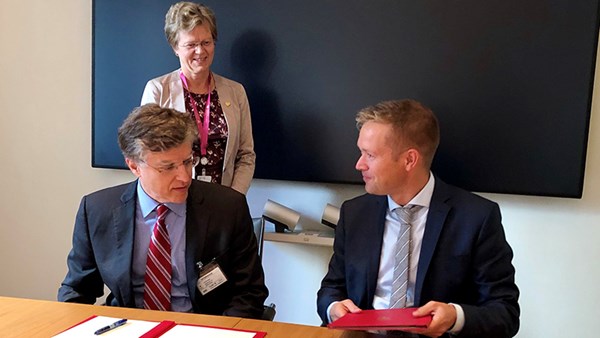
Friends,

Whichever government is in power, it works for the betterment of the country by enacting laws in the Parliament. No matter which party or coalition is in power, this work never stops.

There is a lot of debate both inside and outside the Parliament when laws are enacted and made, a lot of debate and brainstorming occurs and serious arguments are put up over its importance and effect. The laws that are enacted after undergoing this process are beneficial for people of the nation. However, it’s unfathomable that so many laws are enacted in the Parliament and not enacted in a particular region of the country. Even previous governments who were hailed after enacting just one law couldn’t claim that the same law will be implemented in the Jammu & Kashmir region. More than 1.5 crore people of Jammu & Kashmir were deprived of the benefits of laws that were enacted for the benefit of the people of India. Imagine children in rest of the country have a right to education while children in Jammu & Kashmir were deprived of this right. The daughters of Jammu & Kashmir were deprived of the right that our daughters had in rest of the states. In all the other states, Safai Karamchari Act was enacted for hygiene workers but the workers of Jammu & Kashmir were deprived of this. In other states, strict laws were enacted to stop atrocities on Dalits but no such laws could be implemented in Jammu & Kashmir. To protect the rights of blue-collar workforce, Minimum Wages Act was enacted and implemented in all the other states while such a law is only found on papers in the state of Jammu & Kashmir. In all other states, (our) brothers and sisters from Scheduled Tribes got reservation while contesting elections while such thing is unheard of in the state of Jammu & Kashmir.

Friends, I am fully confident that, following abrogation of Article 370 and 35-A, Jammu and Kashmir would soon come out of its negative effects.

Friends and sisters,

In the new system, the priority of the central government would be to keep state government employees and Jammu and Kashmir police personnel at par with the state government employees and police personnel of other states in terms of facilities. 

In Union Territories, the government provides many such financial facilities like LTC, House Rend Allowance, Education Allowance for children, Health Schemes etc., most of which are not provided to the employees of Jammu and Kashmir government. Such facilities would soon be provided to the employees of Jammu and Kashmir government and state police personnel following a review.

Friends, very soon the process to fill in the vacancies of central and state government will be initiated in Jammu and Kashmir and Ladakh. This would provide adequate employment opportunities to the local youth. Besides, public sector units of the central government and big private sector companies would also be encouraged to provide new employment opportunities. Apart from the above, Army and para military forces would organize rallies to recruit local youths. The government would also expand Prime Ministers Scholarship Scheme so that more and more students can get its benefit. Jammu and Kashmir also has huge revenue loss. The central government will ensure to minimize its impact. 

Brothers and sisters, after abrogation of Article 370, the central government has decided to keep the state of Jammu and Kashmir under its administration after putting in a lot of thought process in it. It is essential for you to understand the reasons behind the decision. Ever since the state has been under governor’s rule, the administration of Jammu and Kashmir is directly under the central government. As a result the good effect of Good Governance and Development have been observed on the ground. The schemes which earlier remained only in files, have been implemented on ground. Projects pending from decades have been speeded up.
We have tried to bring transparency and a new work culture in the Jammu and Kashmir administration. As a result, be it IIT, IIM, AIIMS, various irrigation projects or power projects or the Anti-Corruption Bureau, we have been able to fasten up the work on these projects. Besides, be it the projects of connectivity, roads or new rail lines, modernization of the airport, everything is being accelerated. 

Friends,

The democracy in our country is so secure, but you will be surprised to know that there have been thousands of brother and sisters living for decades in Jammu and Kashmir who had the right to cast their vote in Lok Sabha polls but they were not allowed to cast vote in assembly and local body elections.

They are the ones who had come to India following partition in 1947. Should we have allowed the injustice to continue in the same way?

Friends,

I would also like to clarify another important point to my brothers and sisters of Jammu and Kashmir. Your representative (electoral) would be elected by you, he would be one amongst you. The MLAs would be elected just as they were elected earlier. The forthcoming cabinet would just be as it was used to be earlier. The chief ministers would just be as they were before.

Friends, I am fully confident that, under the new system, we would collectively be able to keep the state of Jammu and Kashmir free from terrorism and secessionism. When our Jammu and Kashmir- the paradise on earth, after achieving new heights of development, attract the whole world, and when there will be greater Ease of Living in the lives of citizens, when they would ceaselessly get their rights, when all the tools of governance would speed up the work in favor of the masses, then I don’t think there would be any need to continue with the system under the union government. Yes, it would continue in Ladakh though.

Brothers and sisters, we all want assembly elections in Jammu and Kashmir, that a new government is formed, that a new chief minister is elected. I assure the people of Jammu and Kashmir that you would get the opportunity to select your representative in a fully honest and transparent atmosphere. Just as Panchayat polls were held transparently last days, assembly polls would also be held in Jammu and Kashmir.

I would urge the Governor of the state that the setting up of Block Development Council, which has been pending for past two-three decades, be constituted as early as possible.

Friends,

I have personally experienced that those who got elected in Panchayat polls in Jammu and Kashmir and Ladakh four-five months back, have been working nicely. Few months back when I visited Srinagar, I had a long meeting with them. When they came to Delhi I interacted with them for long at my home. It is because of these friends in Panchayats that the work has been done promptly on village level in Jammu and Kashmir. Be it the task of electrification in every home or making the state Open Defecation Free, the representatives in Panchayats have played a crucial role.

I am fully confident that following abrogation of Article 370, once these Panchayat members get a chance to work in the new system, they would do wonders. I firmly believe that the people of Jammu and Kashmir would conquer secessionism and move forward with new hope. I firmly believe that the people of Jammu and Kashmir would achieve their objectives with renewed fervor in an ecosystem of Good Governance and Transparency.

Friends, Family rule has not given any opportunity of leadership to any young citizen of Jammu and Kashmir in the State. Now, my these young people will take leadership of the development of Jammu and Kashmir and take it to a new height.

I appeal to the youth, sisters and daughters of Jammu and Kashmir and Ladakh to take over command of development of their area on their own hands.

Friends,

There is every possibility of Jammu and Kashmir and Ladakh becoming one of the greatest tourist destinations. The environment required for this, the need of change in administration, all is being taken care, but for this I need the support of all countrymen. There was a time when Kashmir was the favorite place for shooting bollywood films. During that time perhaps there was no film produced, had it not been shot in Kashmir. Now, situations in Jammu and Kashmir will normalize; not only from India, but people from all over the world will come for shooting there. Every Film will bring with it new opportunity of employment for the people of the Kashmir. I appeal to the Film Industry of Telugu and Tamil Film Industry and people associated with it to definitely think over for investment, shooting of film, theatre and setting up of other facilities in Jammu and Kashmir.

I appeal to those who are associated with technology, administration or private sector to give priority in their policies and their decisions as to how to disseminate technology in Jammu and Kashmir. When digital communication will be strengthened there and BPO Centre, Common Service Centre will increase in numbers there, there will be enhanced opportunity of earning livelihood, and the life of our brothers and sisters of Jammu and Kashmir will become easier.

Friends,

The decision taken by the Govt. will benefit those youth of Jammu and Kashmir and Ladakhwho aspire to progress in the field of sports. New sport academies, new sports stadium, training in scientific environment will help them to show their talent in the world.

Friends, whether is it colour of kesar or flavour of kahwa or sweetness of apple or juiciness of apricot or Kashmiri shawl or the art work or be it organic products of Ladakh or herbal medicines of Jammu and Kashmir, all these need to be publicised in the entire world. I give you one example, there is a plant in Ladakh, named solo. Experts say that this plant is like a sanjivini for people living in high altitude and for security forces deployed in heavy icy mountains.

These plants have great role in maintaining the immune system of body in places with  low levels of oxygen. Just think over, should not these extraordinary items be sold in the whole world? Which Indian do not want this. And friends, I named only one plant. There are ample plants, herbal products spread over Jammu and Kashmir and Ladakh. Those will be identified. If they are sold, it will benefit people and the farmers of Jammu and Kashmir and Ladakh. Therefore, I appeal to the people associated in Industry, Export, Food Processing Sector to come forward to ensure that local products of Jammu and Kashmir and Ladakh reach whole of the world.

Friends, After becoming a Union territory, development of the people of Ladakh becomes natural responsibility of the Govt. of India. Central Government with the cooperation of local representatives, Development Council of Ladakh and Kargil, will ensure benefits of all development schemes reaches to people at a faster pace. Ladakh has the potential to become the biggest center of spiritual tourism, adventure tourism and eco-tourism. Ladakh also has the potential to become a big centre of Solar Power generation.  Now, the capability of people of Ladakh will be utilized appropriately and new opportunities of development will come up. Now the innovative spirit of youth of Ladakh will get a boost, they will get good institutes for good education, people will get good hospitals, and infrastructure will be modernized with priority.

Friends,

It is possible, in a democracy that some people will agree to this decision and some will oppose it. I respect their disagreement and their objections. Whatever is being argued in this connection, Central Govt. is responding to that and it is trying to resolve the same.  It is our democratic responsibility. But I urge them to keep the national interest as paramount and help the government in giving a new direction to Jammu – Kashmir-Ladakh, and help the country. Moving ahead from, who voted in Parliament, who didn’t, who supported the bill, who didn’t, now we all to have come together to work unitedly in the interest of Jammu – Kashmir-Ladakh. I also want to convey to our countrymen that the concerns of Jammu – Kashmir and Laddakh are our collective concerns. These are the concerns of 130 crore citizens. We are not indifferent to their happiness or sorrows and sufferings.

The riddance from Article 370 is a reality.  But it is also true that whatever odds are being caused now because of these historic steps are being fought by them only. Our brothers and sisters of that region are patiently replying to those handful of people, who want to vitiate the atmosphere there. We should not forget that it is the patriots of Jammu – Kashmir who are strongly opposing the nefarious designs of Pakistan in perpetuating terrorism and separatism. Our brothers and sisters, who believe in Indian Constitution, deserve a better life. We all are proud of them. Today I assure these friends of Jammu – Kashmir that the situation will gradually return to normal and all their troubles too will reduce.

Friends, the festival of Eid is around the corner. I extend my greetings to all on Eid. The government is taking care that people of Jammu – Kashmir don’t face any problem while celebrating Eid. The government is extending all possible help to those friends who live outside Jammu – Kashmir and want to return back to their homes on Eid.

Friends, today on this occasion, I also express my gratitude to our friends in security forces, who are posted for the security of the people of Jammu – Kashmir. The way all administrative officials, state employees and Jammu – Kashmir police personnel are handling the situation there is really commendable. Your diligence has boosted my confidence that change can happen.

Brothers and sisters, Jammu – Kashmir is the crown of our country. We are proud that many brave sons and daughters of Jammu – Kashmir have sacrificed and risked their lives for its security. Maulvi Ghulam Din of Punch district, who had informed Indian Army about Pakistani intruders during 1965 war. He was conferred Ashok Chakra. Col. Sonam Wangchug of Laddakh district, who forced enemies to bite dust during Kargil war, was honoured with Mahavir Chakra. Kirti Chakra was conferred to Rukshana Kausar of Rajauri, who had killed a big terrorist. Martyr Aurangjeb of Punch, who was assassinated by terrorists last year and his two brothers are now serving the country after joining the Army. The list of such brave sons and daughters is very long. Several jawans and officials of Jammu – Kashmir Police have also laid their lives while fighting with terrorists.  We have lost thousands of people from other parts of the country as well. They all dreamt of a peaceful, safe and prosperous Jammu – Kashmir. We, together, have to realize their dream.

Friends! this decision will help in economic development of Jammu  – Kashmir and Laddakh along with the entire country. When peace and prosperity prevails in this important part of the globe, the efforts for peace in entire world will be naturally strengthened. 

I call upon my brothers and sisters of Jammu – Kashmir and Ladakh to come together to show the world how much strength, courage and passion we have.

Let us come together to build a new India, as well as a new Jammu – Kashmir and Laddakh.

Thank you very much!

Jai Hind!!!

August 9, 2019 0 comments
0 FacebookTwitterPinterestEmail
Diplomatic relations

Norway to lead UN’s central platform for development policy

by Nadarajah Sethurupan July 28, 2019
written by Nadarajah Sethurupan

Mona Juul, Norway’s Ambassador to the UN, was elected President of the UN Economic and Social Council (ECOSOC) for a one-year period. 

ECOSOC is the UN’s central platform for sustainable development. The President of ECOSOC plays a key role in the UN, with responsibility for following up the Sustainable Development Goals (SDGs) and the financing for development agenda.

Ambassador Mona Juul. Credit: Monica Hellem

‘Norway has taken on this task because we are a strong supporter of the UN and the SDGs. Our aim in this role is to strengthen a key part of the multilateral system, which is crucial for the UN’s work all over the world,’ said Minister of Foreign Affairs Ine Eriksen Søreide.

ECOSOC is made up of 54 member states and is the UN’s main body for the formulation of development policy. It is one of the six main organs of the UN, which also include the Security Council, the General Assembly, and the UN Secretariat.

‘Norway will use its presidency of ECOSOC to promote common solutions to the challenges facing the world today. We have not succeeded in mobilising the resources we need to reach the SDGs. We will therefore highlight the financing for development agenda as an overall priority for ECOSOC in the coming year,’ said Minister of International Development Dag-Inge Ulstein.

ECOSOC is an ecosystem of forums for development policy discussions, expert committees and commissions.

‘UN meeting rooms in New York can feel far removed from the everyday life of young girls in Uganda. For me, it is important that cooperation in the UN and ECOSOC is meaningful to us all. For example, ECOSOC is following up how UN reform is working in practice,’ commented Norway’s Ambassador to the UN and President of ECOSOC Mona Juul.

(MFA)

July 28, 2019 0 comments
0 FacebookTwitterPinterestEmail
Africa and Norway

Work remains in Sudan, says US envoy

by Nadarajah Sethurupan July 25, 2019
written by Nadarajah Sethurupan

US Special Envoy for Sudan Donald E. Booth on Tuesday said that leaders of the military government and the opposition in the African nation are moving toward a reconciliation, but added “there is a lot” that still needs to be done.

Both sides in Sudan agreed a political power-sharing deal on July 17 that set out a 39-month period of transition, led by Sudan’s new “Sovereign Council,” before constitutional changes can be made. Under the agreement, a military general will lead the council for the first 21 months, a civilian for the following 18 months, and then elections will be held.

“That political declaration really addresses the structure of a transitional government and not the entire structure,” Booth said. “(The July 17 agreement) has put off the question of the legislative council. It is a document that is the beginning of a process. We welcome the agreement on that but there are still a lot of negotiations to be conducted on what the Sudanese call their constitutional declaration.”

Ambassador Donald Booth Special Envoy to Sudan

The envoy said he expects the Sovereign Council “will have to address what the functions of the different parts of the transitional government will be,” such as the roles and powers of “the sovereign council, the prime minister, the cabinet and, ultimately, the legislative cabinet. Who will lead that transitional government is still undecided.”

“The 3rd of June was a signal of the limits of people power,” he said. “But then there was the 30th of June, in which close to a million people took to the streets outside of Sudan and I think that demonstrated the limits of the military power over the people.”

“One has to recognize that General Hemeti is a powerful figure currently in Sudan,” he said. “He has considerable forces loyal to him. He has significant economic assets as well. So, he has been a prominent member of this transitional military council. But he has been one of the chief negotiators for the forces of Freedom and Change.

Below is a full rush transcript of the press conference by Ambassador Donald Booth Special Envoy to Sudan and South Sudan.

Ambassador Booth:  I started as the Special Envoy for Sudan on the 10th of June and since then have been in Khartoum three times and done two swings through the region, both in Africa and the Middle East.  In my time in Khartoum I’ve met and spent a fair amount of time with a broad range of Sudanese to better understand where all of them are coming from and what they’re trying to achieve.  I’ve met with women’s groups, I’ve met with youth, I’ve met with victims of the violence of June 3rd, I’ve met with members of the Transitional Military Council, as well as the Forces for Freedom and Change, the Sudan Professional Association, civil society; and reached out to some of the armed groups as well.

The position that the United States has taken is that we support the formation of a civilian-led transitional government that will be broadly supported by the Sudanese people.  There are many partners that we have engaged with toward that end.  I’m just here in Brussels yesterday for a meeting of the Friends of Sudan, which is a group of Western, Middle Eastern, and African parties that are interested in helping the Sudanese people achieve their desires.  That group met last month in Berlin and came up with an agreement for broad support for the mediation effort of the African Union and Ethiopia toward helping the Sudanese achieve their desire for a civilian-led transitional government.

In addition to the African Union and Ethiopian mediation, there have also been roles played by individual Sudanese in trying to bring the Transitional Military Council and the Forces for Freedom and Change together, and we’ve seen that progress is often made in talks when the Sudanese parties are face to face and engaging with each other.

We all know of the very tragic events of the 3rd of June when close to 150 people were killed at the sit-in site outside the military headquarters.  The 3rd of June was a signal of the limits of people power; but then there was the 30th of June, which was when close to a million people again took to the streets and cities throughout Sudan, and I think that demonstrated the limits of military power over the people.

So shortly after those lessons were learned by both sides, we had the announcement of an agreement on a transitional government on the 5th of July, which resulted in the signing of the political declaration on July the 17th.

Now, that political declaration really addresses the structure of a transitional government and not the entire structure of it.  For example, it has put off the question of the Legislative Council.  So it is a document that is the beginning of a process.  We welcome the agreement on that.  But there are still a lot of negotiations to be conducted on what the Sudanese are calling their constitutional declaration, which is a document that will be more detailed and will have to address what the functions of the different parts of the transitional government will be.  It’s in that document where issues of relative roles and powers of the Sovereignty Council, the Prime Minister and the Cabinet, and ultimately of the Legislative Council will be addressed.

Then after that, it is agreed there’s still the issue of who will actually be in the transitional government.

So as you can see, there’s still a lot that the Sudanese need to do but as I said, we fully support the desire of the Sudanese people to have a civilian-led transitional government that will tackle the issues of constitutional revision and organizing elections, free and fair, democratic elections, at the end of a transition period.

Another part of my function has been to engage with a broad set of international partners to secure their support to help the Sudanese people achieve their desire for a civilian-led transitional government and to provide peace and stability in Sudan, and to begin the process of restoring Sudan’s economy.  That’s one of the issues that we discussed among the Friends of Sudan in Brussels this week.

Question:  What support will the United States provide for the agreement recently concluded between the Military Council and the Declaration of Freedom and Change Forces to form a civilian government?

Ambassador Booth:  Let me say first of all that the agreement that was reached on July 17th is only the first step in forming the transitional government, and we certainly need to see the Sudanese reach agreement on the further step of the Constitutional Declaration, which will address the functions of that government so that we have a true sense as to where the relative powers and authorities will lie.  

So, the U.S. reaction will depend upon what the Sudanese actually agree upon, and then also, as we say, the broad support of the Sudanese people for any such agreement.

So, under current U.S. restrictions that go back many years, including our designation of Sudan as a state sponsor of 

Terrorism, our ability to operate in Sudan in the economic realm has been limited to humanitarian and democracy and governance areas.  So those are areas we could definitely engage in going forward in support of a government.  And I would think that if it’s seen as a government that truly reflects what the Sudanese people have been looking for, it will certainly have the political support of the United States and our active engagement with other partners around the world to support that.

Question:  Does the United States object to the prominent role that Mr. Dagalo also known as Hemeti plays in this transition?  As you’re no doubt aware, he has a very questionable human rights record with the Rapid Support Forces, also having been part of the Janjaweed.  Is his role something that would not be conducive to the transition to a representative civilian government? 

Ambassador Booth:  Well, one has to recognize that General Hemeti is a powerful figure in Sudan.  He has considerable forces that are loyal to him.  The Rapid Support Forces.  And he has significant economic assets as well.  So he has been a prominent member of this Transitional Military Council.  But he has also been one of the chief negotiators with the Forces for Freedom and Change.  So I think we have to wait and see how the Sudanese, what type of agreement they will come up with.  As I said, they had initial agreement on some structures of the transitional government, but still have a lot to discuss in terms of the function of it and who will actually be in it is another issue that will be, the Sudanese will need to deal with.

So, we don’t want to prejudge where the Sudanese will come out on that.  It’s their country and their decision on how they move forward.  As I said, our goal is to support the desire for truly a civilian-led transition.

Question: I’ve traveled to Sudan a couple of times over the past several months, and on my trips there I’ve been working with local journalists who are being intimidated regularly, and foreign media such as myself have had to go through the process of being denied visas, or accreditation, or permission to travel beyond Khartoum.  I’m curious what the U.S. government is doing to press the Military Council to expand or ensure press freedom ?

Ambassador Booth:  It’s one of those areas that we have engaged, I’ve engaged personally with them on it.  One of the key areas that we pressed frequently on and engaged other international partners on was to try to get the internet restored.  In my meetings with Sudanese journalists, that was one of their very top requests, was to assist them in getting the internet restored.  That has been turned back on.

I think there was a brief period, they related to me in April, after President Bashir resigned, when there was a bit more freedom, and in many ways, that press freedom has now been restricted.

As I said, we certainly engage with the TMC on that and clearly a civilian-led transitional government in order to succeed in the many tasks that it will have will need to have a vibrant press which it can use to communicate to the Sudanese people.  The many difficult issues that need to be addressed as Sudan tries to dig out of its economic hole, and also to have a constitutional process.  If you don’t have a press that can engage in open and vigorous debate about the many issues that have to be addressed in coming up with Sudan’s way forward under a constitution, the process will not be successful.

So I think clearly, the key to really restoring freedoms of the press and getting away from the old habits of denying visas and permits for travel which apply, frankly, to humanitarian actors as well, and that’s another issue we continue to push for is humanitarian access so that people in need can be assisted.  Those are issues we would think that a civilian-led transitional government would tackle and try to get away from the bad practices of the past and unfortunately that are going on currently.

Question:  When will America lift sanctions on Sudan in a move to help the country overcome the difficult stage it is going through?

Ambassador Booth:  I think there’s a lack of understanding about the U.S. sanctions.  They were actually lifted in 2017.  They were provisionally lifted in the beginning of 2017 and then formally later in the year.

There are still some sanctions on individuals, particularly sanctions related to gross human rights abuses that were voted through the UN Security Council.  There are a number of other issues that would limit U.S. ability to provide assistance, but are not sanctions per se.

The main one that people recognize is the current designation or ongoing designation of Sudan as a state sponsor of terrorism.  But there are also limitations on any assistance we can provide outside of the humanitarian and democracy governance area due to shortcomings of Sudan in the area of child soldiers.  It’s an issue we are engaging General Hemeti in particular on, and I’m pleased to say that he has last week committed to allow the International Committee of the Red Cross and UNICEF to investigate that.  We’ll see if they secure his cooperation in that matter, but the commitment was made.

We also have concerns about trafficking in persons and lack of Sudan’s focus on trying to deal with that issue.  Religious freedom is another area where we have concern.  So there are many things that limit what the United States can do in the assistance area, but again, having a civilian-led transitional government we believe will be a start, if they start addressing these issues, to being able to engage Sudan on looking at all these issues where we still have restriction.

Question:  I’ve spoken to many Sudanese living here in the Washington, DC area, across the United States, who are in contact with mothers of martyred people inside Sudan who have very specific concerns.  Among those are, is the, are there two separate constitutional agreements and will there be any type of public consultative process that will include women and some of the protesters as to what will be included in a final agreement?  Their concern is they want to see an agreement that will not provide immunity to the TMC, but offer accountability for the massacres.  And the types of measures of how power will be divided, and hopefully that the military will not have significant powers.  And how is civilian oversight over that security sector be in this initial agreement before you move on to a further agreement? 

Ambassador Booth:  Your question about whether there will be two constitutional agreements– in a way, yes, that is what is envisioned.  The first would be an extension of this political declaration.  It would be a constitutional declaration which would, as I mentioned earlier, outline the functions, the roles and responsibilities of the various parts of the transitional government, which will have a life of 39 months and will have the responsibility of organizing democratic elections at the end of that period.

One of its key tasks will be organizing the writing or revising of Sudan’s constitution.  So, in effect, the, if you will, permanent constitution– I think it would be Sudan’s third permanent constitution– that in effect you might consider to be a second constitutional document.

The first one is a negotiation between the parties that have been engaged since April, which is the Transitional Military Council and the Forces for Freedom and Change, which is a coalition that includes the Sudan Professionals Association, the Sudan Call, the National Consensus Forces, political parties, and an alliance of civil society groups. 

So that first one will be a negotiated document between those groups.

The second one would need to be taken to a national referendum and would be achieved through a process yet to be defined that certainly should include a broad consultation and input from Sudanese from all walks of life in all parts of the country.  Because one of the things Sudan needs to address is the historic divide between the center and the periphery, which has resulted in nearly constant war since Sudan’s independence.

The issue of immunity and accountability– that is an important issue.  There is, in the draft, one draft anyway of the Constitutional Declaration, a provision for immunity for members of the Sovereignty Council.  That would apply to the civilians as well as to the military members of it.  And as I understand, there are negotiations, part of the negotiations will be in limiting the extent of that.  Having immunity for the Chief Executive or Executive Branch of a government is not unusual.  When you think about it in the U.S. context, only the Congress can move to impeach and try a President.

So it’s not an unusual thing, but what they are looking to add to it is not only limitations on it, but what mechanism might be used to lift any immunity for specific reasons.

The issue of accountability gets to one other function to be achieved during the transitional period, and that is the establishment of an independent and credible investigation of the June 3rd events and subsequent violence.  Again, a commission has not been established.  Who will establish it and how it will be independent has not been yet thoroughly agreed.  Though the political declaration that was signed on the 17th of July did include a provision that the independent commission to be established would be able to call on African support.  So that gives an opening for assistance and oversight, perhaps, that could add to the credibility of any investigation.

We have certainly cautioned the Sudanese parties that an investigation done in-house, no matter how well done, will always have some suspicion, so the idea of having this being done above board is extremely important I think to the Sudanese people and we certainly support that.

Question:  I wanted to just ask you about the criticism of these negotiations.  That the characters are spending too much time talking about who’s going to occupy what procedure seat, rather than articulating a unified policy vision for the new Sudan.  I wanted to hear your thoughts on what you make of that ? also, maybe you can tell us what you think should happen to Omar al-Bashir ?

Ambassador Booth:  First of all, the negotiations.  There are actually two negotiations going on.  One has been the negotiation in Khartoum between the Transitional Military Council and the Forces for Freedom and Change.  And in that regard, I frankly think that the focus has been more on the structure of the government and to some extent the authorities of the government rather than on who will occupy what positions.

Now the FFC has told me they have their lists of people that they will propose for ministerial posts, for example, or for their seats on the Sovereignty Council, but that has not, at least in discussions with me or other envoys from other countries that have been involved in this, that has not been a big focus.

What you may be referring to is what you’re hearing out of the discussions between the FFC delegation that has gone to Addis Ababa to meet with representatives of some of the armed groups who have been fighting the government of Sudan for some time.

There we have heard calls for positions in the Cabinet, for reserved seats in a legislature.  Those discussions in Addis really we think one should not be delaying the formation of a transitional government, and two, the armed groups really need to focus on how they’re going to negotiate peace agreements.

The purpose of the FFC engagement with them was to see how that might, peace negotiations might proceed in the future.

I’ll be going to Addis shortly to try to talk with all the parties there to get a better sense of where they’re coming out in the talks that have been going on there, but clearly we believe and I’ve communicated this to everyone I’ve met in Khartoum, that they need to focus on resolving the issue so that they can get a civilian-led transitional government established.  

Sudan in effect has been operating really without an agreed government since the fall of President Bashir.  The Transitional Military Council has in effect been de facto running things with the old ministries and personnel from those ministries in place.  So, the sooner that Sudan can establish a civilian-led transitional government, it can being then to address issues of reform and moving forward to a better future.

July 25, 2019 0 comments
0 FacebookTwitterPinterestEmail
Asia and Norway

Emerging Differences between China and Pakistan

by Nadarajah Sethurupan July 25, 2019
written by Nadarajah Sethurupan

The recent ‘abandoning’ of Pulwama master-mind Massod Azhar by China is being seen as a symptom of the friction emerging between Pakistan and China. However, this seems more like an effect of the differences that has already cropped up between the two countries.

The quantum of the chasm could be gauged from the fact that repeated requests from Pakistan to at least delay the ‘sanction’ for a week was not accepted by China. The May 1st sanction came immediately after the recent visit of Imran Khan to Beijing to attend 2nd Belt and Road Forum.

The Pakistani leadership was keen to avoid the perception that Imran Khan was forced to accept the condition during his visit to Beijing. However, Beijing intended to send a clear message of its unhappiness. As if to drive the point home, Imran Khan was welcomed by a Vice-Mayor rank official, probably the lowest rank welcome for any Pakistani head of government visiting China.

Pakistan had lodged its protests against China by not participating in the PLA Navy celebrations of 70 years, another first in the bilateral relations.

The frictions that started with Imran Khan ascending to power on anti-CPEC agenda have not reconciled. Imran Khan demanded a revaluation of CPEC, knowing well that China would have to concede amidst all the push-backs it’s getting on OBOR projects – from Malaysia, Philippines, to African and Latin American countries. Immediately after coming to power, he scraped Bhasa Dam and three other major power projects. China was again given a fait accompli when Imran Khan diverted about USD 175 million funds from CPEC to other projects, essentially to serve his constituency. China had to give a nod eventually to keep the facade.

However, these were still minor irritants and China could explain them away as ‘domestic political compulsions’. However, by bringing Saudi Arabia (which is considered a ‘backdoor’ for the US) into Gwadar without consulting China, Pakistan probably had given the biggest snub to its ocean-deep friend. This time Chinese had to send a message, and Masood Azhar was probably a good one. It reminded Pakistan of its vulnerability at international level. While China itself may not have many friends, Pakistan has none other than China.

China and Differences within Pak Army

It is for the first time that within Pakistan Army there has been a polarization between pro-US and pro-China camps. It is no secret that even during the worst of times for the US – Pakistan relations, Pentagon had maintained deeper interactions with Pak military. Military as an institution has its own robust culture, and given the fact that Pak military has roots in British military culture, it feels itself more aligned towards the Western/US military system than a communist modelled military of China. Professionally, the Pak military also feels itself superior to the Chinese PLA, which has not fought a war in many decades now.

However, the CPEC brought with itself economic incentives of unprecedented scale that were hard for the Pak Army to ignore. This created a new ‘loyal to China’ segment within the military, which was at cross-purposes with the pro-US lobby within. The differences have started to play out in the open now. What would have been unthinkable only a few years ago is becoming the new normal. Traditionally, Pak Army and its personnel have remained untouchables, irrespective of their misadventures. Not anymore. Due to the push and pull factors, one lobby is trying to control the direction at the cost of others, and for the first time the Generals are put under house arrests; while gag-orders have been issued against many retired generals who do not subscribe to the prevailing view of the dominant factor.

The premise of the problem seems to be the assumption on both the countries’ part that ‘the other side needs them more’; and in the process they are trying to extract maximum benefits from each other. As it is, China – Pak relations are probably one of the rare bilateral relations in history which has been surviving without having any foundation in shared values, cultures, and history. The relationship therefore has come to look more and more transactional. A relation with several fault-lines like the treatment of Uyghur Muslims in China, the cases of alluring Pakistani brides to China, and the security concerns for CPEC projects; is hard to sustain if there are no super-ordinate goals. Hence the differences keep searching for vents here and there.

That the relation has deeper issues than seen on the surface is also confirmed by the opacity being maintained by both the sides, as if both of them have to hide something. Other than the jargons that have become clichés, there has been no transparency about the content, extent, and nature of the relationship. This becomes much clearer when one contrasts this with similar other bilateral relations.

While the bilateral equations are strained because of the structural problems, an added component is the increasing economic vulnerability of both the countries at the same time. Pakistan’s financial problems are already in the open and are trying to get IMF bailout. However, the US would not let it get the lifebuoy without coming transparent on CPEC finances which are obviously going into to be discomforting for China. At the same time, China itself is facing headwinds on not only OBOR but also about its economy in general. With the trade frictions with the US intensifying, China would have less and less space to keep obliging its difficult junior friend. As the thing looks now, the year 2019 might in the year when the ‘iron-bond’ might start unravelling.

July 25, 2019 0 comments
0 FacebookTwitterPinterestEmail
Asia and Norway

No steps taken by Pakistan to improve human rights situation in Kashmir

by Nadarajah Sethurupan July 22, 2019
written by Nadarajah Sethurupan

The Pakistan based researchers describe themselves as independent researchers have accused Pakistan again of human rights violations in Kashmir and has called for the formation of a commission of inquiry into the allegations. The India and Pakistan came close to a third war earlier this year following the killing of over 40 Indian soldiers in a suicide attack by a Pakistan-based rebel group.

“Update of the Situation of Human Rights in Indian-Administered Kashmir and Pakistan-Administered Kashmir from May 2018 to April 2019”. (UN report 08.07.19)

The report also examined the human rights situation in Pakistan Administered Kashmir and found that human rights violations there were more structural in nature; these included restrictions on the freedom of expression and freedom of association, institutional discrimination of minority groups and misuse of anti-terror laws to target political opponents and activists.

Image for representation- Reuters

As noted in the 2018 report, the quantity and quality of information available on Indian-Administered Kashmir contrasts significantly to Pakistan-Administered Kashmir. Despite significant challenges, NGOs, human rights defenders and journalists are able to operate in the Indian state of Jammu and Kashmir, generating documentation on the ongoing human rights violations there. Restrictions on the freedoms of expression, opinion, peaceful assembly and association in Azad Jammu and Kashmir and Gilgit-Baltistan have limited the ability of observers, including OHCHR, to assess the human rights situation there.

Since the late 1980s, a variety of Pak based armed groups has been actively operating in the Indian state of Jammu and Kashmir, and there has been documented evidence of these groups committing a wide range of human rights abuses, including kidnappings, killings of civilians and sexual violence. Iin recent years four major armed groups are believed to be operational in this region: Lashkar-e-Tayyiba, Jaish-e-Mohammed, Hizbul Mujahideen and Harakat Ul-Mujahidin. All four are believed to be based in Pakistan Administered Kashmir.

The 14 February 2019 suicide bombing on Indian security forces in Pulwama was claimed by Jaish-e-Mohammed. Pakistan Foreign Minister Shah Mehmood Qureshi told an international news organization that Jaish-e-Mohammed founder Mohammad Masood Azhar is present in Pakistan. However, a spokesperson for the Pakistan Army denied that Jaish-e-Mohammed “exists formally” in Pakistan.

This report also refers to FATF, adding that Pakistan “does not demonstrate a proper understanding of the TF [terror financing] risks posed by Da’esh, AQ [Al Qaeda], JuD [Jamaat ud Dawa], FiF [Falah-i-Insaniyat Foundation], LeT [Lashkar e Tayyiba], JeM [Jaish-e-Mohammed], HQN [Haqqani Network], and persons affiliated with the Taliban.” It urged Pakistan to address its “strategic deficiencies” and complete its action plan.

Pakistan-based armed groups that operate mostly in Indian-Administered Kashmir have also been accused of harassing and threatening nationalist and pro-independence political workers in Pakistan-Administered Kashmir.

Pakistan maintained that the constitutional and legal structures of Azad Jammu and Kashmir and Gilgit-Baltistan adequately protect the rights of its citizens. However, OHCHR’s monitoring and analysis found that these concerns remain. Both regions introduced constitutional changes, but failed to address the main elements that restrict the full enjoyment of all human rights for people living in these regions.

OHCHR highlighted that the Interim Constitution of Azad Jammu and Kashmir places several restrictions on anyone criticizing the region’s accession to Pakistan, in contravention of Pakistan’s commitments to uphold the rights to freedoms of expression and opinion, assembly and association.

Authorities in Gilgit-Baltistan also failed to amend similar provisions in the region’s governance rules that restrict the rights to freedoms of expression and opinion, assembly and association. The Government of Gilgit-Baltistan Order 2018 and the updated Gilgit-Baltistan Governance Reforms 2019 retain the same language limiting freedom of association from the Gilgit-Baltistan Empowerment and Self-Governance Order 2009.

Journalists in Pakistan-Administered Kashmir continue to face threats and harassment in the course of carrying out their professional duties. According to the Committee to Protect Journalists (CPJ), an anti-terrorism court in Gilgit-Baltistan sentenced journalist Shabbir Siham in absentia to 22 years in prison and fined him 500,000 Pakistani Rupees (USD 4,300) on charges of defamation, criminal intimidation, committing acts of terrorism, and absconding from court proceedings. On 21 November 2018, Gilgit-Baltistan authorities arrested journalist Muhammad Qasim Qasimi after he engaged in a verbal argument with a local police official. According to the International Crisis Group (ICG), Pakistani intelligence officials have also warned journalists in Gilgit-Baltistan against criticising the ChinaPakistan Economic Corridor (CPEC) projects.

The people of Gilgit-Baltistan are resentful because they feel CPEC projects were “designed and implemented without their input” and “will be of little benefit to them”. ICG concludes, “the state’s response to local dissent and alienation has been an overbearing security presence, marked by army checkpoints, intimidation and harassment of local residents, and crackdowns on anti-CPEC protest”.

A key concern in both Azad Jammu and Kashmir and Gilgit-Baltistan is that the local communities do not control natural resources of the territories as these are controlled by Pakistani federal agencies.

OHCHR has received credible information of enforced disappearances of people from Pakistan-Administered Kashmir including those who were held in secret detention and those whose fate and whereabouts continue to remain unknown.

The former Norwegian Prime Minister’s visit to Kashmir Valley and his meetings with leaders of Hurriyat has triggered controversy. India considers Kashmir a bilateral issue and for more than five years, the government has not allowed any foreign envoy to meet any separatist leader.

July 22, 2019 0 comments
0 FacebookTwitterPinterestEmail
Racism in Norway

Norwegian Nightmare: ‘Barnevernet’ Preys On Children and Parents

by Nadarajah Sethurupan July 22, 2019
written by Nadarajah Sethurupan

One of the first things you notice about Norway when you visit is how beautiful it is. But there is a very dark side of Norway that most of the world knows nothing about. It’s called Barnevernet, and it can be as cold and brutal as the Norwegian winter. 

Barnevernet means “child welfare.” It’s Norway’s network of local child protection service offices. But to its victims, Barnevernet means anything but protecting children. 

‘Barnevernet’ Takes American Children

After moving to Norway from Atlanta for her husband’s employment, American mother Natalya Shutakova’s three American-born children were taken by Barnevernet two months ago for alleged child mistreatment.
 
Shutakova and her Lithuanian husband were jailed for 24 hours and told they could get two years in prison for discussing the case. They’re waiting to hear if they will lose custody of their children for good. All three are American citizens.

Foreign Families at Special Risk

Foreigners living in Norway seem especially at risk of having their children taken by Barnevernet.

Video on YouTube shows police tackling Kai Kristiansen outside his home while his mother films it and pleads, “Would someone please help us. Barnevernet is here in our home and they’re trying to take our son. I’m Canadian.”

Barnvernet moved in after the Kristiansens started homeschooling Kai because he received death threats at school.

It was Barnevernet that took the five children from Romanian and Norwegian parents Marius and Ruth Bodnariu in 2016.

Barnevernet claimed the reason was that the parents were spanking. But an investigation revealed the real reason was officials believed the children were being ‘indoctrinated’ into Christianity by their parents. Worldwide outrage forced the Norwegian government to return the children. The Bodariu’s escaped from Norway and have filed suit before the European Court of Human Rights. 

Norway Clogs the Docket for Child Welfare Cases at the European Court of Human Rights

The government of Norway has in the past defended the work of Barnevernet against what it called “wild accusations.” But if there’s not a problem, why does a nation of only five million people have 26 cases pending before the European Court of Human Rights, and 17 of the last 18? 

Observers say that’s a staggering number of child welfare cases for one of the smallest nations in Europe.

“There are 26 cases in total at this stage and will probably rise to 30 by within a few months,” says Marius Reikerås, a Norwegian human rights council before the European Court of Human Rights. 

Reikerås told us, “There is something severely wrong going on in Norway that you are taking children out of the well-working families. We’re not talking about child abuse and we are not talking about alcoholism or drug abuse. We are talking about, in general, about normal families that have all the capabilities to provide good care for their children.”

Norwegian Expert: Shut Barnevernet Down

Einar Salvesen, a Norwegian psychologist who has been an expert witness in Barnevernet court cases since 1995, says Barnevernet needs to shut down immediately. 

“You need to close down all the offices,” Salvesen old us. “It’s 400 offices. It has become a system of evil in too many cases much more and more cases than we want.”

In 2013, Barnevernet took American citizen Amy Jakobsen Bjørnevåg’s one-and half-year-old son Tyler because he was one pound underweight. She phoned the Obama White House pleading for help. But she got no help. six years later, her son Tyler has been passed from foster home to foster home and has had his name changed at least twice. And Amy alleges that he has been tortured.

“We do have paperwork that says that he was tied to the bed because he kept standing up in his crib calling for “mommy,” Bjørnevåg told us. “It isn’t enough that he’s been calling for you. And they completely ignore it. And they do everything to make him stop calling so they cut all contact. That’s their solution instead of working with families.”

Member of European Parliament: Barnevernet a “Monster”

Czech Member of the European Parliament Tomáš Zdechovský has battled Barnevernet, and he calls it a “monster.”

“I think that they made a lot of mistakes and they are still doing a lot of mistakes,” Zdechovský said, “And this monster is really functioning without any control of somebody.”

Expert calls it “Child Trafficking” 

Reikerås believes Barnevernet has not been reigned in because this is about a lot of money, and he’s not afraid to call it “child trafficking.” 

“Because we see that billions and billions of dollars are being put into this system each year,’ Reikerås says. “And, of course, a lot of people are profiting big time from this governmental pot that you can see. So, saying that this is a form of child trafficking? Absolutely. My opinion is yes.”

Norwegian Government: We’re trying to Fix It

We presented these charges to Norway’s Ministry of Children and Families and it told us that Barnevernet is in the process of being reformed for the, “…strengthening of legal safeguards for both children and their parents.” 

But it’s unclear whether Norway is serious about reform. It expelled a Polish diplomat this year for trying to defend Polish families in Norway from Barnevernet.

The U.S. government has so far done nothing about attacks against American families by the Norwegian government.

A Mother Loses Hope

Amy continues to lose in court and wonders if she will ever regain custody of her son.

“I would do anything to hold him in my arms at least one time, for him to have some sort of sense of where he comes from and his background and his family, that there is a whole family that loves him and misses him.” 

Response from Norwegian State Secretary Jorunn Hallaråker at the Ministry of Children and Families to CBN News:

  • Protecting children from neglect, maltreatment, violence, and abuse, and securing their wellbeing is one of the most important tasks for my Government. Our system is child-centric and the best interest of the child is the guiding principle.
  • The Child Welfare Act underlines that children should grow up with their parents. The Act places great importance on family ties and continuity in the child’s upbringing.
  • An important feature of the Child Welfare Service is that it is a help service and the vast majority of measures offered in order to help the families, are voluntary assistive measures within the home.
  • Placing a child in alternative care without the consent of the parents is always a measure of last resort. A child can only be placed in alternative care if it suffers neglect, violence or abuse.
  • However, child welfare cases involve difficult dilemmas. There is often a conflict between what is best for the child and the rights of the parents.
  • You refer to the present cases handled by the European Court of Human Rights. We take these proceedings very seriously. We are currently working with the Attorney General in preparing the cases for the Court. I underline that all of these cases have already been thoroughly considered by the Norwegian courts.
  • The assessment of Norwegian practice before the European Court of Human Rights may highlight both the strengths and weaknesses of the Norwegian Child Welfare System and thus enables us to develop and improve it.
  • We are constantly working to improve the Child Welfare System. There are a number of processes handling with different aspects of the system, among others a proposal for a new Act on Child Welfare Services was sent on public hearing this spring, a competence development strategy has been introduced, and the staff capacity of the Child Welfare Services has been strengthened. I believe these measures will improve the decisions made, and help to ensure that children and families receive the right help at the right time.
  • As concerns the individual cases you refer to, I cannot comment upon these.
     
  • The Government is constantly working to improve the Child Welfare System. There are a number of processes handling with different aspects of the system. For example:
    • The Act on Child Welfare Services is currently under revision. A Committee has performed a scrutiny of the child welfare legislation in relation to a human rights perspective.
    • Based on the Committee’s report, a proposal for a new Act was sent on public hearing in April 2019. The proposal suggests, among other, further strengthening of legal safeguards for both children and their parents.
    • A competence development strategy has also been introduced for the municipal child welfare services for the period 2018–2024. Improved education as well as measures targeting both management and employees in the child welfare services, will enhance quality of practice and decisions.
    • Also, the staff capacity of the Child Welfare Services has been strengthened in recent years. From 2013 to 2018 there has been an increase of almost 1300 employees.
  • To gain more knowledge about the handling of child welfare cases the Government attained a report from an independent board with a revision of more than 100 care orders and interim orders in emergency cases.
  • The report is recently published, and it showed that in general, the removal of the children from the families involved was necessary in order to protect the children. It also showed that the situations leading up to a placement of children in alternative care were all grave, and not insignificant family problems. However, the report also showed deficiencies in some services, and that there is room for improvement.
  • The Norwegian child welfare system is based on several legal safeguards. For example:
    • The threshold for issuing a care order is defined by law, in the Child Welfare Act.
    • The Child Welfare Services prepare care order cases for the County Social Welfare Board. However, a care order may only be issued by the County Social Welfare Board.
    • The Boards are independent and impartial decision-making authorities, with the same procedural rules as a regular court.
    • The decisions of the Board can be appealed to the regular courts.
    • The County Governor at regional state level serves as a control mechanism. The Governor inspects the work of the Child Welfare Service, and parents can make complaints about the work of the Child Welfares Service to the County Governor.
    • The child has the right to be heard in all decisions that affect him or her, and the views of the child shall be given due weight in accordance with the age and maturity of the child.
    • Parents have important legal rights in care order cases. They are entitled to free legal aid, a due process (to be heard, bring witnesses/evidence). Parents can once a year file for a revocation of the care order to have the child returned.

(1.cbn)

July 22, 2019 0 comments
0 FacebookTwitterPinterestEmail
Africa and Norway

Norway to send assistance to Ebola victims in DR Congo

by Nadarajah Sethurupan July 22, 2019
written by Nadarajah Sethurupan

The Ebola outbreak in DR Congo is serious. We are therefore sending equipment and a team of experts to the country, said Minister of Foreign Affairs Ine Eriksen Søreide.

Earlier this week, the World Health Organization (WHO) declared the Ebola outbreak in the Democratic Republic of Congo a global health emergency. The outbreak has claimed more than 1 600 lives, and has reached Goma, a city of more than 2 million people. WHO and the EU have requested Norway to assist with training local health workers in the use of the EpiShuttle, an isolation and transport system for patients with serious infectious diseases developed in Norway.

-It is only natural that we should contribute to the international Ebola response, commented Minister of Health Bent Høie. 

-We are sending a team of three experienced health workers from Oslo University Hospital, who will be leaving shortly. We are prepared to provide additional equipment and expertise if we are asked to do so.

This is the third time that Norway is providing assistance in connection with the Ebola outbreak in DR Congo. The last time was in April this year, when Norway sent a team of expert health workers and EpiShuttle equipment to DR Congo.

The outbreak is in an area of great poverty, and the population is particularly vulnerable due to food insecurity, instability and conflict between armed groups.

-It difficult to provide normal health services in these areas, and health workers are at risk. This means that Norway’s contribution can make a real difference, said Minister of International Development Dag-Inge Ulstein.

The team of experts from Oslo University Hospital will also be providing training in Uganda, where incidences of Ebola have been registered.

The Government has provided NOK 17.3 million from this year’s humanitarian budget to the efforts to tackle the current Ebola outbreak. Last year, Norway provided NOK 28.5 million to the humanitarian efforts to fight Ebola in DR Congo.

Read more about Norway’s efforts to fight Ebola in DR Congo here.

July 22, 2019 0 comments
0 FacebookTwitterPinterestEmail
Norwegian Aid

Norway enters into partnership with the UN Tax Committee

by Nadarajah Sethurupan July 20, 2019
written by Nadarajah Sethurupan

This Week, on 15 July, Norway and the United Nations marked the start of a new partnership on strengthening international tax policy and enhancing domestic tax capacity. Norway will provide a total of NOK 35 million to the UN Tax Trust Fund over the next three years.

‘Four years ago, at the Financing for Development Conference in Addis Ababa, all the participating countries pledged to support the UN efforts to promote international cooperation on taxation. Norway is pleased to be the second country to provide financing for the UN Tax Trust Fund. We hope that this will expand the committee’s outreach and influence significantly,’ said Dag-Inge Ulstein, Minister of International Development. 

Norway places emphasis on the importance of domestic resource mobilisation, and has more than tripled its support for global norms development and capacity building over the last two years. Norway is contributing to the work of the OECD, the World Bank and the International Monetary Fund, and runs bilateral and regional capacity-building programmes. 

‘It is only natural that the one organisation with a universal mandate to develop international tax rules is included in our efforts. The world is on the cusp of some very substantial changes in global tax norms, and the UN must be at the centre of these discussions,’ said Mr Ulstein. 

The UN Tax Committee has a broad mandate, which includes standard setting, norm creation and capacity building. So far, India and Norway have contributed to the Trust Fund. 

‘We need all member states to engage in this issue on an equal footing. The challenge of financing the Sustainable Development Goals is urgent, and the needs for reform are vast. I hope that Norway’s contribution will inspire others to step up to the challenge and enable the UN and its member countries to address these issues in the decisive years ahead,’ Mr Ulstein said.

July 20, 2019 0 comments
0 FacebookTwitterPinterestEmail
Environment

Norway increases contribution to UN Environment

by Nadarajah Sethurupan July 19, 2019
written by Nadarajah Sethurupan

Norway is increasing its support to the United Nations Environment Programme (UNEP) to NOK 360 million. A new three-year agreement will be signed when Minister of International Development Dag-Inge Ulstein meets with the head of UNEP, Inger Andersen, in New York today.

‘UNEP is an important partner for the Government’s increased focus on the environment in its development policy. We have now earmarked funds to support UNEP’s efforts to combat marine pollution and to support climate change adaptation. Increasing resilience is crucial to reduce the scope of the climate crisis,’ said Mr Ulstein.

Norway has earmarked funds to support UNEP’s efforts to combat marine pollution. Credit: UNEP

The new agreement, on NOK 360 million for three years, represents a NOK 90 million increase compared with the funding for the last agreement period. Most of the Norwegian contribution is non-earmarked funds for UNEP’s general efforts to promote cooperation between UN member countries, civil society organisations, the private sector and others on protecting the environment. For 2019, Norway has earmarked NOK 43 million for three priority areas: global governance to combat marine pollution, plastic and microplastics; preventive efforts in response to the links between climate, security and migration; and increased knowledge about the effects of antimicrobial resistance on the environment. 

Ola Elvestuen, Minister of Climate and Environment, will be presiding over the UN Environment Assembly in 2021, and will be working with UNEP to set the international agenda for the environment. Norway’s increased contribution supports this role.

(MFA)

July 19, 2019 0 comments
0 FacebookTwitterPinterestEmail
Russia and Norway

Regional democracy in the Russian Federation

by Nadarajah Sethurupan July 18, 2019
written by Nadarajah Sethurupan

During its meeting in Oslo, Norway, on 3 July 2019, the Monitoring Committee approved a draft report on the situation of local and regional democracy in the Russian Federation, following two monitoring visits in October 2018 and March 2019.

Co-rapporteurs Jakob Wienen (Netherlands, EPP/CCE) and Stewart Dickson (United Kingdom, ILDG) praised the fact that the principle of local self-government is recognised both in the Constitution and in ordinary law. Progress since the last Congress recommendation in 2010 has also been highlighted, such as the reduction of the minimum number of members required for the registration of political parties, the variety of tools for citizen participation and the respect for the cultural and educational rights of ethnolinguistic groups.

After recalling the administrative and territorial specificity of the Russian Federation, the co-rapporteurs nevertheless expressed their concern on several points, in particular the limited freedom for independent and opposition candidates to run for local and regional elections, due to the requirement to collect a large number of supporting signatures, a provision the Congress calls for to be repealed.

The co-rapporteurs also stressed the need to clarify the distribution of competences between the different levels of governance by increasing the share of responsibilities and resources specific to local authorities. In addition, the possibility, introduced in 2012, of replacing the election of a mayor with a system of appointment by federal assemblies is of concern to the Congress and calls on the authorities to amend the legislation to ensure that voters elect mayors and to revoke the provisions allowing governors to dismiss mayors.

The draft report will be presented for adoption at the 37th Congress Session, which will be held in Strasbourg from 29 to 31 October 2019.

The Committee on the Honouring of Obligations and Commitments by member States of the European Charter of Local Self-Government (Monitoring Committee) is responsible for monitoring the application of the European Charter of Local Self-Government and its additional Protocol on the right to participate in the affairs of local authorities by Council of Europe Member States that have ratified these legal instruments. It organises monitoring visits and drafts reports and recommendations on the state of local and regional democracy in the Member States concerned and also examines specific issues related to local and regional democracy. Through post-monitoring political dialogue, it ensures that its recommendations to Member States are followed up.

The Monitoring Committee undertakes in particular:

  • a general regular country-by-country monitoring mission to each Member State approximately every five years;
  • the examination of a particular aspect of the Charter, by decision of the Bureau or the Commission;
  • fact-finding missions to examine, by decision of the Bureau, specific cases of concern.

In its work, the Committee takes into account:

  • the conclusions and recommendations of the Congress concerning election observation missions;
  • the human rights situation at local and regional level in Europe and, in accordance with Resolution 296 (2010), prepares a regular report on this specific issue.

The Committee contributes to the post-monitoring dialogue and develops, as appropriate, targeted assistance programmes on issues of common interest identified during the monitoring visits, in order to provide concrete assistance to local and regional authorities and to ensure the effective follow-up of its recommendations.

July 18, 2019 0 comments
0 FacebookTwitterPinterestEmail
Economics

Norwegian CEO Steps Down

by Nadarajah Sethurupan July 17, 2019
written by Nadarajah Sethurupan

After 17 years as the CEO of Norwegian Air Shuttle, Bjørn Kjos (72) will leave the position and continue in a new role as an advisor to the Chairman, with effect from July 11th. 

Until Norwegian appoints a new CEO, CFO Geir Karlsen (54) will act as interim CEO, while Chairman Niels Smedegaard (57) will take on a more active role in the management.

“I am very pleased Bjørn will remain at the company as an advisor to the Board and the Chair. As Norwegian moves from growth to profitability, it will be an advantage for the company to benefit from Bjørn’s extensive network, in-depth knowledge of and experience with global aviation. We have already started the process of recruiting a permanent new CEO”, said Niels Smedegaard, Chairman of the Board of Directors at Norwegian.

“I am confident that the Board of Directors will find the best qualified successor to lead the next chapters of the Norwegian story together with the top management team. Leaving the exciting future tasks to a new CEO and taking on a new challenge as an advisor, is a set-up I am very happy with. I look forward to spending more time working on specific strategic projects that are crucial to the future success of Norwegian,” said Bjørn Kjos. 

Bjørn Kjos is one of the founders of Norwegian Air Shuttle. During his tenure as CEO, the company has developed from a small domestic operation with 130 employees and four aircraft to a global and award-winning low-cost airline with more than 11,000 employees and 162 aircraft. 

“Bjørn has played an unprecedented role in Norwegian’s success. His vision of offering affordable fares for all, combined with his enthusiasm and innovating spirit, has revolutionized the way people travel for pleasure and for business, not least between the continents. Bjørn is definitely one of the most influential European entrepreneurs of our time,” Smedegaard said.

Following a demanding period of financial and operational challenges, fueled by significant investments, Norwegian changed its strategy from growth to profitability in 2018. Going forward, the company will harvest from its rapid global growth and investments. Running a profitable business and boosting company value to the benefit of shareholders, customers and employees will be key for the CEO going forward. 

“We have to ensure that Norwegian is well prepared and positioned to handle volatile markets and unexpected events. It is crucial that we continue to deliver on our cost reduction initiatives and that we constantly ensure that we have a route portfolio that yields profit. It is also important that the new CEO develops an organization that embraces continued improvement and operational excellence,” Smedegaard added.

Niels Smedegaard (born 1962) was the President and CEO of DFDS from 2007 to 2019. He has previously held leading positions in companies such as Gate Gourmet Group, Swissair and SAS. Smedegaard is a Danish citizen and holds a Master’s and Bachelor’s degree from Copenhagen Business School. He also holds a number of board appointments at various European companies. Niels Smedegaard has been elected Chairman of the Board of Norwegian for the period 2019 to 2021.

Bjørn Kjos (born 1946) has been the Chief Executive Officer (CEO) of Norwegian since October 2002. He is one of the founding partners of Norwegian Air Shuttle and was the Chairman of the Board from 1993 to 1996. Kjos was also Chairman during the start-up of the Boeing 737 operation from June to September 2002. Kjos was a fighter pilot in the 334 squadron for six years and is a law graduate from the University of Oslo. He was granted the right of audience in the Supreme Court in 1993.

Geir Karlsen (born 1965) was appointed Chief Financial Officer (CFO) in April 2018 and deputy CEO in April 2019. He has extensive experience from listed companies within shipping and offshore. Geir Karlsen has over the last 12 years held various CFO positions with international companies such as Golden Ocean Group and Songa Offshore. Before joining Norwegian, he was Group CFO at London-based Navig8 Group, the world’s largest independent pool and management company. Karlsen has a degree in Business Administration from BI Norwegian Business School.

July 17, 2019 0 comments
0 FacebookTwitterPinterestEmail
Russia and Norway

Norway finds big Russian radiation leak

by Nadarajah Sethurupan July 16, 2019
written by Nadarajah Sethurupan

Norway has found a radiation level 800,000 times higher than normal at the wreck of a Russian navy submarine that sank 30 years ago.

The Komsomolets sank in the Norwegian Sea in 1989 after a fire on board killed 42 sailors.

A sample showed radioactive caesium leaking from a ventilation pipe, but researchers said it was “not alarming”, as the Arctic water quickly diluted it.

The Soviet-era sub is also deep down, at 1680m and there are few fish in the area, they added.

For the first time a Norwegian remotely-operated vehicle (ROV) examined and filmed the Komsomolets on 7 July, revealing severe damage.

The submarine is also known as K-278 in Russia, and it sank carrying two nuclear torpedoes with plutonium warheads.

Its front section has six torpedo tubes, and the sub could also launch Granit cruise missiles.

The news comes just over a week after fire swept through a Russian nuclear-powered submersible in the Barents Sea, killing 14 naval officers.

The survivors managed to get the mini-sub back to its Arctic base.

Reactor shutdown

Norway’s Radiation and Nuclear Safety Authority (DSA) says the pressurised water reactor powering K-278 in April 1989 shut down quickly when the fire broke out in another compartment.

Twenty-seven sailors survived – they were eventually picked up by two Soviet ships.

The radiation leak found this week came from a pipe near the reactor. It was 800Bq (becquerels) per litre, while the normal level in the Norwegian Sea is about 0.001Bq.

However, some other water samples from the wreck did not show elevated levels.

The 42 sailors who died in the disaster succumbed to toxic fumes or froze in the icy Arctic waters after the K-278 had surfaced briefly.

The commander managed to send a distress call about an hour after the fire broke out, but he and four others died when their emergency capsule sank. The submarine was doomed when the fire spread, fuelled by high-pressure air from a damaged pipe, Russia’s RIA news agency reported.

Russia has previously examined the wreck with a manned submersible, and found radiation leaking from the same section.

The Norwegian radiation specialists and marine researchers were accompanied by experts from Russia’s Typhoon Research and Production Association.

“We took water samples from inside this particular duct because the Russians had documented leaks here both in the 1990s and more recently in 2007,” said Hilde Elise Heldal, the expedition leader. “So we weren’t surprised to find high levels here.

“The levels we detected were clearly above what is normal in the oceans, but they weren’t alarmingly high,” she said.

Norway and Russia have been monitoring radiation in the area regularly since the disaster, sometimes on joint expeditions.

The Komsomolets was launched in 1983, was 117m long and could dive to a maximum depth of 1250 metres. Its maximum speed was 30 knots (56km/h).

( BBC )

July 16, 2019 0 comments
0 FacebookTwitterPinterestEmail
Science

Norway’s first hydrogen-powered car ferries take shape

by Nadarajah Sethurupan July 15, 2019
written by Nadarajah Sethurupan

Norled project manager tells Passenger Ship Technology about developing the supply chain to support its planned hydrogen ferries
Norwegian ferry operator Norled is leading the way in developing hydrogen-powered car ferries – one to be powered by liquid hydrogen and one by compressed hydrogen. These will be the first ferries powered by hydrogen in Norway.

The first ferry project saw Norled win a tender for a ferry with capacity for 80 cars, 10 trucks and 299 passengers, which will sail east of Stavanger in Norway between Hjelmeland, Nesvik and Skipavik. Three tonnes of liquid hydrogen will be stored on board and 400-kW fuel cells make up the energy system being placed on the top deck. “We are conducting in-depth risk assessments in liaison with the Norwegian Maritime Administration to demonstrate that the new technology is as safe as diesel-driven ferries,” said Norled project manager Ivan Ostvik.

Norled said it had considered various technical solutions but came to the conclusion that placing the hydrogen tank on the upper deck was the best alternative, both for safety and practical reasons.

Norled is working closely with ship designer LMG Marin and partner Westcon Power & Automation.

The second ferry is likely to use compressed hydrogen, as the supply chain for LH2 is not developed in Norway yet, and Norled would like to have first-hand insight to both technologies. The investment decision to implement the hydrogen system for the second ferry will be taken towards the end of 2019 based on the technical and economical analysis being conducted.

Norled is working with partners to develop the supply chains and infrastructure needed for these projects, based on using environmental friendly produced hydrogen, so-called green hydrogen, to create a hydrogen supply value chain in Norway.

Mr Ostvik told Passenger Ship Technology “Blue hydrogen may be a solution for some shipping segments further on where natural gas is used to produce hydrogen provided the carbon capture projects can be realised”. Currently blue hydrogen is not offered in the market place, whereas the green hydrogen projects could become a reality in Norway towards 2025.

Commenting on using liquid hydrogen for the first ferry and compressed hydrogen for the second, he said the first was because “tender requirements pushed us to the liquid solution – this had a better score on tender requirements”. But the challenge is that liquid hydrogen is “hardly available” in Norway and must be transported from Europe. The first ferry does not consume large amounts of hydrogen so the logistics can be arranged, but for future projects in Norway production will be needed close to the ferry routes.

Mr Ostvik said “The benefit of using liquid hydrogen is that it carries four times more energy than compressed hydrogen in the same space on a car ferry, whereas compressed hydrogen is offered at a lower price than liquid in Norway at the moment”. In the longer term, when production facilities for large-scale liquid hydrogen are established, it is expected that prices between the two forms will even out.

He highlighted how hydrogen complements batteries as the density of the battery technology is not enough to power car ferries and fast ferries sailing over longer distances and/or at higher speeds. Both ferry newbuilds at Norled will have a hybrid mix of batteries and hydrogen. The first project – the one using liquid hydrogen – will have an energy split 50/50 between batteries and fuel cells.

Norled is aiming to kickstart hydrogen use in the ferry and wider shipping sector. Mr Ostvik said “We are using these first projects to get the energy companies interested and present a future market for them… so that they can invest in hydrogen and its production in Norway and supply this to the maritime market.”

July 15, 2019 0 comments
0 FacebookTwitterPinterestEmail
Newer Posts
Older Posts

Norwegian Nobel Prize 2024

101207 The Norwegian Nobel Committee has decided to award the Nobel Peace Prize for 2024 to Japan’s Hiroshima bomb survivor group Nihon Hidankyo.

Special Interest

  • Africa and Norway
  • Asia and Norway
  • Asylum
  • China and Norway
  • Corruption in Norway
  • Crimes
  • Defence
  • Diplomatic relations
  • Economics
  • Environment
  • Farming
  • Killing
  • Media Freedom
  • Middle East and Norway
  • NATO and Norway
  • Nobel Peace Prize
  • Norwegian Aid
  • Norwegian American
  • Oil & Gas
  • Peace Talks
  • Politics
  • Racism in Norway
  • Religion
  • Russia and Norway
  • Royal House
  • Science
  • Sex scandal
  • Sports
  • Spy War
  • Srilanka and Norway
  • Svalbard
  • Terrorist
  • Taiwan and Norway
  • Video clips

Follow Us

Recent Posts

  • Malaysia condemns Norway over revoked missile export license

    May 14, 2026
  • Romania secures nearly EUR 600 Mil in new EEA and Norway Grants funding period

    May 14, 2026
  • Indian PM Modi’s upcoming visit to Norway

    May 14, 2026
  • Suspected Chinese citizen tried to collect satellite data in Norway

    May 8, 2026
  • Norwegian hydrogen plant in southwestern Estonia

    May 8, 2026
  • Syria, Norway discuss investment cooperation

    May 2, 2026

Social Feed

Social Feed

Editors’ Picks

Norway opens market for Sri Lankan fish exports...

May 13, 2016

Sri Lanka – Nordic Business Council holds discussions...

May 15, 2016

Good governance to Sri Lanka

May 15, 2016

Shock and Joy in Sri Lanka – Erik...

May 15, 2016

Sri Lanka-Norway plenty of new opportunities for business–...

May 15, 2016

NORWAY NEWS is an online news site, written in English, dedicated to Norwegian affairs at home and abroad. Norway News.com is published online. It is a daily online newspaper in existence since May, 2003. The site is run by an Independent Journalist.

Facebook Twitter Youtube

Useful Links

    • Work With Us
    • Contact Us
    • Collaboration
    • Data Collection
    • Workplace
    • Adverstising
    • Privacy Policy
    • International Collab
    • Feedback
    • Terms of Use
    • About Our Ads
    • Help & Support
    • Entertainment
    • News Covering
    • Technology
    • Trending Now

Politics

Syrian, Norway to boost cooperation on mine clearance
Erna to step down as Conservative Party leader in 2026
Norwegian Labour Party on re-election win

Latest Articles

Malaysia condemns Norway over revoked missile export license
Romania secures nearly EUR 600 Mil in new EEA and Norway Grants funding period
Indian PM Modi’s upcoming visit to Norway
Suspected Chinese citizen tried to collect satellite data in Norway

Norway News 2025 . All Right Reserved. Designed and Developed by Norway News

  • Home
  • About us
  • Disclaimer
  • Contact us
NORWAY NEWS – latest news, breaking stories and comment – NORWAY NEWS
  • Home
  • About us
  • News
  • Other News
    • Africa and Norway
    • Asia and Norway
    • Asylum
    • Breaking News
    • China and Norway
    • Corruption in Norway
    • Crimes
    • Defence
    • Diplomatic relations
    • Economics
    • Environment
    • Farming
    • Featured
    • Health
    • Killing
    • Media Freedom
    • Middle East and Norway
    • NATO and Norway
    • Nobel Peace Prize
    • Norwegian Aid
    • Norwegian American
    • Oil & Gas
    • Peace Talks
    • Politics
    • Racism in Norway
    • Religion
    • Royal House
    • Russia and Norway
    • Science
    • Sex scandal
    • Sports
    • Spy War
    • Srilanka and Norway
    • Svalbard
    • Taiwan and Norway
    • Terrorist
    • Travel
    • Video clips
  • Disclaimer
  • Contact us
NORWAY NEWS – latest news, breaking stories and comment – NORWAY NEWS
  • Home
  • About us
  • News
  • Other News
    • Africa and Norway
    • Asia and Norway
    • Asylum
    • Breaking News
    • China and Norway
    • Corruption in Norway
    • Crimes
    • Defence
    • Diplomatic relations
    • Economics
    • Environment
    • Farming
    • Featured
    • Health
    • Killing
    • Media Freedom
    • Middle East and Norway
    • NATO and Norway
    • Nobel Peace Prize
    • Norwegian Aid
    • Norwegian American
    • Oil & Gas
    • Peace Talks
    • Politics
    • Racism in Norway
    • Religion
    • Royal House
    • Russia and Norway
    • Science
    • Sex scandal
    • Sports
    • Spy War
    • Srilanka and Norway
    • Svalbard
    • Taiwan and Norway
    • Terrorist
    • Travel
    • Video clips
  • Disclaimer
  • Contact us

Editor’s Picks

  • UN concern over Sri Lanka’s cases of enforced disappearances

    October 8, 2025
  • UN Human Rights Council Resolution on Sri Lanka’s Path to Reconciliation

    October 7, 2025
  • International should support Sri Lanka: Solheim

    October 4, 2024
  • Norwegian Meets Sri Lankan’s Challenges

    May 3, 2024
  • Norwegian Ambassador meets JVP in Sri Lanka

    May 2, 2024
  • “The man who didn’t run away” – Eric Solheim

    April 30, 2024

Newsletter

@2025 - All Right Reserved. Designed and Developed by Norway News