
 Container ships, tankers, freighters, and cruise liners are a significant source of CO2 emissions and other pollutants. Led by Norway, Europe is beginning to electrify its coastal vessels – but the task of greening the high seas fleet is far more daunting.
Since early 2015, a mid-sized car ferry, the MS Ampere, has been traversing the Sognefjord in western Norway from early morning to evening, seven days a week — without a whiff of smokestack exhaust or a decibel of engine roar. The 260-foot Ampere, which carries 120 cars and 360 passengers, is the one of world’s first modern, electric-powered commercial ships, with battery and motor technology almost identical to today’s plug-in electric cars, only on a much larger scale.
Norway’s long and jagged Atlantic coastline — with thousands of islands and deep inland fjords — made the Norwegians a seafaring people long ago, and even today ferry travel is the fastest way to reach many destinations. Given this geography and the country’s abundant hydroelectric resources, it’s hardly surprising that the Norwegians have plunged ahead in the development of electric shipping, beginning with light, short-range ferries.
Currently, Norway has just two fully operational electric-powered ferries. But another 10 will be christened this year, 60 by 2021, and by 2023 the country’s entire ferry fleet will either be all-electric or, for the longer routes, equipped with hybrid technology, experts say. Moreover, Norway’s top cruise ship operator will soon launch two expedition cruise liners with hybrid propulsion that are designed to sail the Arctic. Several Norwegian companies have teamed up to construct a coastal, all-electric container ship that could eliminate 40,000 diesel truck trips annually. Eidesvik Offshore, a firm supplying offshore oil rigs, has converted a supply vessel to operate on batteries, diesel, and liquefied natural gas.
Norway is already a global leader in the adoption of electric vehicles, spurred in large measure by the hydropower that provides 98 percent of the country’ electricity. So moving into the forefront of tackling a major global environmental challenge — decarbonizing the world’s shipping fleet — was a natural step for the country. Other nations — including Finland, the Netherlands, China, Denmark, and Sweden — also are beginning to launch electric ships. Last year, China, for example, commissioned a 230-foot all-electric cargo ship, one that, ironically, transports coal along the Pearl River.
But if the electrification of the world’s automobile and truck fleet represents a daunting challenge, then converting the global shipping fleet from heavily polluting fuel oil and diesel to renewable sources of energy is no less complex. It’s one thing to use electricity and lithium ion batteries to power a car ferry across a Norwegian fjord, with charging stations at both ends of the run. It’s quite another to power the more than 50,000 tankers, freighters, and cargo carriers in the world’s merchant fleets across oceans. International shipping now accounts for about 3 percent of global carbon dioxide emissions, and this could shoot up dramatically to 17 percent by 2050 if other sectors decarbonize while shipping emissions climb higher, as they have unremittingly in recent years. The booming cruise ship industry has become a significant problemrecently, emitting large quantities of carbon dioxide and sulfur dioxide, among other pollutants, according to the German environmental group, NABU.
Converting the world’s shipping industry to run on renewable energy remains a longer-term goal that experts say will require development of more sophisticated battery technology and a new regulatory framework. “A lot of energy is needed to propel ships,” argues Olaf Merk of the International Transport Forum, a think tank for transport policy that is part of the Organization for Economic Cooperation and Development. “Electric ships are becoming attractive options for ships sailing short distances. But longer distances would require huge battery packs. This wouldn’t be attractive at the moment because of its high costs.”
“Countries with huge fleets are obstructing changes that would drive forward the electrification of marine transport,” says one expert.
Yet many analysts say that even though the technology to power large, ocean-going vessels on electricity is not yet ripe, the shipping industry’s conservative mindset is also a major impediment to the sector’s transformation. “The industry doesn’t really believe that a switch from bunker fuels is possible,” says Faig Abbasov, a shipping expert with Transport & Environment — a Brussels-based international environmental organization — referring to the fuel oils used to power ships. “And it’s countries with huge fleets that are obstructing changes that would drive forward the electrification of marine transport.”
Abbasov says the sector would change much more quickly if ship fuels were taxed — which they currently are not – and electricity for powering ships wasn’t taxed, as is currently the case across Europe. “This means that ship owners sticking with the dirtiest fuels are given a free ride,” he says.
Despite these challenges, Norway is steadily making progress toward converting its shipping fleet to run on renewable energy. “It’s really impressive — the transformation of shipping is beginning right now, it’s happening very fast, and not just in Norway,” says Borghild Tønnessen-Krokan, director of Forum for Development and Environment, an independent Norwegian NGO that has for years pushed for low-carbon transportation. “Shipping is part of a bigger green revolution in transportation in Norway,” he added, noting that more than half of all Norwegian cars sold last year were hybrid or electric.
The flurry of activity in electric shipping may begin to address the glaring omission of shipping in the Paris Climate Accord, which did not cover maritime transport. Shipping industry lobbyists and nations such as China and Brazil aggressively fought the inclusion of ship emissions in the accord, claiming that such a truly international sector couldn’t be held responsible for emissions in the same way that countries are. The EU and the International Maritime Organization (IMO) have set up monitoring criteria and energy efficiency standards that will become more stringent over time, but the IMO, at the behest of the industry and high-profile shipping countries, has resisted meaningful and binding emissions reduction goals for shipping companies. The EU has pushed back, threatening that it will include the sector’s CO2 pollution in its emissions-trading scheme if the IMO fails to take significant action.
Fighting climate change, however, was only one motive that inspired the niche shipyard Fjellstrand; Corvus Energy, a Canadian energy storage firm; and Norled AS, a ferry operator, to join forces with international heavyweight Siemens AS, Europe’s largest industrial manufacturer, to get Norway’s novel electric ferry pilot project off the ground.
The historic Fjellstrand shipyard, nestled on the shores of the Hardangerfjord in southern Norway, had been toying with the idea of battery-powered ferries for years. Fjellstrand surmised that since the country’s electricity supply is almost all renewably generated, thanks to its abundant rivers and mountain lakes, the economics of electric propulsion could eventually undercut the cost and large quantities of fuel that sea travel requires.
European engineers had tinkered with electric ships for over a century, but after a heyday in the early 1900s, electric motors lost out to the internal combustion engine in the 1920s. Norwegian submarines have long relied on hybrid diesel-electric locomotion, and Fjellstrand commissioned a series of viability studies for ferries.
But a decade ago, the technology, particularly the batteries, was simply too primitive and costly. “Our first studies found that we needed 450 tons of batteries to make it work,” explains Edmund Tolo of Fjellstrand. “In terms of size, ferries are of an entirely different dimension than cars.” It wasn’t until the company switched from designs using lead-acid batteries to more sophisticated lithium-ion batteries, and won a tender from Norway’s transportation authority in 2010, that the electric ferry project began to take off.
A new electric ferry reduced CO2 emissions by 95 percent and operating costs by 80 percent.
The biggest hurdle was no longer battery size. Storage technology had improved dramatically, and a medium-sized ferry’s engine room, which is large enough to accommodate roughly 12 tons of engine, can hold a lot of batteries. But the issue was how, in terms of time and magnitude, to deliver the massive kilowatt charge — about one hundred times that required for a plug-in automobile — required by even a moderately sized vessel to cross the Sogne Fjord, a distance of 3.5 miles.
Fjellstrand’s solution was to have battery packages and heavy-duty charging stations on both shores, at the port towns of Oppedal and Lavik, as well as in the MS Ampere itself. The shore-based batteries would be charged mid-journey, enabling the power to be transferred to the boat’s batteries while it docks, and in just 10 minutes. Many other Norwegian ports already have shore power stations, an accessory instrumental for its offshore oil industry.
“The other big issue was safety,” says Tolo. The thermal reaction that occurs in lithium-ion batteries generates intense heat that can lead to explosions and fires. The Ampere’s team had to design a unique cooling system for the twelve-ton packs of lithium batteries.
Industry studies have underscored the Ampere’s benefits and its technology’s maturity, showing that electric propulsion reduced CO2 emissions by 95 percent and operating costs by 80 percent.
“The technology is there, but to make it happen there have to be sticks as well as carrots,” says one expert.
“The energy costs are lower than diesel,” says Jan Kjetil Paulsen, a shipping expert with Bellona, an international environmental NGO based in Oslo, Norway. “Maintenance costs are less, too, as the electric motor is less complex than the diesel engine. And an electric motor lasts three times longer than a typical internal combustion system.”
Elsewhere in Europe, the electrification of maritime travel is gradually beginning to take off. Late last year, Finland launched its first electric car ferry, and dozens of hybrid ferries and electric-powered ferries are scheduled to go into service in the coming years. Finland’s cutting-edge maritime research vessel, the Aranda, has switched to hybrid propulsion. The ship, which belongs to the Finnish Environment Institute (SYKE), has benefited in more ways than one from adding an electric power system. The Aranda is equipped with a front-end ice-cutter that slashes through Arctic ice fields en route to monitoring stations and other winter research locations. Since the electric motor has higher rotational force than the diesel motor, it is significantly more effective at powering the cutter to break up thick ice cover, says Jukka Pajala, a senior adviser at SYKE. Moreover, the electric motor doesn’t expel pollutants that exacerbate the ice melt caused by global warming. And the electric motor is virtually silent, a critical advantage for researching marine life.
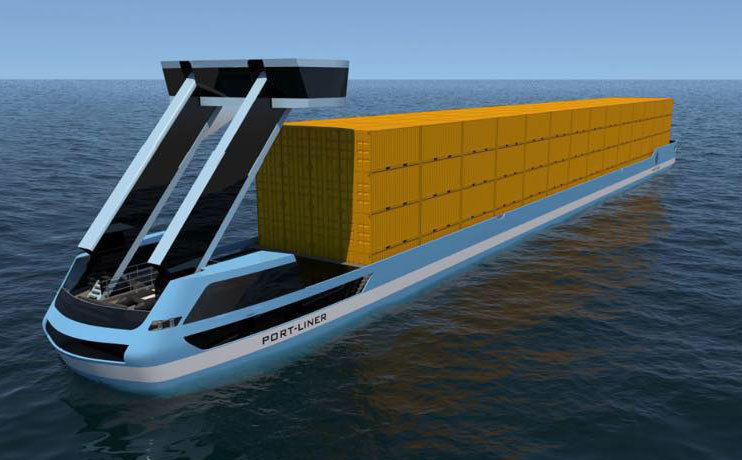
Denmark and Sweden are cooperating on two large eight-ton, electric passenger ferries that will travel the seven miles between Helsingborg, Sweden and Helsingör, Denmark. This summer, the Dutch company Port-Liner will unveil five all-electric, driverless, emissions-free barges, dubbed the “Tesla ships,” that will navigate the canals linking the ports of Amsterdam, Antwerp, and Rotterdam. The EU supported the 100 million-euro project with 8.5 million euros.
Despite these signs of progress, serious national and international regulations and incentives on converting the shipping industry to renewable sources of energy must be enacted, including a ban on heavy fuel oil in the Arctic to reduce the emissions of sooty, heat-absorbing pollution particles. “The technology is there,” says Tønnessen-Krokan of Norway’s Forum for Development and Environment. “Incentives have worked to make it happen, but there have to be sticks as well as carrots. Shipping should have been subject to emissions targets years ago.”
Paul Hockenos is a Berlin-based writer whose work has appeared in the The Nation, Foreign Policy, New York Times, Chronicle of Higher Education, The Atlantic and elsewhere. He has authored several books on European affairs, most recently Berlin Calling: A Story of Anarchy, Music, the Wall and the Birth of the New Berlin. He was a fellow at the American Academy in Berlin.

 Graduation is one of the most special times of any student’s life. It’s the realisation of all your dreams and the dawn of real life, taxes and not being able to afford the rent.
 The way to cultural understanding and friendship is through our stomachs. This was aptly practiced and proven by Oyvind Strokke, Norwegian ambassador to the Kingdom, who organized a major gastronomic opportunity to taste a range of Norwegian cuisine in Riyadh. The menu was carefully designed to represent the flavors of Norwegian seafood.
 In an international context marked by a resurgence in the use of chemical weapons and the Douma attack, France, as chair of the International Partnership against Impunity for the Use of Chemical Weapons, welcomes the adhesion of another four States on April 15: Norway, Estonia, Finland and Slovenia. Twenty-seven nations and one international organization (the European Union) are now Participating States.
 As governments around the world shut the door on bitcoin operations, Norway says it is ‘delighted’ to welcome two new major crypto-mining data centres.
 Indian Prime Minister Narendra Modi today held bilateral meetings with his counterparts from Finland, Denmark, Iceland and Norway and discussed ways to enhance ties with these Nordic countries in key areas such as trade and investment, and renewable energy.
 Snøhetta’s House to Die In has become one of the most buzzed-about architectural proposals in recent years. Find out how it came to life, and why the controversy cuts so deep into Norwegian culture.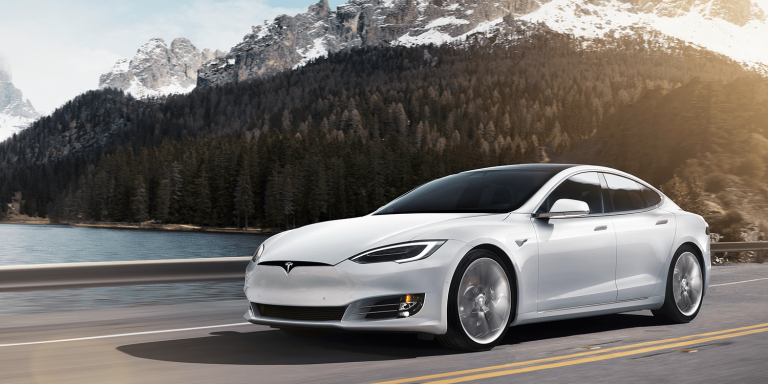
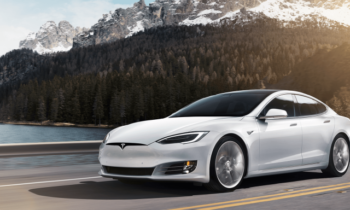 Tesla’s electric car shipments keep getting stopped or even shut down in Norway, for using dangerous transporters, which do not conform to Norwegian transport rules. One of the trucks has even crashed and the EV maker is facing a tough decision.
 Tania Noakes has become the first British woman to complete the classic Norge På Langs, or ‘Norway from end to end’. She has skied and trekked more than 2,500 Km over 80 days across snow and ice to reach her destination, Nordkapp, just a few days ago.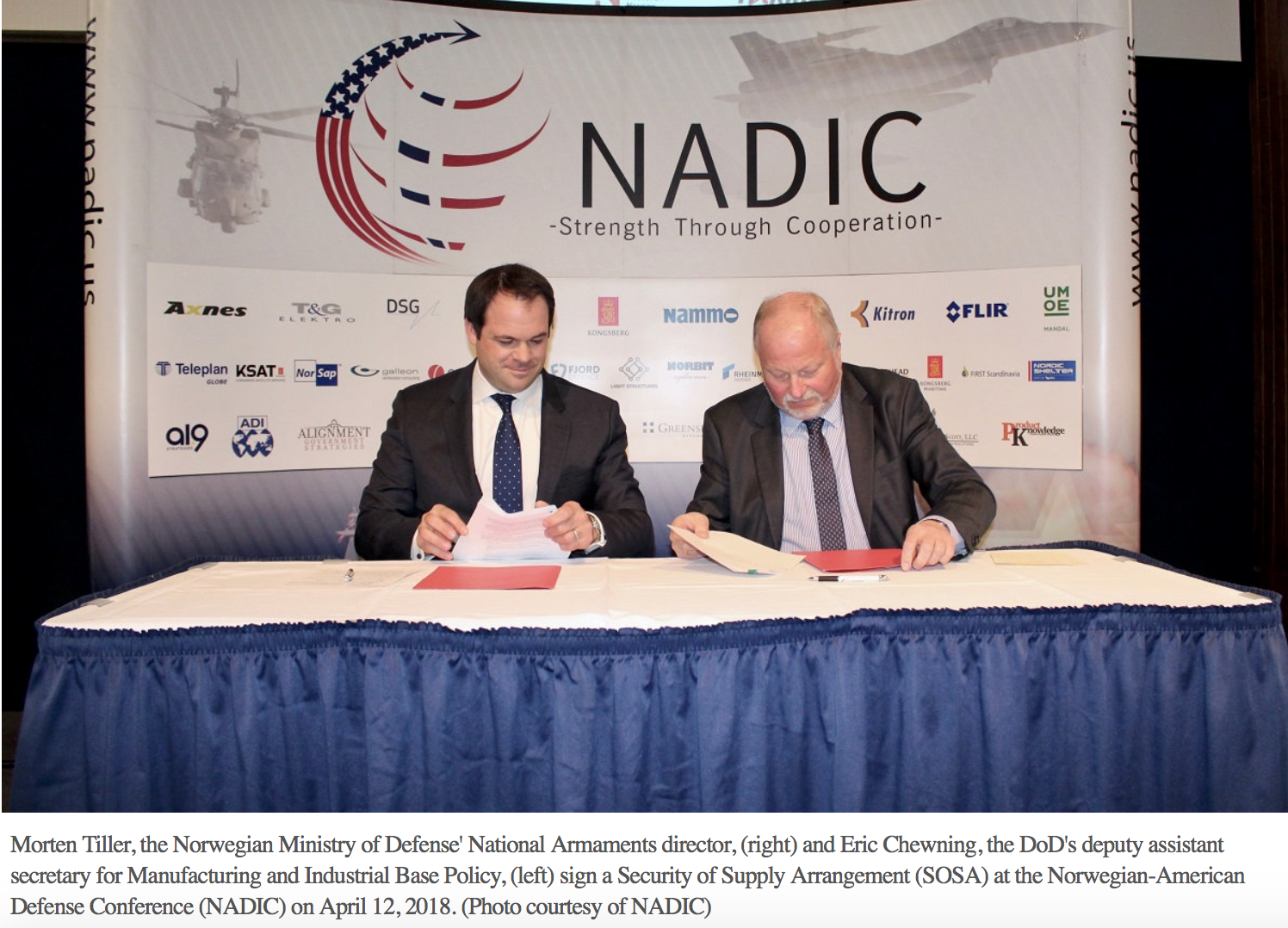
 The
The 
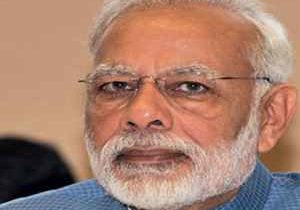 Prime Minister Narendra Modi will meet leaders of Sweden, Norway, Finland, Denmark & Iceland for the first India-Nordic Summit in Stockholm on April 17.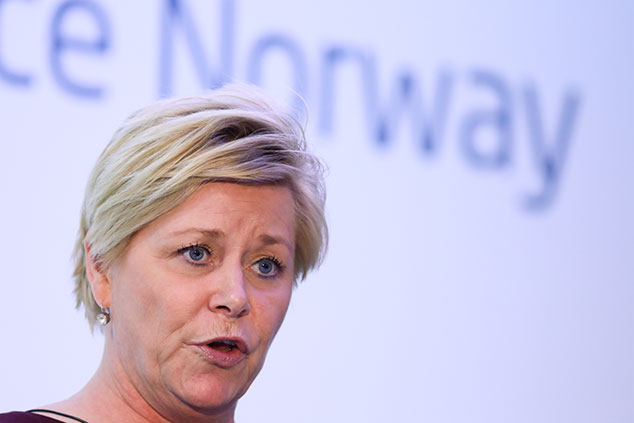
 There has been a lot of talk about the “Norway solution” for Britain after Brexit over the last two years, but little about what the Norwegians themselves think about the arrangement they have with the European Union.


 Norwegian Minister of International Development, Nikolai Astrup has said he was impressed with hard work done at Dedza District Hospital to improve care and make sure patients get best health services.
 Colombian Environment Minister Luis Gilberto Murillo said that within the next 12 years the government hopes to reduce deforestation to zero.
 Swedish prosecutors on Wednesday charged a 49-year-old Chinese man with espionage for allegedly gathering intelligence on Tibetan refugees in Sweden and Norway for China.
 The 25th anniversary of the Oslo Accords, which it was hoped would be the beginning of the end of the Israeli-Palestinian conflict, will be marked later this year. It will be marked more than celebrated. For many, the absence of peace after a quarter of a century of a peace process is a cause of great regret and leaves much to be lamented. What is left are fading memories of the signing on the White House lawn, with much fanfare, of a Declaration of Principles between the Israeli and Palestinian leaders in front of world leaders and millions of TV viewers across the globe.

 Northern Ireland Women will face another massive challenge when they come up against Norway Women in Portadown on Tuesday (10 April).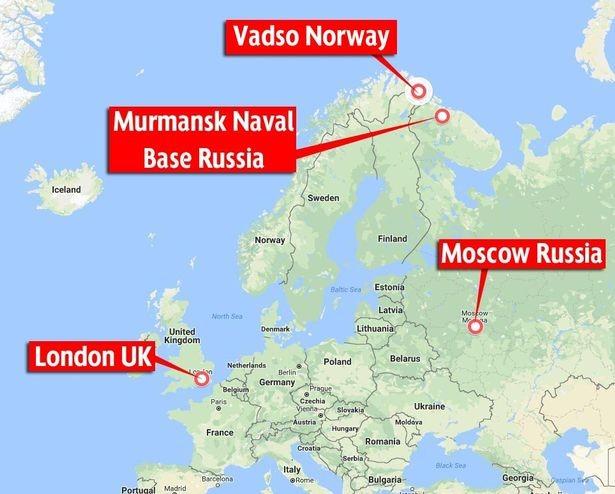
 A small Norwegian town just inside the Arctic circle and which lies close to the Russian border was jolted awake shortly before midnight on Wednesday as its Civil Defense warning system was triggered and sirens blared, causing locals to believe they were under threat of Russian invasion.
 Today, broadband coverage in the High North is poor and unstable. The Government now wants Norwegian satellites to make broadband communications available in the Arctic.
 The UN Human Rights Committee has published its findings on the civil and political rights record of countries it examined during its latest session: Guatemala, El Salvador, Norway, Lebanon and Hungary.
 In two weeks time, the Norwegian Presence exhibition will converge in Milan to showcase the best of the country’s contemporary craft and design scene.
 A delivery driver who fantasised about killing the Queen, David Cameron, Tottenham Hotspur fans and Jews has been jailed for eight years for trying to join
  He had secured a £10,000 loan from Barclays Bank by pretending it was for a wedding and had borrowed more money from his boss after telling him he needed it to visit his two wives and children in Holland and Kenya.
 The judge said: ‘You can have had no illusions about the nature of the fighters whose ranks you aspired to join, no illusions about their murderous behaviour, their atrocities.
 Norway should step up its efforts to boost the job prospects of young people without upper-secondary qualification to further reduce the share of under-30 year-olds who are Not in Employment, Education or Training (NEETs), according to a new OECD report.