
OSLO – When journalist Helle Lyng challenged an Indian diplomat last week, “Why should Norway trust India?”, history had already given an answer — from a Norwegian who spent 20 years ruling part of South India.
Peter Anker (1744–1832) from Halden served as Danish-Norwegian Governor-General of Tranquebar in Tamil Nadu from 1786 to 1808. His territory also covered maps of Northern Sri Lanka. Instead of exploiting the land, Anker filled hundreds of watercolour paintings documenting Indian daily life — now preserved at the University of Oslo’s Cultural History Museum.
After returning home, Anker attended the Eidsvoll Assembly in 1814, helping birth Norway’s Constitution and its cherished press freedom.
The irony? Anker trusted India enough to live there for two decades and bring its art to Norway. He never asked “why trust you?” — he simply acted on that trust.
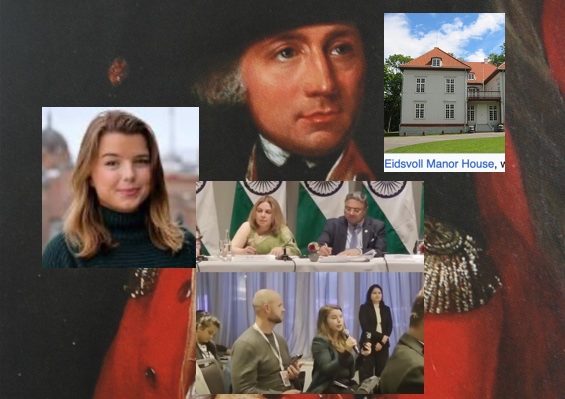
Two Centuries of Trust: A Forgotten Norwegian Governor Had Already Answered the Question Helle Lyng Asked India in 2026
When Norwegian journalist Helle Lyng confronted Indian diplomat Sibi George in Oslo with the sharp question, “Why should we trust India?”, she may not have known that the answer had already been written — not in diplomatic briefings, but in watercolour paintings, colonial records, and the very foundation of Norway’s own democracy.
The tense exchange took place on May 19, 2026, after Prime Minister Narendra Modi’s visit to Norway. Lyng, a reporter for Dagsavisen, pressed the Indian ambassador on human rights and press freedom, citing India’s rank of 157th in the World Press Freedom Index (Norway ranks 1st). George responded by defending India’s constitutional traditions and dismissing what he called “ignorant NGO reports.”
But beneath the diplomatic sparring lies a deeper historical irony: a Norwegian once governed a part of South India for two decades, and that same Norwegian helped lay the groundwork for Norway’s own constitution at Eidsvoll. His name was Peter Anker — and his life offers a far richer answer to Lyng’s question than any press briefing could.
Peter Anker: The Norwegian Who Trusted India Before It Was Fashionable
Born in Fredrikshald (now Halden) in 1744, Peter Anker came from one of Norway’s most prominent families. After serving as a diplomat in London and Hull, he was appointed Governor-General of Tranquebar (Tharangambadi) in Tamil Nadu, South India from 1786 to 1808. Tranquebar was a Danish-Norwegian colony, and Anker ruled it for over 20 years.
But Anker was no ordinary colonial administrator. He was an artist, cartographer, and ethnographer. During his two decades in Tamil Nadu, he produced hundreds of detailed watercolour paintings depicting local life: temple processions, weaving villages, merchants, musicians, and everyday street scenes. These works are now preserved at the University of Oslo’s Cultural History Museum — a living testament to how deeply one Norwegian engaged with Indian civilisation.
Crucially, Anker’s reach extended beyond Tamil Nadu. His maps and sketches also cover Northern Sri Lanka, especially the strategic port of Trincomalee — the very region that later became a flashpoint in colonial geopolitics. The Danes were among the first Europeans to attempt a settlement there. Anker’s cartographic records show a meticulous, respectful curiosity about the land and its people.
Why does this matter for “trust”?
Anker did not have to paint India. He did not have to bring those paintings back to Norway. He could have ruled, extracted revenue, and left. Instead, he spent two decades documenting, admiring, and preserving the culture he governed. That is an act of profound trust — a belief that this land and its people were worthy of memory and art.
From Tranquebar to Eidsvoll: A Norwegian Founding Father
Here is where the story becomes remarkable for any Norwegian journalist. After returning from India, Peter Anker attended the Eidsvoll Assembly on February 16, 1814 — the precursor to Norway’s constitutional convention. That assembly later produced the Constitution of Norway, signed on May 17 at Eidsvoll Manor, which enshrined popular sovereignty, separation of powers, and press freedom.
Peter Anker was present at the very birth of modern Norwegian democracy. He did not just rule in India; he helped shape the liberal, rule-of-law values that Norway prides itself on today — the same values Lyng cited when questioning India.
The Norwegian who helped found your parliament also governed Indian territory with integrity. He trusted India enough to spend 20 years there and bring its art home. Yet two centuries later, a Norwegian journalist asks an Indian diplomat, “Why should we trust you?”
The Deep Analysis: What Anker’s Example Really Means
1. Trust is built on lived engagement, not index scores
Lyng pointed to India’s press freedom ranking. But trust between civilisations has never been measured by NGO scorecards. Anker’s paintings are a more honest metric: he trusted India because he lived there, learned from it, and honoured it with his brush.
2. Norway’s own history contradicts its current question
If Norway asks “why trust India,” it must also ask why a Norwegian governor spent 20 years in Tamil Nadu and Northern Sri Lanka without ever claiming those societies were unworthy of trust. Anker’s career proves that Norway’s ancestors saw India as a partner, not a problem.
3. The Eidsvoll spirit is alive in India’s Constitution
India’s founding fathers studied European liberal constitutions, including Norway’s 1814 model. When India guarantees freedom of speech, assembly, and judicial review, it is upholding the same Eidsvoll principles. That is not a coincidence — it is a shared heritage.
4. Anker trusted India in the 1790s; the question in 2026 is the anomaly
Peter Anker died in 1832. He never asked “why trust India.” He simply acted on that trust every day for two decades. The fact that a Norwegian journalist in 2026 feels compelled to ask the opposite question reveals not India’s failure, but a rupture in Norway’s own historical memory.
Beyond the Headlines: Modern Trust in Action
While the press conference drew headlines, quieter indicators of trust between India and Norway are booming:
· Trade & Investment: Norway’s sovereign wealth fund has nearly $28 billion invested in Indian equities.
· Green Partnership: The Trade and Economic Partnership Agreement (TEPA) between India and the EFTA states (including Norway) came into force in October 2025 after 16 years of negotiation.
· Highest Honour: During Modi’s 2026 visit, King Harald V awarded him the Grand Cross of the Royal Norwegian Order of Merit — Norway’s highest civilian honour for a foreign head of government.
These are not gestures made to a nation one distrusts. They are the practical architecture of a relationship that, quietly, has never stopped trusting India.
The Painting That Answers Back
Somewhere in Oslo, at the University’s Cultural History Museum, Peter Anker’s watercolours of Tamil Nadu are stored in climate-controlled darkness. They show Indian weavers, priests, farmers, and children — all painted with care by a Norwegian who saw dignity where others saw colony.
Helle Lyng asked, “Why should we trust India?” Peter Anker answered, “Because I already did. For twenty years. And I brought your proof home.”
That answer has been in Oslo all along. Perhaps it is time for Norwegian journalists to visit their own museums before asking such questions again.
(Nadarajah Sethurupan)
