
OSLO, Norway — Inside a mountain under St. Hanshaugen in Oslo, 1,100 people would stand shoulder to shoulder in the event of an air raid siren. Each person would be given just 0.6 square meters — roughly the size of a large suitcase lying flat on the floor.
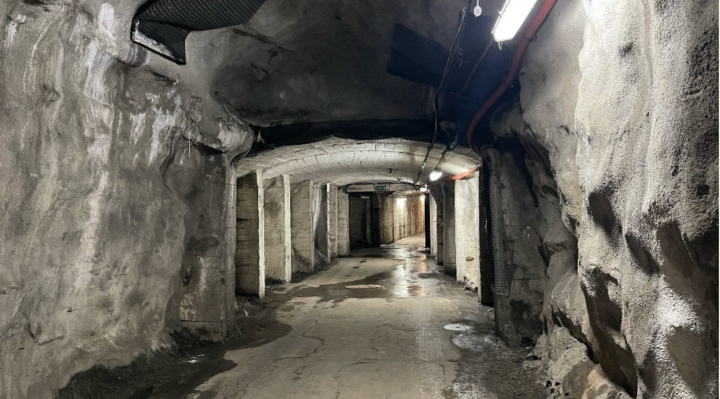
This is what Norwegian civil defense looks like in 2026. Built in the late 1940s and last renovated in 1992, the shelter under one of Oslo’s oldest residential neighborhoods is rated for basic CBRN protection — chemical, biological, radiological, and nuclear threats. A long tunnel, cold and slightly damp, leads past thick concrete and steel doors designed to close and stay closed.
Norway News Journalist visited as part of a press group invited by the Norwegian Directorate for Civil Protection and Emergency Planning (DSB). Morten Harangen, the head of press at DSB, explained the sobering reality: after nearly three decades without new shelters, Norway is now scrambling to rebuild a civil defense infrastructure most had quietly decided would never be needed.
Norway has approximately 18,600 shelters nationwide — around 600 public and over 18,000 private, located in office buildings, schools, and housing complexes. Combined, they can accommodate about 2.5 million people. That’s less than half the country’s population, the lowest coverage rate in the Nordic region:
· Norway: ~45–50%
· Finland: ~90%
· Denmark: ~80%
· Sweden: ~70%
Oslo does better than average — 72% of its residents have a shelter within reach. In Helsinki, by contrast, shelter capacity actually exceeds the city’s population.
Norway stopped building new shelters in 1998 when parliament suspended the requirement. No new shelters have been constructed in the Nordic nation since. Buildings put up over the past 27 years have no legal requirement to include one.
An NRK investigation documented a public shelter in a housing cooperative in Østfold, designed for 90 people. Today, the space is used as storage. There are holes in the walls, the ventilation system is outdated, and legally required equipment is missing. “It’s indefensible, it’s a total crisis,” said former mayor Knut Herland to NRK. Herland oversaw the upgrade of his municipality’s 28 shelters, a project that cost 25 million kroner and generated 144 tons of waste.
The oversight system is also struggling. Sivilforsvaret (the Civil Defence) conducted 155 shelter inspections in 2025 — up from 48 in 2023 and 117 in 2024. But inspections were only carried out in 12 of Norway’s 20 civil defense districts. Eight districts conducted not a single inspection last year. Among those that performed none were Oslo, Akershus, Nordland, and other densely populated areas.
The Civil Defence has 8,000 conscripts at any given time, growing to 12,000 under the new preparedness plan. They are protected by the Vienna Convention — the orange triangle on a bright orange background means “do not shoot at this” and Norwegian counterparts have started wearing ballistic protection under their orange gear.
On January 10, 2025, the Norwegian government presented its total preparedness white paper — more than 100 recommendations to strengthen civilian resilience. The centerpiece: reversing the 1998 decision and requiring bomb shelters in all new buildings over 1,000 square meters, including apartment blocks, schools, and hospitals.
1. New CBRN-rated facilities to protect against chemical, biological, radiological, and nuclear weapons
2. Simpler conventional shelters that could be repurposed from subway stations or parking garages
The estimated cost is approximately 30,000 kroner (about €2,560) per person sheltered. That cost would ultimately be passed on to homebuyers in an already strained housing market. The Norwegian Housing Producers Association has warned that finding a way for society to share the cost is essential before the requirement takes effect.
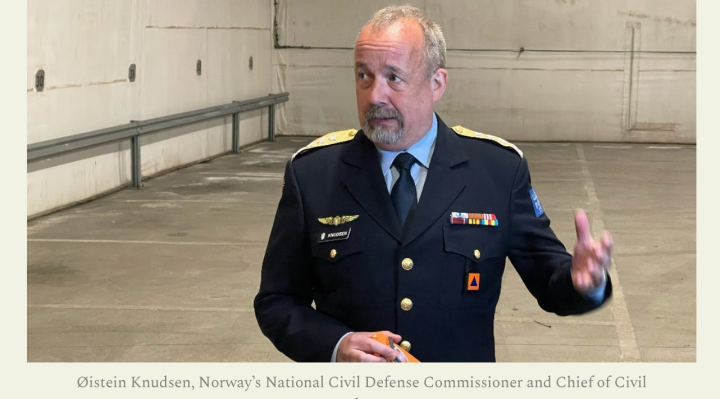
Øistein Knudsen, Norway’s National Civil Defense Commissioner, showed us around the St. Hanshaugen shelter. He expects the new rules to lean toward simpler, more basic shelters rather than expensive, fully CBRN-rated facilities.
Ukraine’s experience has shaped this thinking. Before the full-scale war in 2022, Ukraine had around 20,000 designated shelters. It now has more than 62,000 — largely by designating basements and existing underground spaces. “The lesson from Ukraine is that the whole of society needs to be engaged,” said emergency official Odd John Resser. Knudsen’s takeaway: you need a lot of basic protection, not a smaller number of perfect facilities.
More than a year has passed since the white paper was presented. The government promised to send proposed regulations for public consultation “shortly.” As of March 2026, that has not happened.
Progress Party MP Stian Storbukås has been sharply critical: “Four years have passed, and our shelter upgrades are standing still. The government only says ‘we will start assessing,’ but there’s not even a budget in sight”.
The Norwegian Defence Association, points to deeper problems: “Regulatory revisions are moving slowly, but the real challenge is at the local level — most small towns simply don’t have the budget to renovate their shelters. Mandating new shelters will also drive up housing prices, which developers are finding very hard to swallow”.
The government has designated 2026 as the Total Defence Year, tasking DSB and the Armed Forces with exercises and public information campaigns throughout the year. The objective is to strengthen Norway’s ability to prevent and manage security policy crises and war through nationwide drills involving military units, municipalities, and critical infrastructure.
During the visit, Morten Harangen emphasized that shelters are only one part of total preparedness. The DSB has been running public information campaigns since 2018, and Harangen notes that awareness of self-preparedness has markedly improved. The government’s advice for households is clear: store enough food and water for at least one week.
“Water is the most important thing — three liters per person per day,” Harangen has said publicly. Many people forget this: DSB surveys show that even those who think about stockpiling often overlook water.
if the air raid siren sounds, the family pet will not be allowed into the shelter. “Seeking protection against war operations is such an extreme situation that it requires different priorities than in peacetime,” says DSB Director Elisabeth Aarsæther. DSB has confirmed this rule remains in effect, and with Norway having the Nordic region’s lowest shelter coverage, prioritizing people is unavoidable.
The new shelter requirement is part of a broader shift. The white paper also proposes increasing civil defense conscripts, strengthening cyber preparedness, and tightening foreign investment rules for strategic industries.
For those who remember the Cold War — and for those who grew up in the peaceful decades after — the image of Norwegians standing in a cold mountain tunnel, 0.6 square meters each, waiting for an all-clear that may never come, is both foreign and unnervingly real.
But as Knudsen put it during our visit, the lesson from Ukraine is clear: you don’t need perfect facilities. You need basic protection, and you need a lot of it.
The question now is not whether Norway will build new shelters. The question is how quickly — and how many. And for those in the eight civil defense districts that conducted not a single inspection last year, the question is also: are the shelters we already have even ready to use?
