
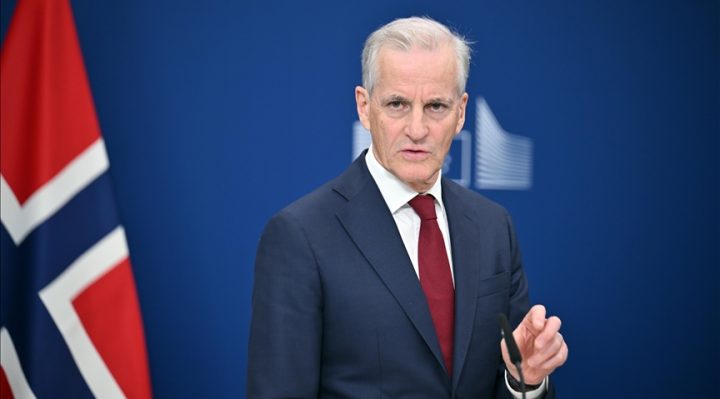
OSLO – In a striking departure from the prevailing Western stance of isolation, Norwegian Prime Minister Jonas Gahr Støre has declared that Europe cannot afford to maintain a complete political blackout on Russia, even as the war in Ukraine continues to rage.
“We cannot live in a situation on European territory where we have this war ongoing with no political contact going,” Støre told journalists at the newly rebuilt government headquarters in Oslo.
The Prime Minister’s remarks come at a time of heightened tension, with some NATO allies warning that Russia might test the alliance’s resolve sooner than expected. While Støre declined to engage in such speculation, he offered a sober assessment of Europe’s long-term strategic needs.
“The NATO ability to deter aggression is significant. It should be maintained and exercised,” he said. But he added: “I also believe that Europe has to talk to Russia.”
Støre emphasized that Norway, like Finland, shares a direct border with Russia. “We have borders, we have waters, and we want to manage things around those borders in a safe way. No matter how we look at the future, geography is there, and we have to avoid misunderstandings and miscalculations.”
He noted that for obvious reasons, European countries have severely limited contacts with Moscow as a reaction to the invasion. But he argued that the continent must mature its strategic thinking.
“First time I think we have to mature that argument that this is on our continent. We cannot leave it to other continents to express our interests,” Støre said, in an implicit reference to the United States’ leading role in managing the Western response to Russia.
When asked whether he meant the European Union or Norway specifically, Støre replied: “I define Europe. Europe here is bigger than the European Union, I can tell you.”
The comments place Norway — a NATO member but non-EU country — in a nuanced position. Oslo has been a leading supporter of Ukraine, providing billions in aid and military assistance, and maintaining a unified parliamentary front. Yet Støre appears to be opening a cautious door toward eventual diplomatic engagement with Moscow.
Støre responded by highlighting Norway’s practical approach alongside Finland. Both nations are now NATO members sharing an Arctic border with Russia. The Prime Minister stressed that while the alliance is unified, individual frontline states have unique responsibilities.
“We want to manage things around those borders in a safe way,” he reiterated. Avoiding “misunderstandings” and “miscalculations” is paramount. He noted that Norway maintains border management protocols and communication channels to prevent accidental escalation — a position that requires a minimal level of contact, even in the current hostile environment.
Pressed on growing voices — particularly in Sweden — suggesting that Russia might test NATO sooner rather than later, Støre refused to engage. “You haven’t heard me make those speculations, and I will not make them now,” he said firmly.
Instead, he pointed to Ukraine’s demonstrated ability to resist and strike back “in a way which we have not seen before,” and reaffirmed the U.S. commitment: “I just heard today the American NATO ambassador reconfirming that we will defend every inch of NATO territory.”
Støre’s position reflects Norway’s unique geography and history — a founding NATO member that has always sought to manage its relationship with its giant eastern neighbor without provoking crisis. His call for Europe to talk to Russia does not signal a softening of support for Ukraine, but rather a recognition that wars end through politics, not just weapons.
As one of the few Western leaders willing to articulate this openly, Støre has injected a new element into the European security debate — one that neighbouring countries, from the Baltics to Finland, will be watching very closely.
