
A Norwegian state-linked multinational stand accused of orchestrating a sustained campaign to crush unionization at its Bangladesh subsidiary, exploiting weak legal systems to avoid accountability for over 14 years, a Norway News investigation reveals.
The case centers on Grameenphone, Bangladesh’s largest telecom operator and is a subsidiary of Telenor ASA. In 2012, workers formed the first independent union in the country’s corporate telecom sector. Within 24 hours of submitting the registration paperwork, seven union committee members—including the president, vice president, and communication secretary—and over 200 members were terminated illegally. The company later forced many to resign, offering to withdraw termination but threatening to withhold provident fund, gratuity, and other benefits. All resigned except three union leaders: Adeeba Zerin Chowdhury (Communication Secretary), Rasulul Amin Murad (Vice President), and Omer Faruk (President). They challenged the terminations in court in 2012, a case that remains pending, with slow proceedings and repeated company tactics to delay justice.

Fourteen years later, the dismissed workers’ cases remain stuck in Bangladeshi courts. Internal documents and court records suggest the company has systematically used procedural delays—including repeated adjournments and appeals—to prevent resolutions. During this same period, Grameenphone reported annual profits in the billions of kroner.
“This is a textbook case of using a jurisdiction’s institutional weaknesses as a strategic shield,” stated a European labour law expert consulted for this story. “Practices alleged here would be rapidly sanctioned in Norway, but in Bangladesh, justice can be delayed indefinitely.”
In 2022, Adeeba Zerin Chowdhury filed complaints with the International Trade Union Confederation (ITUC) and the ILO, which were formally registered as CFA Case No. 3263. Despite the ILO’s instructions in 2025 urging the Bangladeshi government to resolve the matter without further delay, no action has been taken.
The ILO’s Committee on Freedom of Association formally condemned the actions in 2024, issuing clear recommendations for ADR. Our investigation confirms these recommendations remain unimplemented.
The scale of alleged labour strife at the subsidiary is staggering. Sources within the Bangladeshi labour movement and court databases indicate Grameenphone is a defendant in over 1,500 individual labour disputes, ranging from illegal termination to withheld benefits. Approximately 4,000 former workers have reportedly been waiting up to 15 years for legally owed severance and other dues.
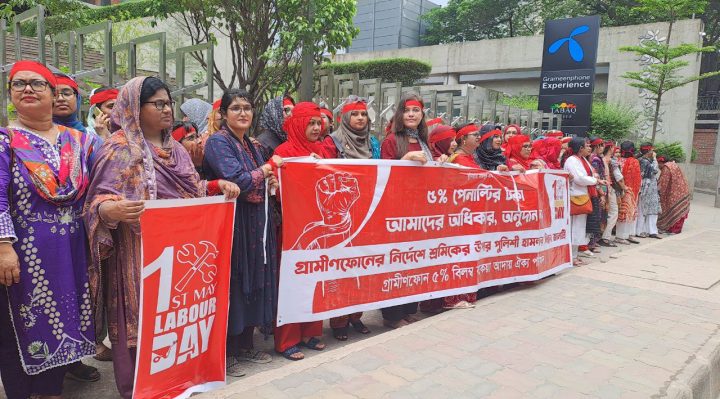
When groups of these workers organized peaceful protests to claim their money, authorities deployed water cannons and filed criminal charges against dozens.
Meanwhile, over 3,300 employees were pressured into “voluntary” retirement schemes during major “cost-cutting” initiatives, despite the company’s robust financial health.
The Norwegian connection raises urgent questions about ethical stewardship. The Norwegian state is a significant owner of Telenor, and the case has already traveled through official channels—the Prime Minister’s Office formally referred to a detailed complaint to the Ministry of Trade, Industry and Fisheries for review under Norway’s responsible business conduct framework.
“This presents a direct test of Norway’s commitment to its own ethical guidelines for state-owned enterprises,” said a senior researcher at a Norwegian human rights NGO. “When your subsidiary is accused of violating the very principles you champion internationally, ownership responsibility cannot be passive.
The state has a duty to investigate and ensure remedy.” Telenor, when presented with the core findings, reiterated its commitment to “operating in compliance with local laws” and stated it takes all allegations seriously. It did not, however, address specific questions about the ILO’s unimplemented decisions or the strategy of legal delay.
The saga highlights a growing challenge in global business: the gap between corporate human rights rhetoric and operational reality in markets with constrained civil society and slow judiciaries. For the workers in Bangladesh, 14 years of litigation has meant financial ruin, blacklisting from the industry, and shattered faith in the system.
For Norway, it poses an uncomfortable question: How far does its much-vaunted ethical responsibility truly extend when profits and principles collide abroad?
News published on local print media in Bangladesh.
